
How to Plan a Large-Scale Web Application: Architecture, Features and Development Process
An enterprise engineering roadmap for scoping, architecting, and scaling complex cloud web applications for high concurrency and mission-critical workflows.


- 1. Beyond Brochure Websites: The Reality of Enterprise Software
- 2. Requirements Discovery, User Roles & Domain Modeling
- 3. The 4-Tier Distributed System Architecture
- 4. Database Architecture: Relational Scaling, Read Replicas & Pooling
- 5. Enterprise Security: RBAC, OWASP Hardening & Token Auth
- 6. Multi-Tiered Caching: Edge CDNs, Redis & Query Invalidation
- 7. DevOps, Testing, CI/CD & Long-Term Observability
Building a simple marketing website and architecting a large-scale web application share as much in common as designing a bicycle and engineering a commercial jetliner. When building a content website, success is measured in visual aesthetics and contact form submissions. When engineering a large-scale web application—such as a national insurance broker portal, an enterprise supply-chain platform, or a multi-tenant B2B SaaS platform—success is measured in concurrent throughput, database query efficiency, fault tolerance, transaction idempotency, and sub-100ms response times under peak load. An architectural flaw that causes minor annoyance on a blog can trigger catastrophic data corruption or millions of dollars in downtime on an enterprise application. In this master technical roadmap, RankVRA's enterprise web application engineering team breaks down the complete end-to-end process of planning, architecting, and deploying large-scale web applications in 2026.
Planning a large-scale web application requires a disciplined enterprise engineering lifecycle: formal domain modeling, multi-tenant Role-Based Access Control (RBAC), decoupled frontend architecture (Next.js streaming SSR), distributed backend microservices, resilient database persistence with read replicas, multi-tiered caching (Edge CDN, Redis), and automated CI/CD container pipelines. Enterprise platforms must be architected from day one to handle high concurrency, strict data isolation, and 99.99% uptime SLAs.
1. Beyond Brochure Websites: The Reality of Enterprise Software
What defines a 'large-scale' web application in modern engineering
A web application transitions into the category of 'large-scale' when it exhibits one or more of these technical characteristics:
• High Concurrency & Traffic Volatility: Handling thousands of simultaneous logged-in users executing intensive read and write operations without database deadlocks.
• Multi-Tenant Data Isolation: Serving thousands of independent corporate organizations where each tenant's sensitive commercial data must remain strictly isolated at the database layer.
• Mission-Critical Business Workflows: The application handles financial transactions, policy underwriting, inventory reservations, or legal compliance where downtime directly halts commercial operations.
• Complex Inter-System Dependencies: Connecting to dozens of external third-party APIs, legacy ERP systems, payment rails, and cloud storage vaults via resilient event pipelines.
2. Requirements Discovery, User Roles & Domain Modeling
The foundation of enterprise software: modeling real-world business complexity
The most common cause of enterprise software failure is not bad code; it is premature coding before business domain boundaries are fully understood. At RankVRA, large-scale application development always begins with formal Domain-Driven Design (DDD):
1. Domain Discovery & Event Storming: Mapping every real-world business event (e.g., 'Policy Application Submitted', 'Underwriter Requested Inspection', 'Invoice Generated', 'Payment Confirmed').
2. Entity & Relationship Definition: Establishing strict data schemas detailing how Organizations, Users, Policies, Transactions, and Audit Logs interact.
3. Role-Based Access Control (RBAC / ABAC): Architecting fine-grained permission matrices separating Super-Admins, Regional Managers, Account Executives, External Brokers, and End-Clients.
This domain model serves as the immutable architectural constitution for the entire engineering lifecycle.
3. The 4-Tier Distributed System Architecture
Organizing enterprise software into decoupled, horizontally scalable layers
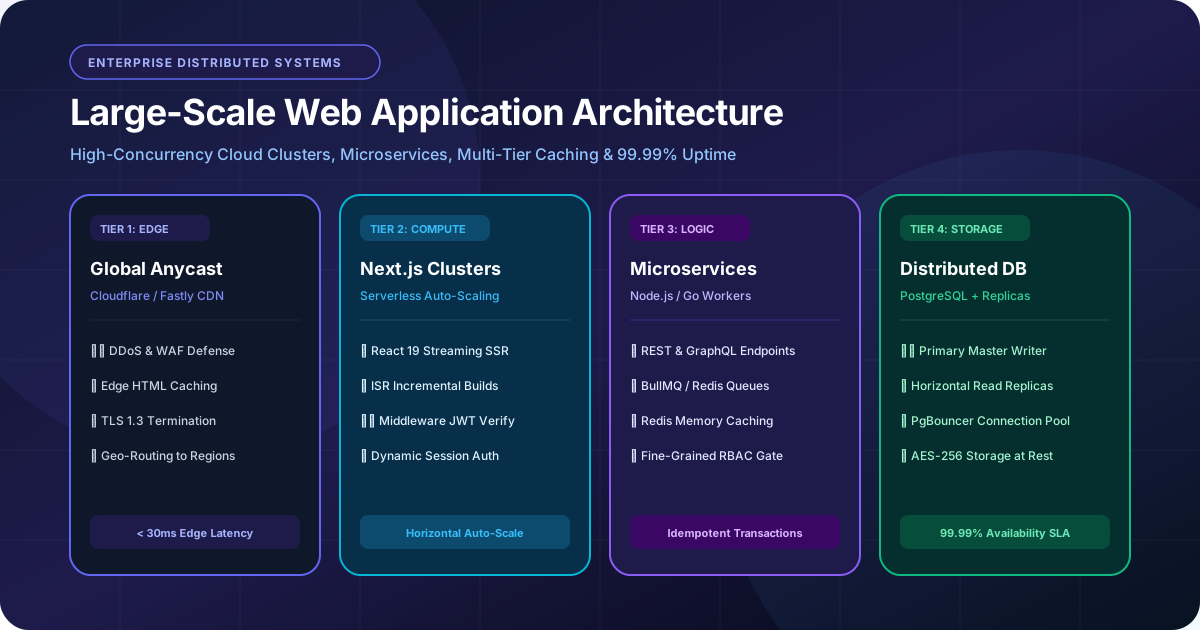
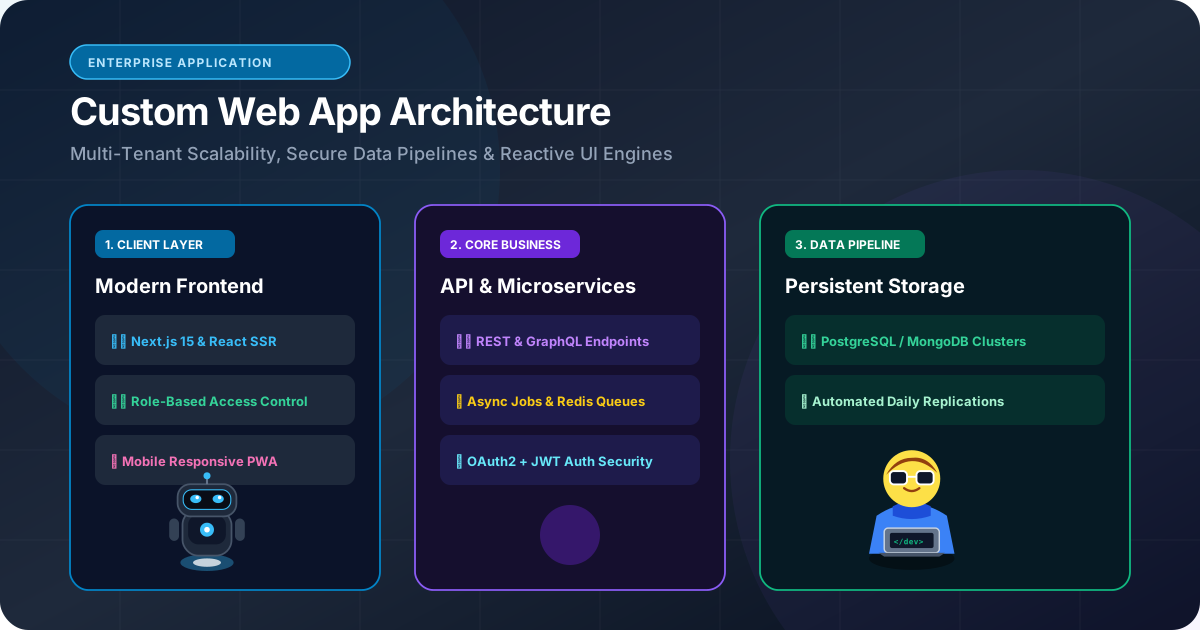
RankVRA architects large-scale applications across four decoupled distributed tiers:
• Tier 1: Global Edge & Security Perimeter: Global Anycast CDN networks (Cloudflare Enterprise / Fastly) handling DDoS mitigation, Web Application Firewall (WAF) rule inspection, SSL/TLS termination, and edge caching of static assets in under 30ms.
• Tier 2: Compute & Frontend Cluster: Modern Next.js React server components deployed across serverless container clusters (AWS ECS, Google Cloud Run). Features streaming server-side rendering (SSR), incremental static regeneration (ISR), and lightweight client-side hydration.
• Tier 3: Core Business Logic & Microservices: Modular, containerized backend services (Node.js, Go, or Python) handling transaction processing, asynchronous worker queues (BullMQ, Kafka), and third-party API integrations.
• Tier 4: Distributed Persistence & Storage: Enterprise PostgreSQL relational databases paired with Redis memory caches and secure cloud object storage vaults (AWS S3 / Google Cloud Storage) with AES-256 encryption.
4. Database Architecture: Relational Scaling, Read Replicas & Pooling
Preventing the database from becoming your application's fatal bottleneck
In 90% of scaling failures, the bottleneck is not the web server; it is the database. When thousands of concurrent users execute database queries, un-optimized connections exhaust server memory and freeze the application.
To achieve high-concurrency resilience, our backend development team implements three architectural disciplines:
• Read/Write Database Splitting: Directing all heavy data writes (inserts, updates, deletes) to a primary master database node, while distributing high-volume read queries across multiple geographically distributed read-replica nodes.
• Connection Pooling (PgBouncer): Managing thousands of transient serverless database connections through a lightweight connection pooling proxy, preventing connection exhaustion.
• Strategic Indexing & Partitioning: Partitioning massive tables (such as activity logs and transaction ledgers) by date or tenant ID, ensuring database index scans execute in single-digit milliseconds even with tens of millions of rows.
5. Enterprise Security: RBAC, OWASP Hardening & Token Auth
Fortifying mission-critical data against unauthorized access and cyber breaches
Enterprise software carries immense responsibility. A breach of confidential client records or financial data can trigger catastrophic regulatory fines and permanent reputational ruin.
Our engineering standards follow the rigorous OWASP Application Security Verification Standard (ASVS):
• Cryptographic Token Authentication: Stateless, short-lived JSON Web Tokens (JWT) paired with secure, HTTP-only, SameSite=Strict cookies to eliminate Cross-Site Scripting (XSS) and CSRF token interception.
• Row-Level Security (RLS): Enforcing multi-tenant data isolation directly inside the PostgreSQL database engine. Every query is cryptographically constrained to the user's organization UUID.
• Real-World Architecture Proof: In our engineering of the Sterling Wholesale Insurance Portal, this exact security architecture safeguards sensitive commercial policy documents, underwriter submissions, and financial filings across thousands of independent broker accounts.
6. Multi-Tiered Caching: Edge CDNs, Redis & Query Invalidation
Delivering sub-100ms response times regardless of platform load
The fastest database query is the one your application never has to make. Large-scale web applications utilize a three-tier caching hierarchy:
• L1 Browser & Edge Cache: Caching immutable static assets (JavaScript bundles, CSS, images) on user browsers and edge CDN nodes for 1 full year.
• L2 Redis In-Memory Cache: Caching frequently requested database objects (user session states, company profile settings, category taxonomies) in high-speed Redis memory clusters, serving queries in under 2 milliseconds.
• L3 Stale-While-Revalidate Revalidation: Serving instantaneous cached data to the user while asynchronously fetching and updating fresh data in the background.
When data is updated (e.g., an underwriter issues a new quote), automated cache invalidation tags purge obsolete cache entries in real time.
7. DevOps, Testing, CI/CD & Long-Term Observability
Ensuring zero-downtime deployments and real-time anomaly detection
Large-scale software requires continuous delivery pipelines that allow engineering teams to ship updates daily without risking system downtime:
• Automated Continuous Integration (CI): Every code pull request triggers automated linters, static security scans (SonarQube), and end-to-end integration test suites (Playwright/Jest) before code can merge.
• Zero-Downtime Blue/Green Deployments: Deploying new software versions to an isolated staging container cluster ('green') before instantly switching production traffic from the existing cluster ('blue'), ensuring zero user disruption.
• Full-Stack Observability & APM: Distributed telemetry tracking (OpenTelemetry, Datadog, Sentry) monitoring API latency percentiles (p95, p99), error rates, and database query slow-logs to identify and remediate performance bottlenecks before users ever notice.
Key Strategic Takeaways
- Large-scale web applications demand distributed architecture, high concurrency engineering, and multi-tenant isolation.
- Database scaling requires read/write splitting, connection pooling (PgBouncer), and partitioned tables.
- Multi-tenant security must be enforced at the database level using Row-Level Security (RLS) and cryptographic tokens.
- The [Sterling Wholesale Insurance Portal](/case-studies/sterling-insurance-portal) demonstrates real-world enterprise portal architecture in action.
- Speak with [RankVRA senior software architects](/services/web-application-development) to plan your enterprise application roadmap.
The Bottom Line & Next Steps
Planning a large-scale web application is an exacting engineering discipline that combines business domain mastery with distributed systems architecture. By laying a robust architectural foundation—spanning edge security, modular microservices, resilient database pooling, and automated CI/CD pipelines—you build an enterprise software asset capable of scaling seamlessly to support your company's most ambitious commercial vision.
Questions Business Leaders Ask About large scale web application development
How long does it take to plan and build a large-scale web application?▾
A comprehensive large-scale web application typically follows a 16 to 28-week engineering lifecycle: 3 to 4 weeks of requirements discovery, domain modeling, and technical specification; 10 to 18 weeks of core full-stack development, database architecture, and API integration; and 3 to 6 weeks of comprehensive load testing, security audits, and staged user onboarding.
What technology stack is best for large-scale enterprise web applications?▾
RankVRA champions a modern, decoupled full-stack architecture: Next.js (React 19) for the high-performance edge frontend; Node.js, TypeScript, or Go for backend microservices and API gateways; PostgreSQL for robust relational data persistence; Redis for distributed caching; and Docker containers orchestrated via AWS ECS or Google Cloud Run.
How do you test a web application for high traffic before launching?▾
We perform automated load and stress testing using tools like k6 and Locust. We simulate thousands of concurrent virtual users navigating the application, submitting forms, querying databases, and uploading files simultaneously to identify memory leaks, database connection bottlenecks, and API latency spikes before production launch.
How does RankVRA handle ongoing maintenance for enterprise applications?▾
RankVRA provides dedicated enterprise SLA agreements that include 24/7 infrastructure uptime monitoring, automated database backups with point-in-time recovery, continuous security vulnerability patching, and dedicated sprint hours for ongoing feature development.

Written by Naveen Panchal
AuthorFounder & Lead Technical Architect, RankVRA
Naveen Panchal is the Founder and Technical Director of RankVRA. He specializes in full-stack web engineering, Next.js architecture, and high-performance digital systems for clients across the US, UK, Canada, and India.
Explore Core Commercial Capabilities
Enterprise-grade web applications, B2B portals, and high-concurrency systems.
Distributed cloud microservices, database architecture, and API gateways.
Resilient connectors between enterprise applications, ERPs, and cloud services.
Intelligent workflow automation and enterprise AI pipeline integrations.
Real-world enterprise broker portal architecture and results.
- martinfowler.com: Martin Fowler: Microservices and Enterprise ArchitectureOfficial Reference
- Amazon Web Services: AWS Well-Architected FrameworkOfficial Reference
- OWASP: OWASP Application Security Verification Standard (ASVS)Official Reference
Ready to Architect a Scalable Enterprise Web Application?
Partner with RankVRA senior software architects to plan your data models, design your cloud infrastructure, and build a mission-critical web application engineered for long-term scalability.
Related Growth Blueprints
Explore more strategic articles from the RankVRA engineering desk.
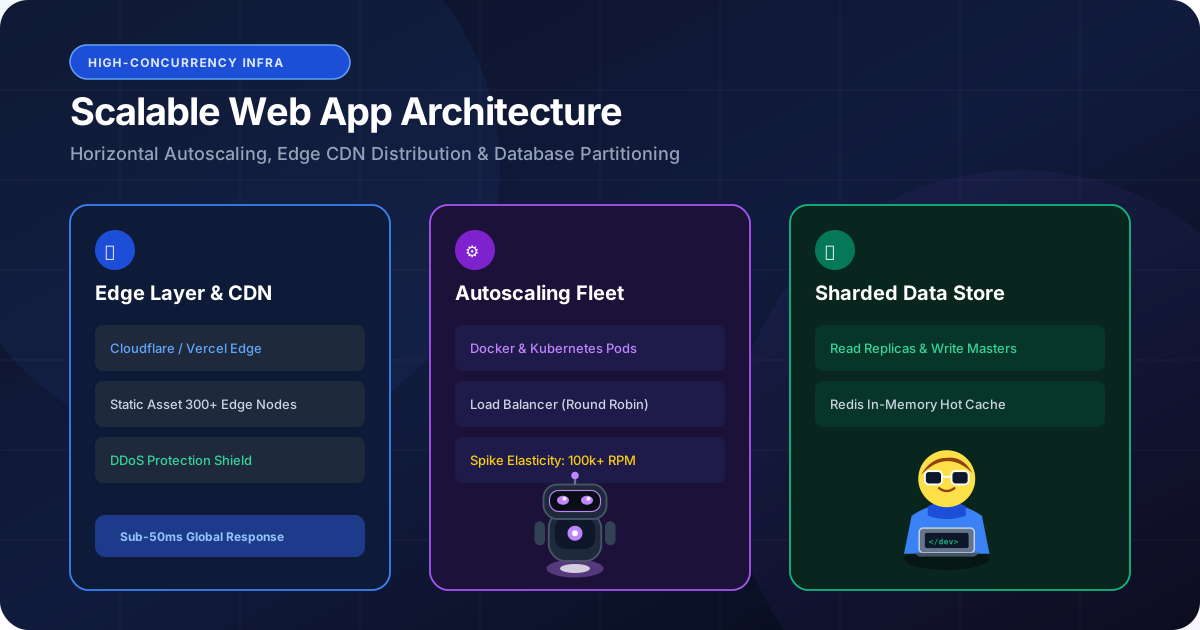
How to Build a Scalable Web Application for a Growing Business
Learn how to architect scalable web applications. Discover proven strategies for horizontal scaling, database read replicas, Redis caching, and zero-downtime growth.
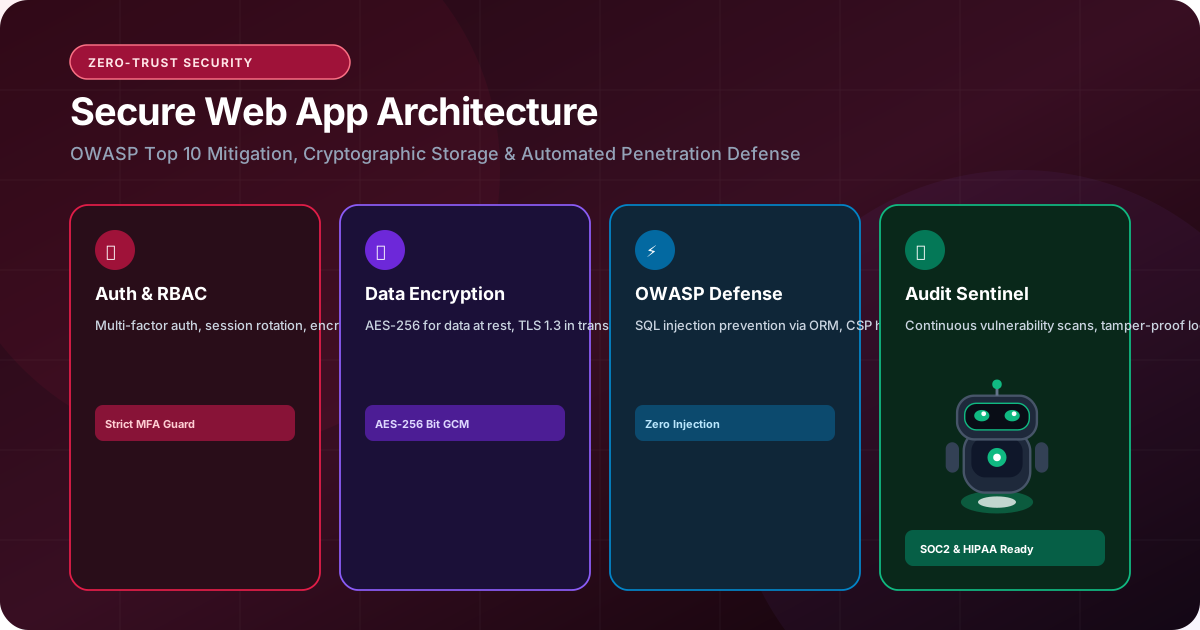
How to Build a Secure Business Web Application: The Enterprise Hardening Guide
Learn how to build secure business web applications. Defend against OWASP Top 10 vulnerabilities, secure API authentication, protect databases, and enforce zero-trust.
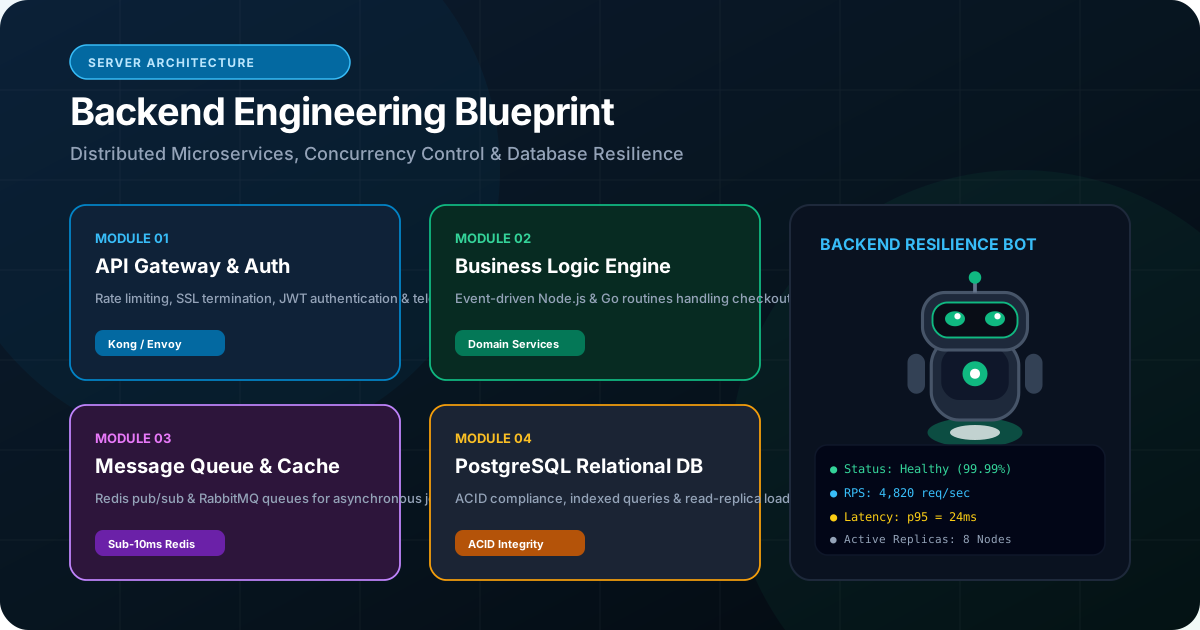
What Is Backend Development and Why Is It Important for Modern Web Applications?
Demystify backend development. Discover how server architectures, relational databases, Node.js, Python, and OWASP security protect and scale business web applications.
Custom Web Application Development: When Should a Business Build a Custom Web App?
When should a business build custom web applications instead of subscribing to SaaS? Learn how custom portals, wholesale dashboards, and bespoke workflows deliver compounding ROI.