
How to Build a Scalable Web Application for a Growing Business
An architectural playbook on horizontal scaling, database sharding, Redis caching hierarchies, and cloud infrastructure.

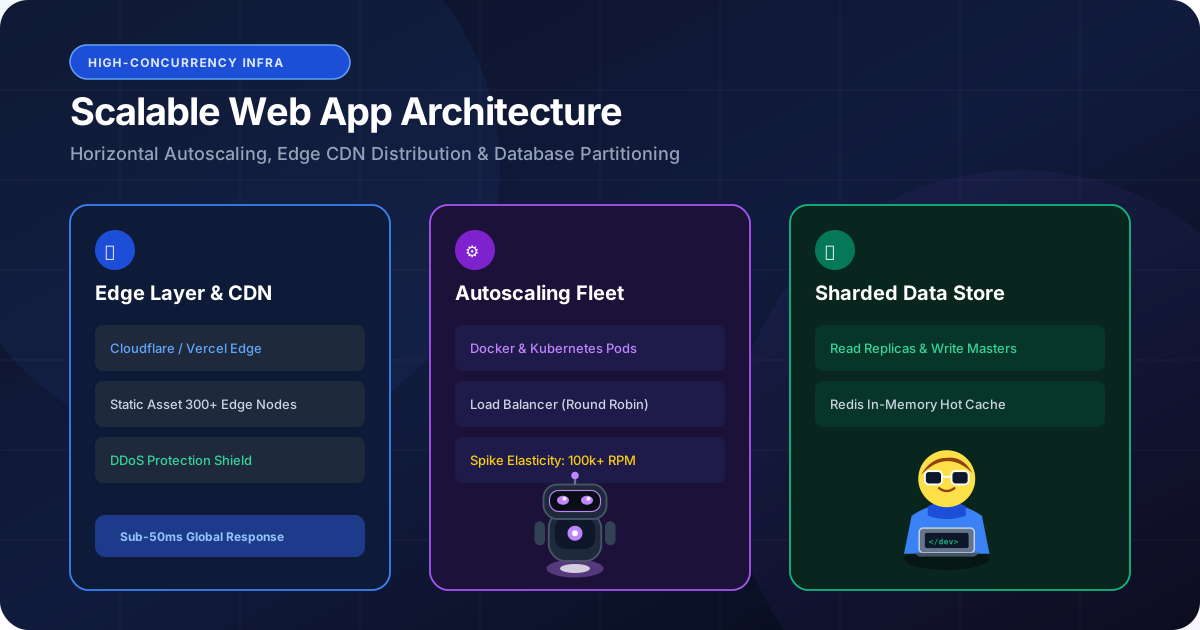
- 1. What Scalability Really Means for Business
- 2. The Foundation: Stateless Application Servers
- 3. Database Scalability: Read Replicas & Connection Pooling
- 4. Caching Hierarchy: Edge CDN, Memory & Application Caches
- 5. Asynchronous Task Queues & Decoupled Microservices
- 6. Vertical Scaling vs Horizontal Scaling Comparison
- 7. The 8-Point Production Scalability Checklist
Building a web application that functions flawlessly for 50 test users in a local staging environment is relatively simple. Building that same application to handle 50,000 concurrent users during a nationwide product launch or marketing surge without crashing, dropping transactions, or slowing to a crawl is a profound engineering challenge. Scalability is not a plugin you install right before launch; it is an architectural philosophy that must be baked into every database query, session token, and API route from day one. When a web application fails to scale, the business consequences are immediate: lost revenue, broken client trust, and frantic developer fire-fighting. This guide outlines the concrete engineering principles required to architect a genuinely scalable web platform for a growing enterprise.
Building a scalable web application requires designing stateless application servers that scale horizontally behind a load balancer, offloading repetitive database queries through an in-memory Redis caching hierarchy, segregating read and write database operations using read replicas, and processing heavy tasks asynchronously via message queues.
1. What Scalability Really Means for Business
Maintaining linear infrastructure cost and sub-second speed as demand grows
In software engineering, scalability is defined as the capability of a system to handle increased workload—more simultaneous users, higher transaction volumes, larger datasets—without a proportional increase in latency or infrastructure costs.
A non-scalable application experiences exponential degradation: as traffic doubles, page load times triple, and database CPU spikes to 100%, causing cascading system timeouts.
A properly architected scalable system scales gracefully: whether 100 or 10,000 users are online simultaneously, API response times remain comfortably under 100 milliseconds.
Achieving this level of resilience requires addressing four architectural bottlenecks: server compute, database I/O, network bandwidth, and third-party API dependencies.
2. The Foundation: Stateless Application Servers
Why decoupling server memory from user sessions is essential for auto-scaling
The cardinal rule of modern scalable engineering is: Servers must be completely stateless.
In legacy monolithic web applications, user session variables (such as active login states or shopping cart contents) were stored directly in the local memory of the specific server machine handling the request. This created a major limitation called 'sticky sessions'—if that server crashed, every user connected to it lost their session.
In a stateless architecture, application servers running Next.js or Node.js do not store any session state locally. Instead, session data is stored in an ultra-fast, distributed in-memory cache (Redis) or encoded in cryptographic JWT cookies.
Because every server instance is identical and stateless, a cloud load balancer (AWS ALB or Cloudflare) can spin up 10 new container instances in seconds during a traffic spike and distribute traffic evenly across them with zero friction.
3. Database Scalability: Read Replicas & Connection Pooling
Preventing the persistence tier from becoming an operational bottleneck
In 95% of web applications, the database becomes the bottleneck long before the server compute runs out of CPU. In typical business applications, 80% to 90% of database traffic consists of read queries (browsing catalogs, reading reports, checking statuses), while only 10% consists of writes (submitting an order or updating a profile).
Senior full-stack architects scale the database tier using three proven patterns:
• Read Replicas: Directing all data-modification queries (INSERT, UPDATE, DELETE) to a Primary PostgreSQL database, while distributing all read queries (SELECT) across multiple synchronized Read Replica databases.
• Connection Pooling (PgBouncer): Managing database connections efficiently. Without pooling, 2,000 incoming requests attempt to open 2,000 separate database connections, rapidly exhausting memory. A connection pool shares 50–100 pre-warmed connections across thousands of concurrent requests.
• Selective Indexing & Query Profiling: Adding composite B-tree indexes to foreign-key and filter columns, ensuring the database engine searches indexes in O(log n) time rather than performing catastrophic full-table scans across millions of rows.
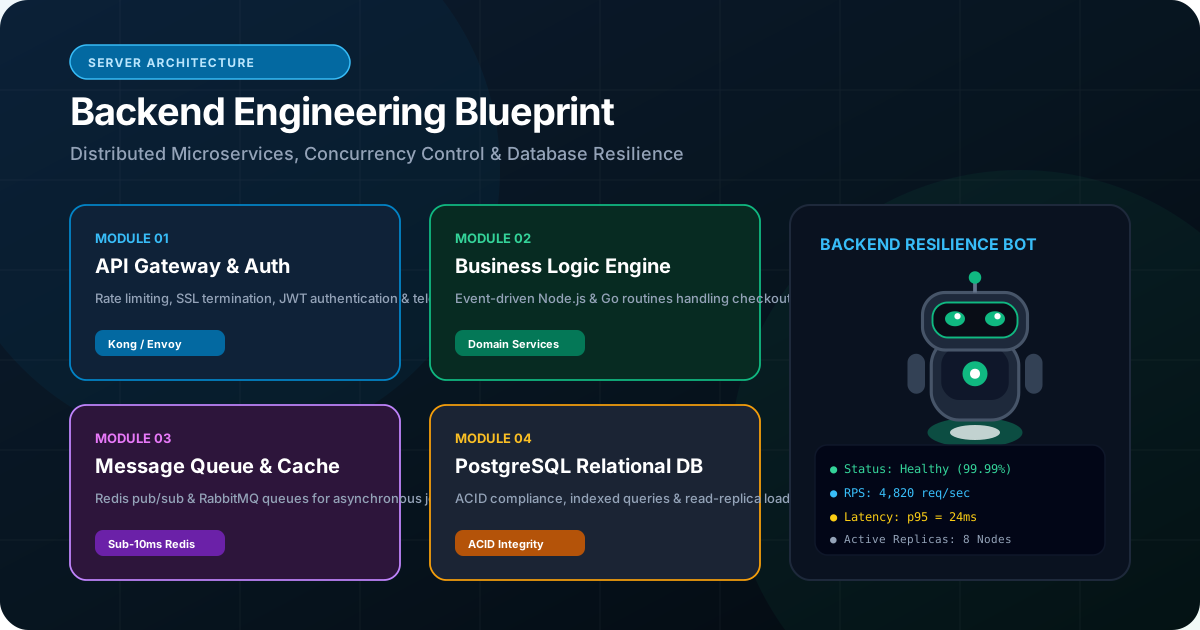
4. Caching Hierarchy: Edge CDN, Memory & Application Caches
The fastest database query is the one that never touches the database
Scalability is largely the art of intelligent caching. We implement a multi-tiered caching hierarchy:
Tier 1: Global Edge CDN Caching (Cloudflare / Vercel Edge): Static visual assets, fonts, pre-rendered marketing pages, and public API responses are cached across hundreds of global edge data centers. A user in London or New York receives content from a server physically located in their city in under 20 milliseconds.
Tier 2: In-Memory Redis Caching: Frequently accessed dynamic data—such as user permission matrices, product catalog categories, and system configuration settings—is cached in Redis RAM. Reads return in sub-millisecond speeds, shielding the primary PostgreSQL database from millions of redundant queries.
Tier 3: Cache Invalidation (Stale-While-Revalidate): Next.js App Router utilizes sophisticated cache invalidation tags, ensuring that when an administrator updates a product price, the cache updates instantly without requiring a full application restart.
5. Asynchronous Task Queues & Decoupled Microservices
Keeping the user request-response lifecycle instantaneous
When building custom web application development, never force a user's browser to wait for a heavy computational task to complete.
If a user clicks 'Export 10,000 Records to Excel' or 'Submit Insurance Application', executing that logic synchronously will tie up the server thread for 15 seconds, risking an HTTP 504 Gateway Timeout.
Instead, the web application receives the request, writes a lightweight task message to an asynchronous queue (such as BullMQ backed by Redis), and immediately responds to the user: 'Your request is processing; you will receive a notification shortly.'
Dedicated background worker processes consume tasks from the queue in the background, generate the files, and notify the user via webhooks or WebSockets. The main application remains blazing fast and completely unblocked.
6. Vertical Scaling vs Horizontal Scaling Comparison
Why throwing bigger hardware at bad software always fails
The table below contrasts the two fundamental scaling philosophies:
| Dimension | Vertical Scaling (Scale-Up) | Horizontal Scaling (Scale-Out) |
|---|---|---|
| Core Mechanism | Upgrading a single server with more RAM/CPU cores | Adding multiple identical smaller server instances |
| Maximum Upper Limit | Hard hardware ceiling (e.g., max 128 cores / 512GB RAM) | Virtually unlimited (Hundreds of cloud container nodes) |
| High Availability / Fault Tolerance | Poor (Single point of failure; if machine fails, app dies) | Flawless (If one container crashes, others absorb traffic) |
| Downtime During Upgrades | Requires scheduled downtime to reboot larger machine | Zero downtime (Rolling deployments across instances) |
| Architectural Requirement | Can run legacy stateful code | Requires strict stateless application server architecture |
| Cost Efficiency at Scale | Exponentially expensive at higher hardware tiers | Cost-effective, linear scaling matching active traffic |
7. The 8-Point Production Scalability Checklist
Verify these technical benchmarks before launching a high-traffic platform
Before launching any enterprise digital platform, verify that your engineering team has implemented these safeguards:
1. Stateless Compute: Are user sessions stored in Redis or secure JWT cookies rather than local server RAM?
2. Database Connection Pooling: Is PgBouncer or an equivalent managed pooler active between the application and database?
3. Read Replica Segregation: Are intensive analytics and search queries routed to dedicated read replicas?
4. Edge Asset Delivery: Are all static images, videos, and scripts distributed globally via an edge CDN?
5. Asynchronous Queue Workers: Are PDF generation, email notifications, and data exports decoupled into background task queues?
6. Database Index Coverage: Have slow query logs been audited with EXPLAIN ANALYZE to ensure zero unindexed sequential table scans?
7. Graceful Rate Limiting: Does the API implement Redis token-bucket rate limiting to prevent scraper abuse and DDoS overload?
8. Automated Auto-Scaling Rules: Are cloud container clusters configured to scale up automatically when CPU or memory exceeds 70% utilization?
The Bottom Line & Next Steps
Scalability is the hallmark of professional software engineering. A scalable web application provides your business with technological peace of mind: the confidence that your digital infrastructure will remain fast, stable, and cost-effective whether you are serving 50 clients or expanding into global markets across the US, UK, Canada, and India. If your existing web application is showing signs of performance degradation or you are planning a high-growth digital product, discuss your scalable architecture with RankVRA today.
Questions Business Leaders Ask About scalable web application development
How do we know if our existing web application needs architectural scaling?▾
Clear warning signs include: API response times degrading noticeably during peak business hours, occasional 502/504 gateway timeout errors, database CPU utilization consistently spiking above 80%, or users reporting that saving forms takes several seconds.
Can an application built on Next.js scale to millions of users?▾
Yes. Next.js powers some of the largest global web platforms in the world (including TikTok, Hulu, and Twitch). Its Server Components, edge caching, and serverless compute primitives make it one of the most naturally scalable web frameworks available today.
Is horizontal scaling more expensive than vertical scaling?▾
In the short term for tiny prototypes, vertical scaling on a single cheap server is slightly simpler. However, as an application grows, horizontal scaling is significantly cheaper because you only pay for smaller cloud instances when traffic spikes, scaling down automatically during quiet hours.

Written by Naveen Panchal
AuthorFounder & Lead Technical Architect, RankVRA
Naveen Panchal is the Founder and Technical Director of RankVRA. He specializes in full-stack web engineering, Next.js architecture, and high-performance digital systems for clients across the US, UK, Canada, and India.
Explore Core Commercial Capabilities
Scalable B2B portals & operational software
Node.js, Python & high-concurrency database architecture
Unified frontend and backend systems
Sub-second speed & Core Web Vitals engineering
Multi-tenant software-as-a-service platforms
- Amazon Web Services: AWS Architecture Center: Well-Architected FrameworkOfficial Reference
- PostgreSQL Global Development Group: PostgreSQL High Availability & Replication DocumentationOfficial Reference
- Redis Ltd.: Redis Architecture & In-Memory Caching Best PracticesOfficial Reference
Discuss Your Scalable Web Application
Planning to scale your web application to thousands of concurrent users? Speak directly with RankVRA Founder & Lead Technical Architect Naveen Panchal to design a resilient, high-concurrency cloud architecture.
Related Growth Blueprints
Explore more strategic articles from the RankVRA engineering desk.
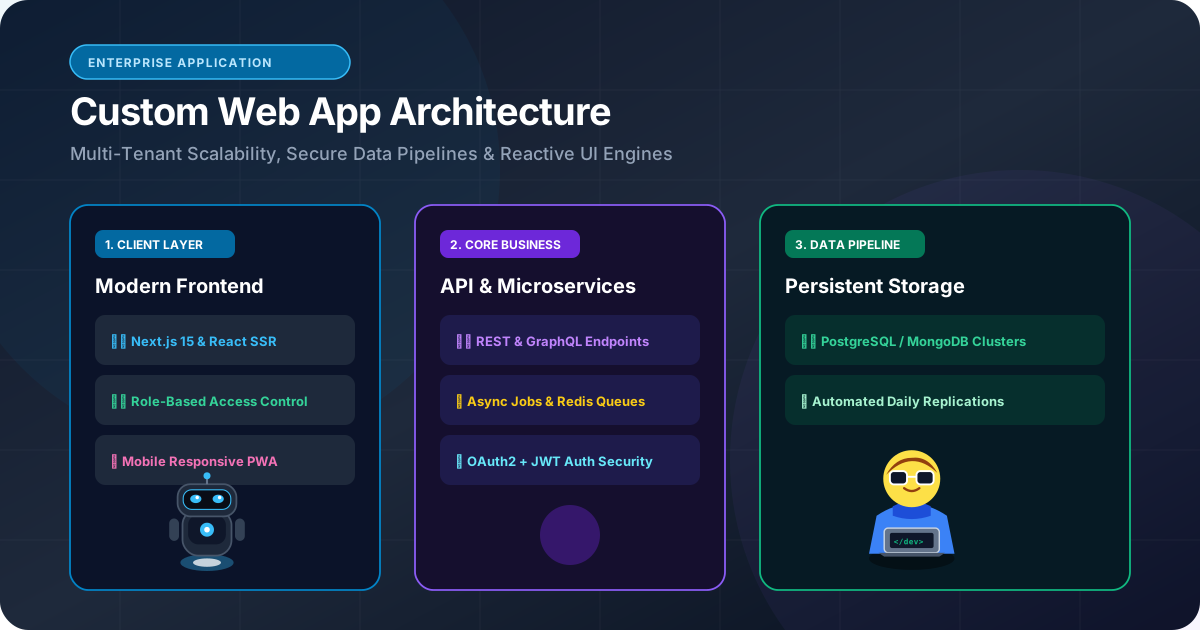
Custom Web Application Development: When Should a Business Build a Custom Web App?
When should a business build custom web applications instead of subscribing to SaaS? Learn how custom portals, wholesale dashboards, and bespoke workflows deliver compounding ROI.
What Is Backend Development and Why Is It Important for Modern Web Applications?
Demystify backend development. Discover how server architectures, relational databases, Node.js, Python, and OWASP security protect and scale business web applications.
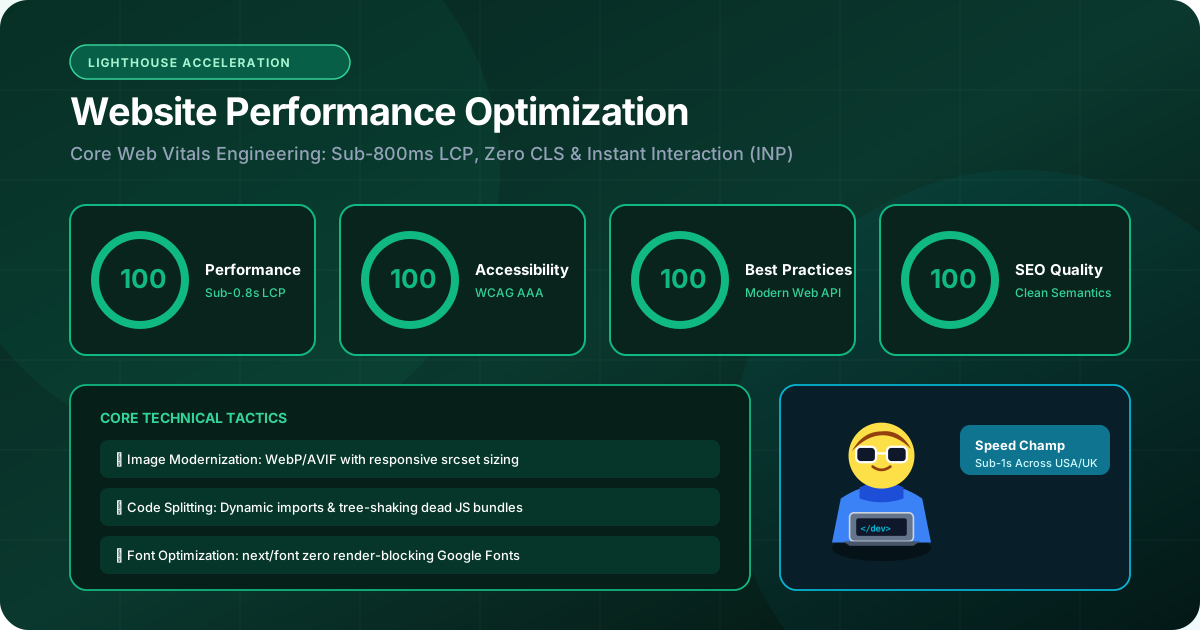
Why Website Performance Matters for Business Growth: Sub-Second Speed Engineering
Slow websites destroy business revenue. Discover how website performance optimization impacts Core Web Vitals, conversion rates, Google rankings, and user retention.