
Custom Web Application Development: When Should a Business Build a Custom Web App?
A strategic evaluation guide for founders, CTOs, and operations leaders assessing custom software vs off-the-shelf SaaS.

- 1. What Distinguishes a Custom Web Application?
- 2. The 5 Inflection Points: When Off-The-Shelf Fails
- 3. High-Impact Commercial Use Cases
- 4. Production Case Study: Sterling Wholesale Insurance Portal
- 5. Financial Comparison: Custom Build vs Perpetual SaaS Subscriptions
- 6. The 6-Stage Custom Web Application Development Lifecycle
- 7. How to Mitigate Risk When Building Custom Software
Every expanding company reaches a critical technological crossroads. In the early stages, relying on a patchwork of generic SaaS subscriptions—Salesforce, HubSpot, Monday.com, Zapier, and spreadsheets—is fast and convenient. But as transaction volumes multiply, teams expand, and proprietary operating processes mature, generic tools begin to push back. Staff spend hours copying and pasting data between disconnected platforms, monthly SaaS bills climb into thousands of dollars, and competitors using streamlined software execute faster. At this inflection point, leaders ask: Should we continue duct-taping off-the-shelf tools, or should we invest in custom web application development? This guide provides a strategic framework to help you make that call with financial clarity.
A business should build a custom web application when off-the-shelf software restricts operational efficiency, requires excessive manual workarounds, imposes escalating per-seat monthly fees, or fails to protect proprietary competitive advantages.
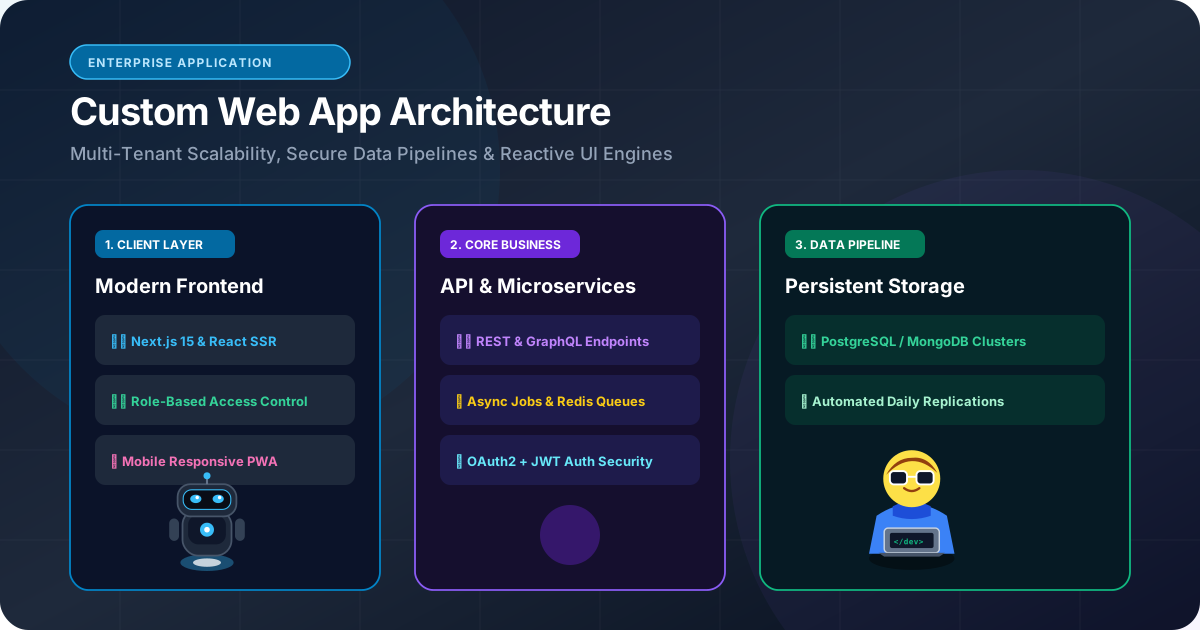
1. What Distinguishes a Custom Web Application?
Software engineered around your exact operating model rather than generic assumptions
A custom web application is a private or client-facing digital platform engineered specifically to execute your company's proprietary workflows, business logic, and data structures.
Unlike a standard marketing website, which exists primarily to display information and collect inquiries, a custom web application is interactive software running inside a browser. Users log in, manipulate data, generate customized reports, upload and process documents, communicate securely, and trigger multi-step business transactions.
Unlike off-the-shelf SaaS, where your business must twist its internal operating procedures to fit the software's pre-built constraints, custom software is molded precisely to your competitive edge.
2. The 5 Inflection Points: When Off-The-Shelf Fails
Clear operational signals that justify commissioning custom software
Investing in custom web application development makes financial sense when your business hits one or more of these operational milestones:
1. The 'Excel Glue' Epidemic: If your core operational workflows rely on multiple staff members manually exporting CSVs from one software, cleaning them in Excel, and re-uploading them to another tool, you are bleeding payroll and courting catastrophic data errors.
2. Punitive Per-Seat Licensing: Many SaaS vendors charge $50 to $250 per user per month. For a business scaling from 20 to 150 team members or field contractors, annual software licensing can balloon from $12,000 to over $200,000 per year.
3. Unique Competitive Workflows: If your pricing model, underwriting process, or supply chain coordination is your unique secret sauce, no generic off-the-shelf software can accommodate it without breaking.
4. Data Sovereignty & Customer Trust: When enterprise clients require strict proof of where their sensitive financial, medical, or corporate records reside, storing records inside shared multi-tenant SaaS environments can cost you lucrative contracts.
5. The Need for Seamless Partner/Client Portals: When your B2B customers demand an intuitive, self-service digital portal to track orders, upload documents, and review statuses 24/7.
3. High-Impact Commercial Use Cases
Where custom web applications generate the highest operational return
Across our global client base, we observe custom web applications delivering exceptional ROI in several specific categories:
• B2B Wholesale & Partner Submission Portals: Replacing messy email chains with secure digital intake systems featuring automated document validation, quote calculation, and underwriter task assignment.
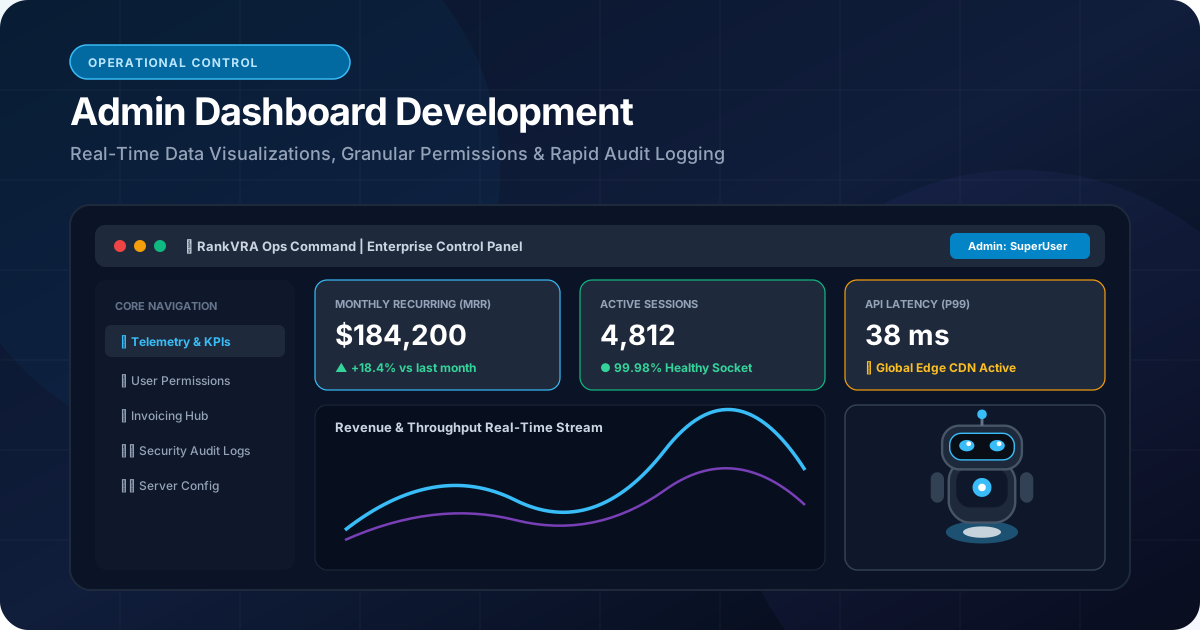
• Custom Operations & ERP Dashboards: Centralizing inventory management, fleet logistics, procurement, and team time-tracking into a single unified control room.
• Client Account & Policy Management Portals: Providing high-value policyholders or corporate clients with secure access to invoices, certificates of insurance, policy documents, and instant renewal workflows.
• Specialized Quoting & Estimation Engines: Automating complex multi-variable pricing algorithms (manufacturing specifications, shipping dimensions, material tariffs) into instant client-facing estimators.
4. Production Case Study: Sterling Wholesale Insurance Portal
Replacing manual underwriting bottlenecks with an automated submission platform
To understand the practical impact of custom web application development, consider RankVRA's engineering work on the Sterling Wholesale Insurance Portal.
The Challenge: Independent insurance brokers submitting commercial risks to wholesale underwriters were previously forced to exchange dozens of unstructured emails, ACORD PDF forms, and loss-run documents. Underwriters spent hours re-keying data into internal spreadsheets, leading to delayed quote turnaround and lost placement opportunities.
The Custom Solution: RankVRA architected and built an end-to-end full-stack web application featuring:
• Secure, role-based broker authentication with dedicated submission pipelines.
• Direct document upload vaults supporting multi-megabyte commercial loss files and ACORD applications.
• Automated underwriting queue assignment with real-time status tracking.
The Result: Quote turnaround times dropped dramatically, email clutter was eliminated, and the brokerage gained complete audit transparency across millions of dollars in commercial risk submissions.
5. Financial Comparison: Custom Build vs Perpetual SaaS Subscriptions
Analyzing three-year Total Cost of Ownership (TCO) and valuation multiples
A frequent objection from non-technical executives is that custom development requires higher initial capital expenditure. However, when viewed over a 3-to-5-year horizon, the financial reality is very different:
Consider a company with 75 employees using an off-the-shelf CRM and operations suite at $150/user/month, plus $1,200/month for integration add-ons and Zapier tiers. Their annual software licensing bill is $149,400. Over 3 years, they spend $448,200—and at the end of year 3, they own zero intellectual property.
Building a custom web application tailored to their exact workflow might require an upfront capital investment of $30,000 to $60,000, plus modest cloud hosting ($200–$500/month) and ongoing maintenance. Over three years, the total investment is under $75,000—saving more than $370,000 while creating a proprietary software asset that substantially increases company valuation.
| Metric / Expense | Off-The-Shelf SaaS Stack (75 Users) | Custom Web Application (RankVRA) |
|---|---|---|
| Year 1 Upfront Investment | $18,000 (Implementation / Onboarding) | $35,000 – $65,000 (Full-Cycle Engineering) |
| Year 1 Subscription / Hosting | $135,000 ($150/user/mo) | $3,600 – $6,000 (Private Cloud AWS/Vercel) |
| Year 2 Cost (Scale to 100 Users) | $180,000 (Subscription Increases) | $4,800 (Hosting) + Maintenance Retainer |
| Year 3 Cost (Scale to 125 Users) | $225,000 (Subscription Increases) | $6,000 (Hosting) + Maintenance Retainer |
| 3-Year Total Expenditure | $558,000+ | $65,000 – $95,000 Total |
| Intellectual Property Ownership | 0% (Vendor Owns Everything) | 100% Client IP Ownership & Source Code |
| Customization Flexibility | Constrained by Vendor API Limits | 100% Tailored to Exact Business Workflow |
6. The 6-Stage Custom Web Application Development Lifecycle
A disciplined engineering process from discovery to production launch
At RankVRA, we execute custom web application engineering through six rigorous phases:
1. Discovery & Architecture Blueprinting: Documenting user roles, data schemas, entity relationship diagrams (ERDs), and third-party integration contracts before writing code.
2. Interactive UI/UX Prototyping: Designing clickable wireframes in Figma to validate usability and task completion speed with actual stakeholders.
3. Database Modeling & Backend Engineering: Constructing normalized PostgreSQL relational databases, API endpoints, and authentication middleware.
4. Frontend Engineering & Hydration: Developing responsive, accessible interfaces in Next.js with optimized state management.
5. Quality Assurance & Security Hardening: Automated unit testing, OWASP vulnerability audits, and load testing simulating peak traffic.
6. Deployment & CI/CD Handover: Provisioning containerized cloud infrastructure, setting up automated backups, and transferring full repository access to the client.
7. How to Mitigate Risk When Building Custom Software
Protecting your investment against scope creep and technical debt
Building custom software carries inherent risks if managed poorly. To ensure project success, insist on three non-negotiable standards:
• Ship an MVP (Minimum Viable Product) First: Never attempt to build a two-year feature wishlist in version 1. Build the core 20% of features that solve 80% of operational friction, launch in 8 to 12 weeks, gather user feedback, and iterate.
• Demand Complete Code Ownership: Ensure your contract states that 100% of source code, database schemas, and documentation belong to your business from day one.
• Insist on Standard Modern Stacks: Avoid proprietary agency frameworks. Building with React, Next.js, TypeScript, and PostgreSQL ensures any competent engineer in the world can maintain the codebase.
The Bottom Line & Next Steps
Custom web application development is one of the highest-leverage investments a growing business can make. By replacing generic subscriptions with tailored digital software, you eliminate operational bottlenecks, slash recurring overhead, protect sensitive data, and build proprietary enterprise value. If your company is ready to explore custom software engineering, discuss your requirements with the technical team at RankVRA.
Questions Business Leaders Ask About custom web application development
How long does it take to develop a custom business web application?▾
A focused Minimum Viable Product (MVP) addressing a core operational bottleneck typically takes 6 to 10 weeks from discovery to deployment. Large enterprise platforms with complex legacy integrations generally require 3 to 5 months.
Who owns the code and intellectual property of the web application?▾
At RankVRA, the client owns 100% of all intellectual property, source code repositories, database schemas, and deployment credentials upon project completion. We do not lock clients into proprietary software licenses.
How do we maintain and update our custom web application after launch?▾
We provide structured post-launch Service Level Agreements (SLAs) covering uptime monitoring, security patching, database backups, and monthly feature iteration sprints. Alternatively, because our code is written in standard TypeScript and Next.js, your internal technical team can manage it effortlessly.

Written by Naveen Panchal
AuthorFounder & Lead Technical Architect, RankVRA
Naveen Panchal is the Founder and Technical Director of RankVRA. He specializes in full-stack web engineering, Next.js architecture, and high-performance digital systems for clients across the US, UK, Canada, and India.
Explore Core Commercial Capabilities
Bespoke portals, wholesale dashboards & SaaS
Unified frontend and backend architecture
Scalable APIs & PostgreSQL database architecture
Tailored sales pipelines & zero per-user licensing
Multi-tenant software-as-a-service platforms
- OWASP Foundation: OWASP Top 10 Web Application SecurityOfficial Reference
- PostgreSQL Global Development Group: PostgreSQL ACID Reliability GuidelinesOfficial Reference
- Vercel: Next.js Enterprise Architecture Best PracticesOfficial Reference
Request a Custom Web Application Consultation
Ready to explore building a custom portal, operational dashboard, or bespoke business application? Speak with technical director Naveen Panchal to review your requirements and receive a transparent project blueprint.
Related Growth Blueprints
Explore more strategic articles from the RankVRA engineering desk.
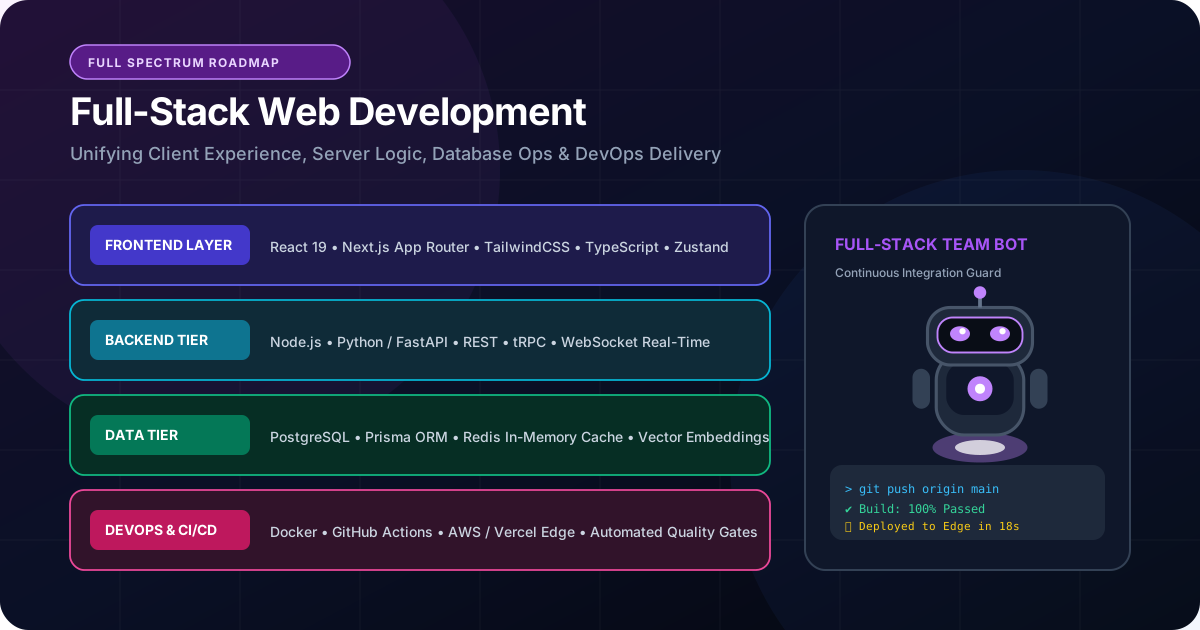
What Is Full-Stack Web Development? Frontend, Backend and APIs Explained
Demystify full-stack web development. Learn how frontend interfaces, backend servers, relational databases, and REST APIs connect to deliver business web platforms.
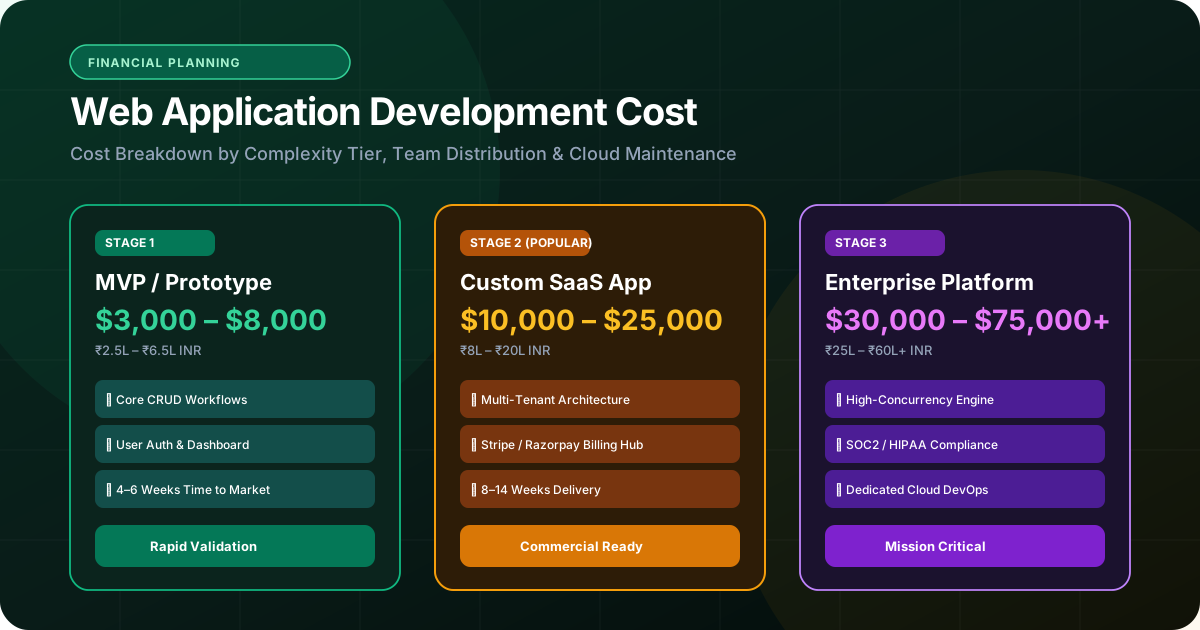
How Much Does Custom Web Application Development Cost? The Definitive Business Guide
Understand what dictates custom web application development cost. Learn the real factors—complexity, integrations, databases, and security—that determine software investment.
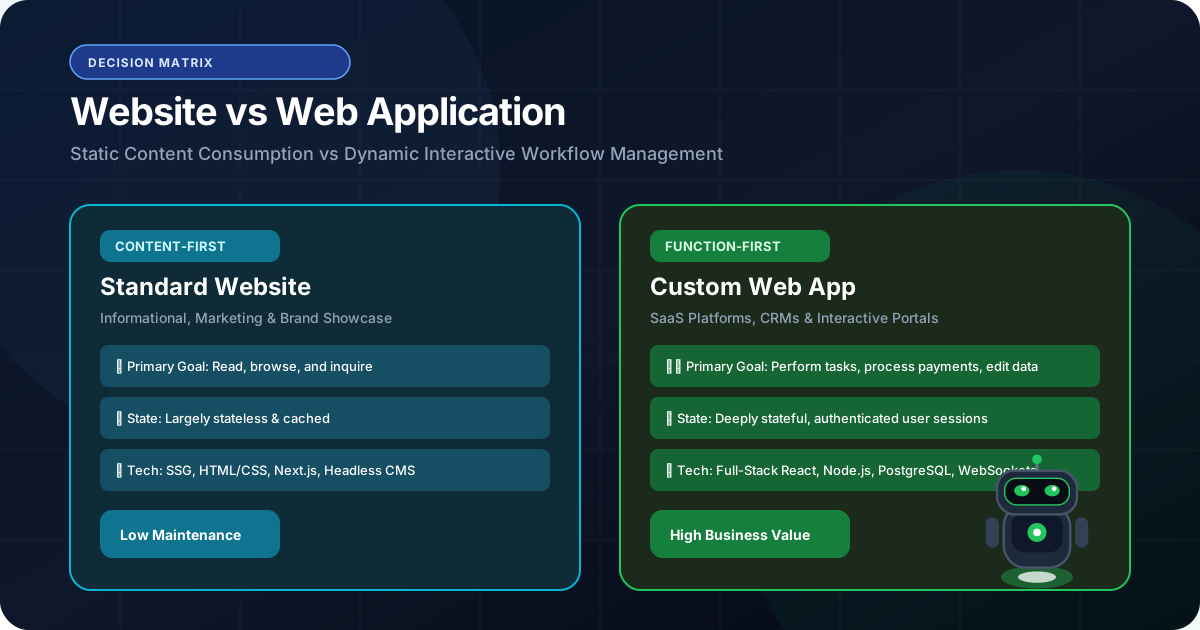
Website vs Web Application: What Is the Difference?
What is the difference between a website and a web application? Compare architecture, costs, user interactivity, databases, and business objectives.