
How Much Does Custom Web Application Development Cost? The Definitive Business Guide
A transparent breakdown of software development cost factors: scope, architecture, integrations, security, and lifetime maintenance.

- 1. The Honest Reality of Custom Software Pricing
- 2. The 10 Primary Factors That Dictate Development Cost
- 3. The 3 Typical Project Complexity Tiers
- 4. Comprehensive Cost Allocation Matrix
- 5. Hidden Costs Many Agencies Conceal in Initial Proposals
- 6. Calculating ROI: Custom Software vs Escalating SaaS Retainers
- 7. How to Protect Your Budget from Scope Creep
When business owners, startup founders, and technical directors begin evaluating custom software projects, the first question they ask is invariably: 'How much will custom web application development cost?' Unfortunately, the answers they receive from the market are wildly inconsistent. One offshore freelance agency quotes $5,000; a mid-tier development firm quotes $45,000; and an enterprise software consultancy quotes $250,000 for what seems like the identical feature list. Why does this massive pricing disparity exist? How can a commercial decision-maker accurately budget for software without either getting trapped by low-cost providers who abandon the project or overpaying for bloated corporate overhead? This guide strips away the mystery to explain the concrete architectural factors that dictate custom web application costs.
Custom web application development costs vary based on scope, feature complexity, database architecture, third-party integrations, authentication security, and post-launch maintenance requirements. Rather than arbitrary pricing, investment is driven by architectural hours, engineering seniority, and operational scale.
1. The Honest Reality of Custom Software Pricing
Why software development is priced like custom commercial architecture, not pre-fabricated furniture
Asking 'How much does a web application cost?' is identical to asking 'How much does it cost to construct a commercial building?'
The price depends entirely on the specifications: Are you building a simple single-room retail kiosk, or a multi-story commercial medical center with reinforced foundations, specialized electrical grids, elevator shafts, and biometric security vaults?
In software engineering, you are not buying pre-packaged code off a shelf; you are investing in engineering hours from senior full-stack architects, database designers, UI/UX researchers, and cybersecurity specialists.
Reputable engineering firms like RankVRA calculate investment based on clear functional specifications, scope complexity, risk mitigation, and verified project milestones.
2. The 10 Primary Factors That Dictate Development Cost
The technical variables that expand or compress your project budget
Every custom software proposal is shaped by ten foundational technical drivers:
1. Functional Scope & Feature Density: The sheer number of distinct workflows, screens, mathematical calculations, and user operations.
2. User Roles & Permission Matrices: Simple applications feature one user type. Enterprise platforms require complex Role-Based Access Control (RBAC) separating Super Admins, Regional Managers, Underwriters, Brokers, and Read-Only Auditors.
3. UI/UX Design Sophistication: Utilizing pre-built component libraries vs engineering bespoke, custom-branded design systems with complex interactive micro-animations.
4. Database Architecture & Relational Complexity: A database with 6 tables is straightforward; an enterprise schema with 45 normalized tables, composite indexes, and complex historical audit logging requires extensive senior modeling.
5. Third-Party API Integrations: Connecting to well-documented modern APIs (like Stripe) is fast. Connecting to legacy SOAP enterprise ERPs or closed banking protocols requires custom middleware and extensive edge-case testing.
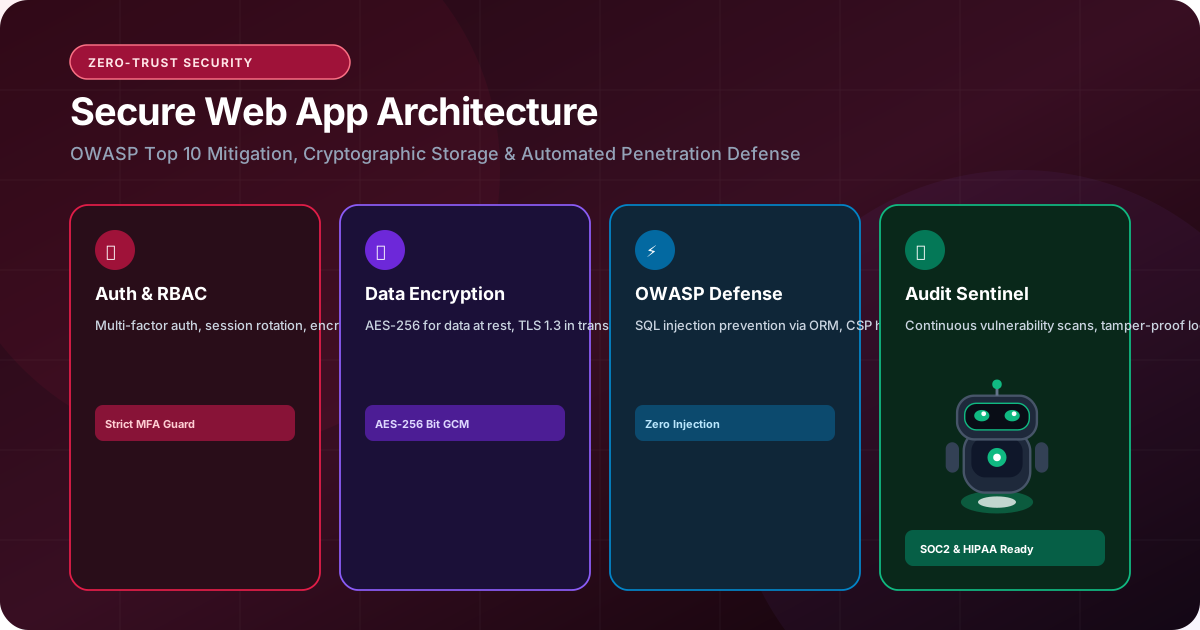
6. Security & Regulatory Compliance: Hardening systems for basic commercial use vs meeting strict HIPAA, SOC-2, or PCI-DSS Level 1 compliance standards.
7. Data Migration Requirements: Starting with a fresh database vs cleaning, validating, and migrating 500,000 historical customer records from legacy spreadsheets and legacy SQL databases without data loss.
8. Concurrency & Scalability Targets: Engineering an application to serve 50 internal team members vs architecting an auto-scaling cloud cluster capable of handling 20,000 concurrent public users.
9. Automated Testing & QA Depth: The proportion of automated end-to-end (Playwright/Cypress) and unit test coverage required prior to production sign-off.
10. Post-Launch Maintenance & SLA Commitments: The level of ongoing infrastructure monitoring, security patching, and on-call developer availability.
3. The 3 Typical Project Complexity Tiers
Understanding where your application fits on the spectrum
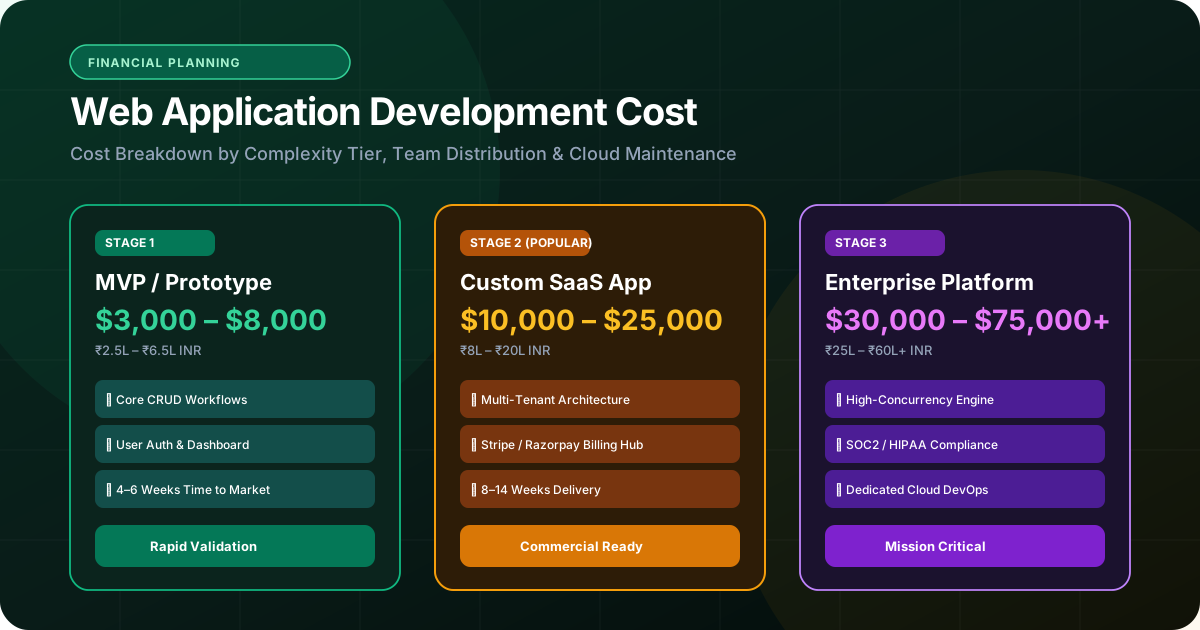
To understand budgeting, custom web applications generally categorize into three distinct development tiers:
Tier 1: Focused MVP / Operational Tool (Typically 4 to 8 Weeks):
• Examples: An internal staff task-tracking tool, a specialized quote calculator, or a streamlined client onboarding portal.
• Scope: 1–2 user roles, basic authentication, 4–8 application views, integration with 1–2 standard APIs (Stripe or HubSpot), and a clean relational PostgreSQL database.
Tier 2: Production Business Web Application (Typically 8 to 14 Weeks):
• Examples: A commercial B2B wholesale submission platform (like the Sterling Wholesale Insurance Portal), a custom CRM, or an end-to-end customer portal.
• Scope: Multi-role RBAC, complex approval workflows, document upload vaults, asynchronous background worker queues, automated notifications (WhatsApp/Email), and advanced reporting dashboards.
Tier 3: Enterprise Multi-Tenant SaaS Platform (Typically 14 to 24+ Weeks):
• Examples: A commercial Software-as-a-Service product sold to enterprise subscribers with separate tenant isolation, automated tiered subscription billing, and complex API webhooks.
• Scope: Complete multi-tenancy, Row-Level Security (RLS), custom domain mapping, SSO/SAML integration, extensive automated test suites, and high-availability cloud infrastructure.
4. Comprehensive Cost Allocation Matrix
How engineering hours and budget are distributed across project phases
In professional software development, budget is not spent solely on typing code. A disciplined project allocates investment across the complete lifecycle:
| Project Phase | Typical % of Total Budget | Key Deliverables Produced | Why It Matters for ROI |
|---|---|---|---|
| 1. Discovery & Architecture Blueprinting | 15% – 20% | Entity Relationship Diagrams (ERD), API Contracts, Technical Specs | Eliminates scope creep; prevents costly mid-project architectural rewrites |
| 2. UI/UX Wireframing & Prototyping | 15% – 20% | Interactive Figma Clickable Prototypes, Accessible Design System | Validates user workflows before expensive engineering begins |
| 3. Backend Engineering & Database | 25% – 30% | PostgreSQL Schema, Node.js/Python APIs, Auth, Redis Queues | Ensures data integrity, sub-100ms API speed, and bulletproof security |
| 4. Frontend Engineering & Hydration | 20% – 25% | Next.js 15+ App Router, Responsive Mobile UX, State Management | Delivers sub-second page transitions, accessibility, and high conversion |
| 5. QA, Security Auditing & Deployment | 10% – 15% | Automated Test Suites, OWASP Security Hardening, CI/CD Pipeline | Guarantees zero-downtime launches and protects against data breaches |
6. Calculating ROI: Custom Software vs Escalating SaaS Retainers
Why custom development often pays for itself within 18 to 24 months
When analyzing custom software cost, the proper metric is not 'How much does it cost to build?', but 'What is the cost of NOT building it?'
Consider a mid-sized commercial brokerage or logistics firm with 60 team members:
• SaaS Expense: Paying $175/user/month across specialized software suites equals $10,500/month, or $126,000 per year.
• Manual Inefficiency: Team members spending an average of 45 minutes per day manually re-keying data between tools equals approximately $75,000 in wasted annual payroll.
• Total Annual Cost of Status Quo: Over $200,000 per year.
Investing $45,000 to $70,000 in a custom web application that eliminates per-seat licensing and automates data hand-offs delivers a full return on investment in under 9 months, with compounding cost savings every year thereafter.
7. How to Protect Your Budget from Scope Creep
The discipline of building a focused Minimum Viable Product (MVP)
The single greatest cause of software budget overruns is attempting to build too much at once. Business stakeholders brainstorm a 50-item wishlist and insist all 50 features must exist on day one.
Our recommendation is strict: Identify the core 20% of features that solve 80% of your operational pain. Build, test, and launch that MVP in 8 to 12 weeks. Put it in front of real users, gather operational feedback, and allocate secondary budget for phase 2 enhancements based on real data rather than assumptions.
The Bottom Line & Next Steps
Custom web application development is a strategic capital investment that creates an enduring proprietary asset for your business. By understanding the core technical drivers—scope, architecture, integrations, security, and lifecycle maintenance—you can evaluate proposals with confidence and partner with engineers who deliver on time and on budget. Request a custom project estimate from RankVRA's engineering team today.
Questions Business Leaders Ask About custom web application development cost
Why do custom software estimates vary so widely between agencies?▾
Estimates reflect differences in developer seniority, code quality, architectural depth, and geographical overhead. A cheap quote often relies on junior freelancers using outdated WordPress templates with zero security audits. A professional estimate reflects senior full-stack architects delivering custom TypeScript code, normalized database schemas, automated testing, and comprehensive documentation.
Can we build our custom web application in phases to manage cash flow?▾
Yes. Phased development is our recommended approach. We architect Phase 1 (MVP) to solve your most critical operational bottleneck, launch to production, and then roll out Phase 2 and Phase 3 enhancements in structured sprints as your business scales.
How do monthly hosting and maintenance costs typically look after launch?▾
For modern Next.js and PostgreSQL applications running on cloud infrastructure (Vercel, AWS, Supabase), baseline hosting costs typically range from $50 to $300 per month depending on traffic. Structured maintenance retainers covering security audits, backups, and developer support typically range from $500 to $2,000 per month.

Written by Naveen Panchal
AuthorFounder & Lead Technical Architect, RankVRA
Naveen Panchal is the Founder and Technical Director of RankVRA. He specializes in full-stack web engineering, Next.js architecture, and high-performance digital systems for clients across the US, UK, Canada, and India.
Explore Core Commercial Capabilities
Bespoke business portals & operational software
Unified frontend and backend systems
Tailored sales pipelines & zero per-user licensing
Multi-tenant software-as-a-service platforms
Connect CRMs, payment gateways & third-party tools
- OWASP Foundation: OWASP Software Assurance Maturity Model (SAMM)Official Reference
- ThoughtWorks / Martin Fowler: Martin Fowler: Software Architecture & Technical DebtOfficial Reference
- Amazon Web Services: AWS Cloud Economics & TCO GuideOfficial Reference
Get a Custom Project Estimate
Ready to budget your web application accurately? Speak directly with RankVRA Founder & Lead Technical Architect Naveen Panchal to review your requirements and receive a transparent, milestone-based estimate.
Related Growth Blueprints
Explore more strategic articles from the RankVRA engineering desk.
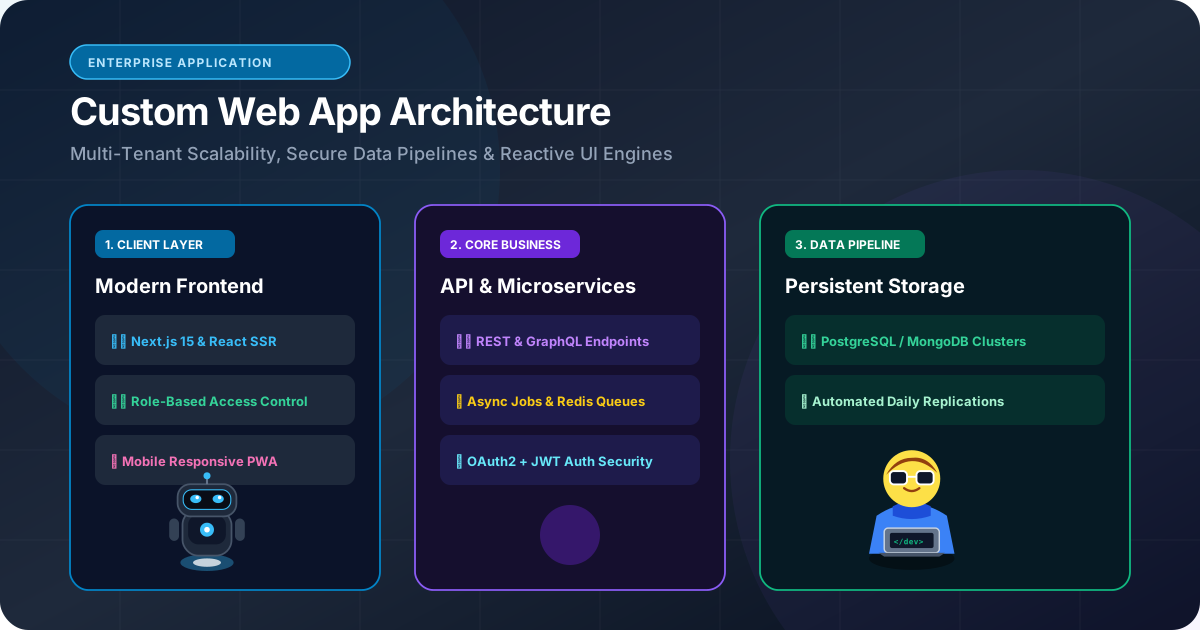
Custom Web Application Development: When Should a Business Build a Custom Web App?
When should a business build custom web applications instead of subscribing to SaaS? Learn how custom portals, wholesale dashboards, and bespoke workflows deliver compounding ROI.
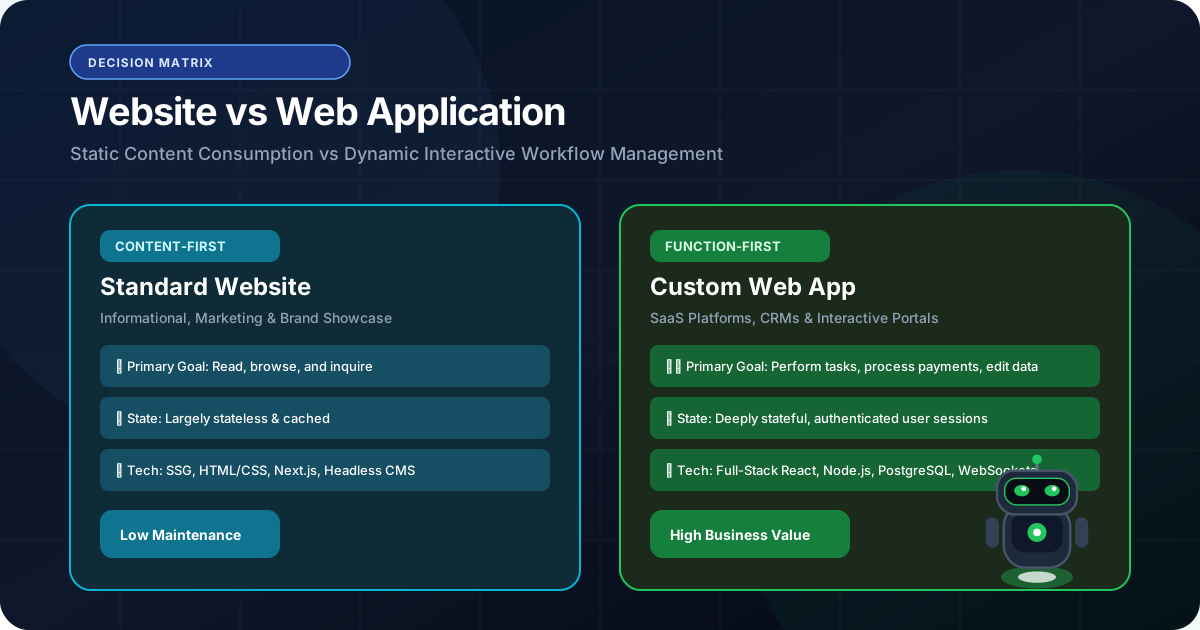
Website vs Web Application: What Is the Difference?
What is the difference between a website and a web application? Compare architecture, costs, user interactivity, databases, and business objectives.
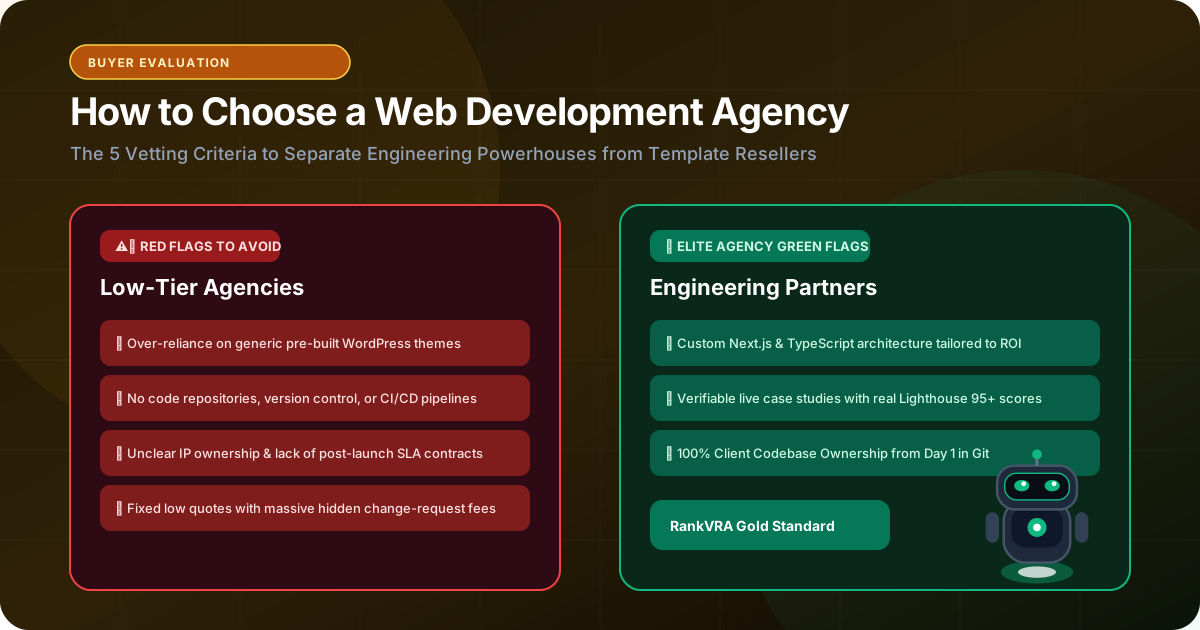
How to Choose a Web Development Company for Your Business: The Due Diligence Guide
Learn how to choose the right web development company. Avoid cheap template traps, evaluate engineering depth, ensure 100% code ownership, and protect your software investment.