
How Much Does It Cost to Build a Business Website in 2026?
A transparent breakdown of scope factors, engineering complexity, hidden overhead, and realistic budget tiers for modern business websites.


- 1. The Myth of the Single Fixed Website Price
- 2. The 14 Technical Factors That Determine Website Cost
- 3. Realistic Business Website Investment Tiers
- 4. The Hidden Costs Most Agencies Conceal
- 5. Custom Engineering vs No-Code Site Builders
- 6. How to Scrutinize Agency Proposals & Avoid Overpaying
- 7. The Website Scope & Feasibility Checklist
Every founder, executive, and marketing director searching for business website development cost encounters the same frustrating obstacle: agencies either advertise absurdly low generic prices like '$499 complete' or refuse to discuss numbers without a three-week sales discovery process. The reason for this disparity is simple: asking 'how much does a website cost?' is equivalent to asking 'how much does a commercial building cost?' A prefabricated garden shed and a 12-story corporate headquarters are both 'buildings,' but their architectural blueprints, foundational engineering, municipal permits, and structural materials share virtually nothing in common. In this comprehensive guide, RankVRA's custom web development team deconstructs the exact 14 technical and architectural variables that dictate website pricing in 2026—giving you an objective, transparent framework to evaluate agency proposals and build an accurate software budget.
The cost of building a business website ranges from $1,500 to $50,000+ depending strictly on technical scope: a 5-10 page brochure website using standard CMS templates costs $1,500-$4,500; a bespoke commercial website with custom UI design, CRM integrations, and performance engineering ranges from $5,000-$15,000; while advanced multi-tenant web applications, client portals, and e-commerce platforms with custom databases require $15,000-$50,000+.
1. The Myth of the Single Fixed Website Price
Why fixed-price packages either cut corners or inflate costs
Fixed-price website packages frequently mislead business owners. When an agency offers a flat $1,500 package for 'any business website,' they can only generate a profit by doing one of two things: cutting engineering corners through unvetted WordPress templates stuffed with security vulnerabilities, or charging exorbitant change fees the moment your team requests a custom integration or design adjustment.
Conversely, high-overhead enterprise digital agencies often charge $60,000+ for standard informational sites simply to subsidize massive executive salaries, project managers, and lavish downtown offices.
A transparent software partner evaluates your digital asset strictly through the lens of engineering scope, operational requirements, and return on investment (ROI). A dental clinic needing a local booking page has fundamentally different technical requirements than a commercial insurance brokerage requiring secure client portals or a global manufacturer needing multilingual catalogs with ERP synchronization.
Websites built on $49 pre-made marketplace themes often achieve 20/100 Core Web Vitals scores, carry over 2MB of unused CSS/JS scripts, and suffer from recurring plugin security breaches that cost thousands of dollars in emergency malware remediation.
2. The 14 Technical Factors That Determine Website Cost
Deconstructing the real engineering and strategic drivers of your digital asset
When professional software engineers and technical architects calculate a project estimate, we evaluate 14 distinct dimensions of complexity:
1. Number of Unique Page Templates: A website with 40 blog posts based on 1 template is vastly cheaper than an 8-page site where every single page requires a bespoke, custom-coded visual layout.
2. Design Complexity & Custom UI/UX: Modifying a pre-built Figma UI kit takes 30-50 hours, whereas conducting user research, wireframing interactive prototypes, and designing a tailored corporate design system requires 100-250+ hours.
3. Frontend Engineering Architecture: Lightweight static HTML/CSS vs high-performance Next.js React server components with streaming data hydration.
4. Content Management System (CMS): Deciding between open-source headless CMS (Sanity, Strapi), decoupled WordPress, or custom administrative dashboards.
5. E-Commerce Capabilities: Product variants, dynamic shipping calculation APIs, automated tax engines (TaxJar/Stripe Tax), and shopping cart state management directly multiply engineering hours.
6. Third-Party API Integrations: Connecting forms to CRM pipelines (HubSpot, Salesforce), ERP accounting, or marketing automation webhooks.
7. Database Architecture: Static content storage vs relational PostgreSQL databases with optimized connection pooling, indexing, and read replicas.
8. User Authentication & Security Roles: Multi-role authorization (RBAC) allowing admins, brokers, and customers to access isolated dashboards.
9. Animations & Micro-Interactions: Subdued CSS transitions vs complex Three.js 3D models, GSAP canvas animations, or WebGL data visualizations.
10. Technical SEO Architecture: Automated schema markup generation, dynamic sitemaps, open-graph generators, and sub-1-second Largest Contentful Paint (LCP) engineering.
11. Cloud Hosting & Serverless Infrastructure: Shared $10/month hosting vs enterprise edge CDN routing on Cloudflare / AWS with 99.99% uptime SLAs.
12. Web Security Hardening: Content Security Policies (CSP), Cross-Site Scripting (XSS) sanitation, rate-limiting, and OWASP compliance auditing.
13. Content Creation & Asset Ingestion: Copywriting, technical diagram illustration, and metadata population across hundreds of service URLs.
14. Ongoing Maintenance & SLA Support: Continuous dependency patching, security audits, database backups, and feature iterations.
3. Realistic Business Website Investment Tiers
Objective budget benchmarks for North American, European, and Indian enterprises
Based on hundreds of enterprise and mid-market deployments, realistic website investments fall into four clearly defined brackets:
• Foundation SMB Website ($1,500 – $4,500): Ideal for local service businesses, medical clinics, and professional consultants needing a trustworthy 5 to 12-page digital storefront, custom mobile design, contact forms, and foundational local search optimization.
• Custom Commercial Growth Platform ($5,000 – $15,000): Designed for B2B companies, manufacturing exporters, and regional brokerages requiring modern website redesign, sub-second page speeds, interactive calculators, CRM synchronization, and high-converting service landing pages.
• Advanced E-Commerce & Web Applications ($15,000 – $35,000): Tailored for high-growth digital brands requiring custom ecommerce development, multi-step quote portals, custom catalog filters, dynamic inventory management, and multi-currency payment checkouts.
• Enterprise Scalable Systems ($35,000 – $100,000+): Multi-tenant customer portals, role-based insurance broker platforms, or high-concurrency SaaS platforms with microservices, complex relational databases, and enterprise SLAs.

| Feature / Scope Dimension | Foundation Tier | Growth Commercial Tier | Enterprise / App Tier |
|---|---|---|---|
| Typical Page Scope | 5 to 15 Pages | 15 to 45 Pages | 50+ Pages / Dynamic App |
| UI/UX Design Process | Curated Premium Kit | 100% Bespoke Figma System | Design System & Prototypes |
| Technology Stack | Headless CMS / Clean WP | Next.js / TypeScript / React | Decoupled Full-Stack Architecture |
| API & CRM Integration | Basic Webhook / Zapier | Native Bi-Directional CRM API | Custom Middleware & Microservices |
| Mobile Core Web Vitals | Passing (75-89 score) | Superior (95+ score, <1s LCP) | Sub-50ms Edge Hydration |
| Database Architecture | Standard CMS DB | Optimized Managed SQL | PostgreSQL + Redis Caching |
| Typical Timeline | 3 to 5 Weeks | 6 to 12 Weeks | 12 to 24+ Weeks |
| Realistic Investment | $1,500 – $4,500 | $5,000 – $15,000 | $15,000 – $50,000+ |
5. Custom Engineering vs No-Code Site Builders
When Wix, Squarespace, or Webflow suffice—and when they become an expensive bottleneck
Many early-stage entrepreneurs ask whether they should spend thousands on professional engineering when no-code website builders like Wix, Squarespace, or Shopify exist for $30/month.
No-code builders are exceptional tools for solopreneurs, pre-revenue ideas, and micro-businesses testing a market. However, as an enterprise scales past $1M in annual revenue, no-code platforms introduce severe liabilities:
1. Closed Source Lock-In: You do not own your code. You cannot export your backend database logic to another hosting provider if the platform increases prices or experiences service outages.
2. Bloated DOM & Sluggish Mobile Speeds: No-code visual builders inject massive generic JavaScript libraries to support visual drag-and-drop editors, dragging down mobile Core Web Vitals and lowering organic search rankings.
3. Inflexible Business Logic: If your business requires a custom insurance rating engine, an ERP sync, or dynamic commission splits, no-code plugins will fail, forcing an expensive complete replatforming.
If your website is merely an online business card, a no-code builder is completely adequate. If your website is your primary vehicle for lead acquisition, digital sales, or customer self-service, custom engineering yields a dramatically higher commercial return.
6. How to Scrutinize Agency Proposals & Avoid Overpaying
The exact questions to ask software vendors during procurement
Before signing a contract or transferring a deposit, require every bidding web development company to answer these 5 technical questions in writing:
• 'Will our company own 100% of the intellectual property, source code, and design assets upon project completion?' (Avoid agencies that hold code hostage on proprietary platforms).
• 'What specific Core Web Vitals thresholds and mobile performance guarantees are written into the statement of work?'
• 'How will our forms and lead workflows connect to our CRM? Are you writing native API connections or relying on fragile third-party automation tools?'
• 'What is the detailed breakdown of hours between UI/UX design, frontend engineering, backend development, QA testing, and technical SEO?'
• 'What is the post-launch warranty period for bug fixes and infrastructure adjustments?'
7. The Website Scope & Feasibility Checklist
Your step-by-step checklist to finalize website specifications before requesting quotes
Use this checklist to draft your internal Scope of Work (SOW):
• Document all primary user personas and their required user journeys.
• Create a comprehensive sitemap listing every mandatory page, legal document, and category.
• List every existing software tool that must integrate with the website (CRM, ERP, payment gateway, email marketing).
• Gather all brand assets: high-resolution vector logos, typography guidelines, photography, and brand color codes.
• Define your target launch date and hard commercial deadlines (trade shows, funding rounds, fiscal year launches).
• Establish whether internal team members or an external engineering team will manage content updates post-launch.
Key Strategic Takeaways
- Business website costs are governed by technical complexity, not arbitrary agency pricing tables.
- A standard growth platform for mid-market companies ranges from $5,000 to $15,000; advanced custom web portals range from $15,000 to $50,000+.
- Beware of cheap flat-rate packages that rely on insecure templates, hidden change fees, and sluggish page speeds.
- Always factor in recurring TCO: managed hosting, cloud infrastructure, domain registration, and ongoing maintenance SLAs.
- Review our [Capital & Co Insurance case study](/case-studies/capital-co-insurance) to see how bespoke engineering transformed high-trust commercial acquisition.
The Bottom Line & Next Steps
Building a business website in 2026 is no longer about throwing together an online brochure; it is about creating a high-performance, secure digital engine that captures qualified commercial demand, automates sales pipeline entry, and represents your company's institutional authority. By understanding the 14 structural cost factors and auditing your technical scope against realistic market benchmarks, you can invest with absolute clarity and guarantee a compelling return on your capital.
Questions Business Leaders Ask About business website development cost
How much does a 5 to 10-page business website typically cost?▾
A professionally designed 5 to 10-page business website built with modern responsive UI/UX, fast page loads, on-page SEO, and lead capture forms typically costs between $1,500 and $4,500 depending on whether custom photography, branding, and copywriting are required.
Why do custom Next.js websites cost more than WordPress templates?▾
Custom Next.js websites require experienced software engineers writing bespoke React components, type-safe TypeScript code, and tailored backend APIs. Unlike pre-made WordPress themes, custom Next.js websites deliver 95+ Core Web Vitals scores, zero plugin bloat, unbreakable security, and complete flexibility for custom software workflows.
How long does it take to develop a professional business website?▾
A standard business website typically requires 4 to 8 weeks from initial discovery and wireframing to QA testing and launch. Complex e-commerce platforms or custom client portals generally take 10 to 18 weeks.
Are website maintenance fees mandatory?▾
While not legally mandatory, ongoing maintenance is essential for business continuity. Maintenance covers cloud hosting monitoring, SSL renewals, security patches, database backups, and framework updates to prevent downtime and cyber breaches.

Written by Naveen Panchal
AuthorFounder & Lead Technical Architect, RankVRA
Naveen Panchal is the Founder and Technical Director of RankVRA. He specializes in full-stack web engineering, Next.js architecture, and high-performance digital systems for clients across the US, UK, Canada, and India.
Explore Core Commercial Capabilities
Full-cycle custom web engineering for modern enterprises.
Bespoke UI/UX design systems that convert visitors into revenue.
Modernize legacy websites with zero loss of SEO equity.
Scalable digital storefronts and payment gateway integrations.
How bespoke insurance web design drove commercial acquisitions.
Request an objective website scope evaluation and cost estimate.
- web.dev: Google Web Vitals Best PracticesOfficial Reference
- World Wide Web Consortium: W3C Web Design StandardsOfficial Reference
- OWASP: OWASP Top Ten Web Application Security RisksOfficial Reference
Get an Objective, Scope-Based Website Estimate
Stop guessing your website budget. Speak directly with RankVRA technical architects to define your exact scope, evaluate integration requirements, and receive a transparent development roadmap.
Related Growth Blueprints
Explore more strategic articles from the RankVRA engineering desk.
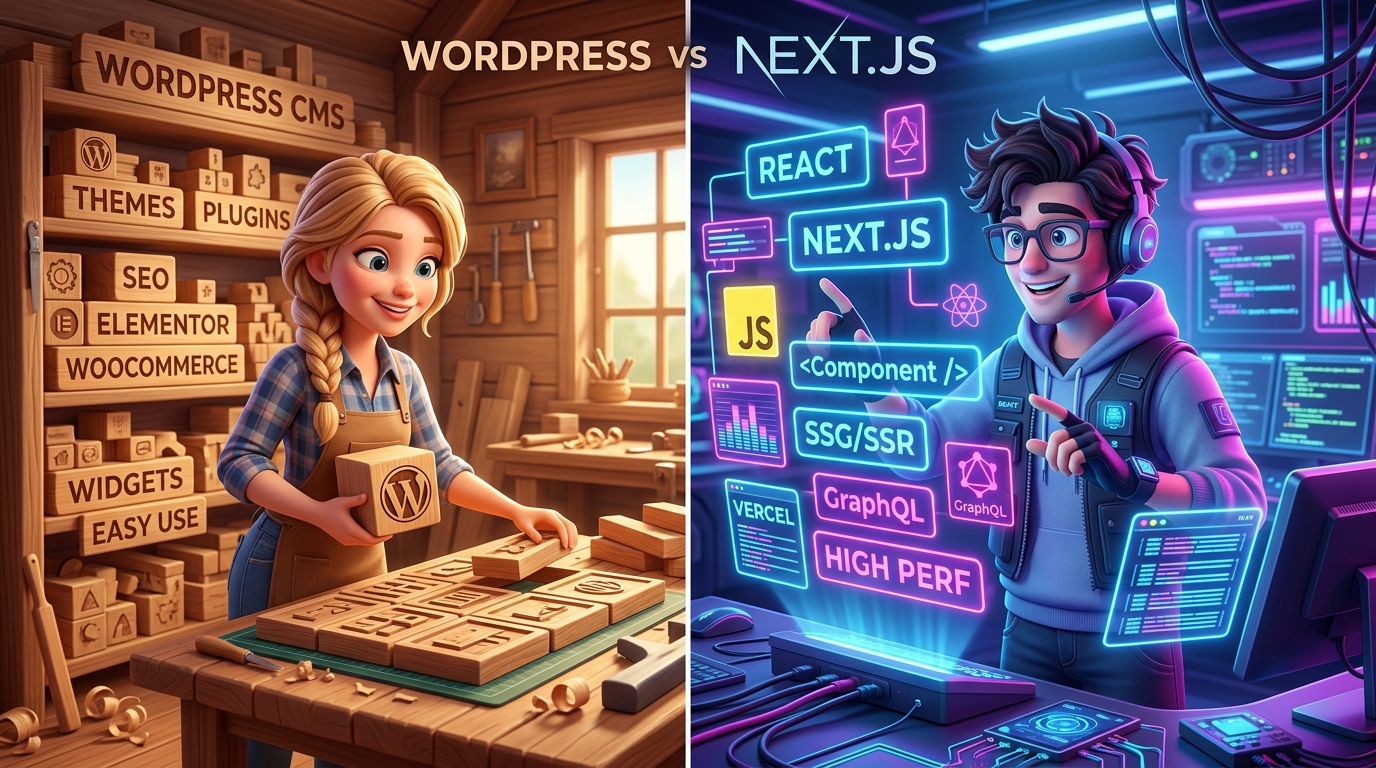
WordPress vs Custom Web Development: Which Is Right for Your Business?
WordPress or custom web development? Discover an unbiased engineering comparison of cost, scalability, security, performance, maintenance, and long-term ownership.
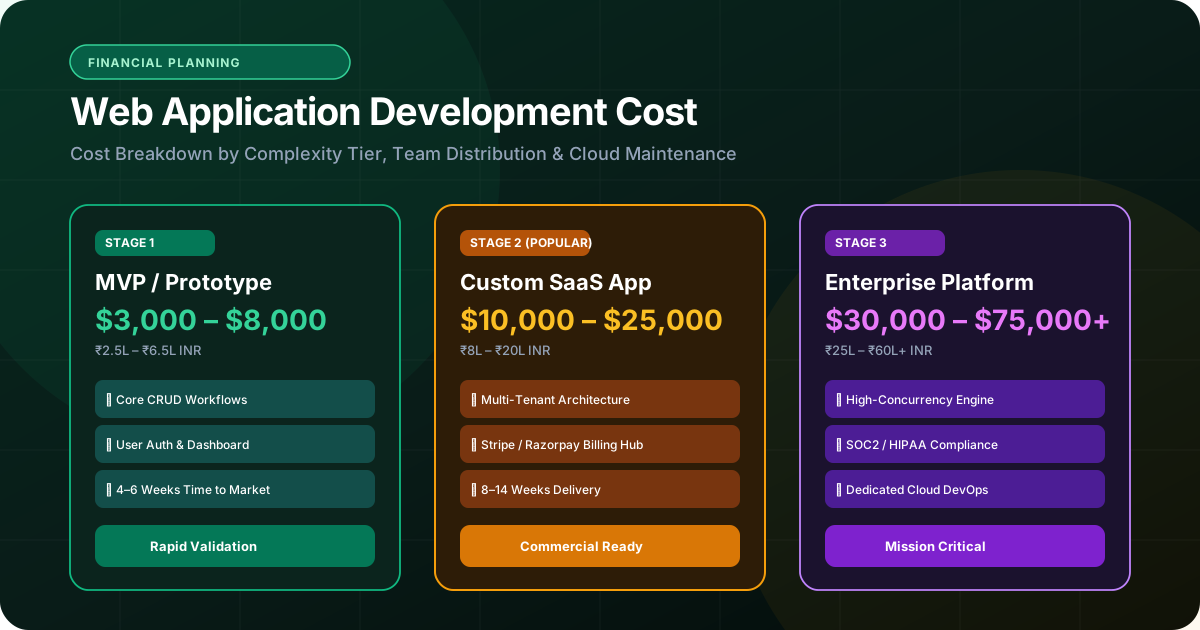
How Much Does Custom Web Application Development Cost? The Definitive Business Guide
Understand what dictates custom web application development cost. Learn the real factors—complexity, integrations, databases, and security—that determine software investment.
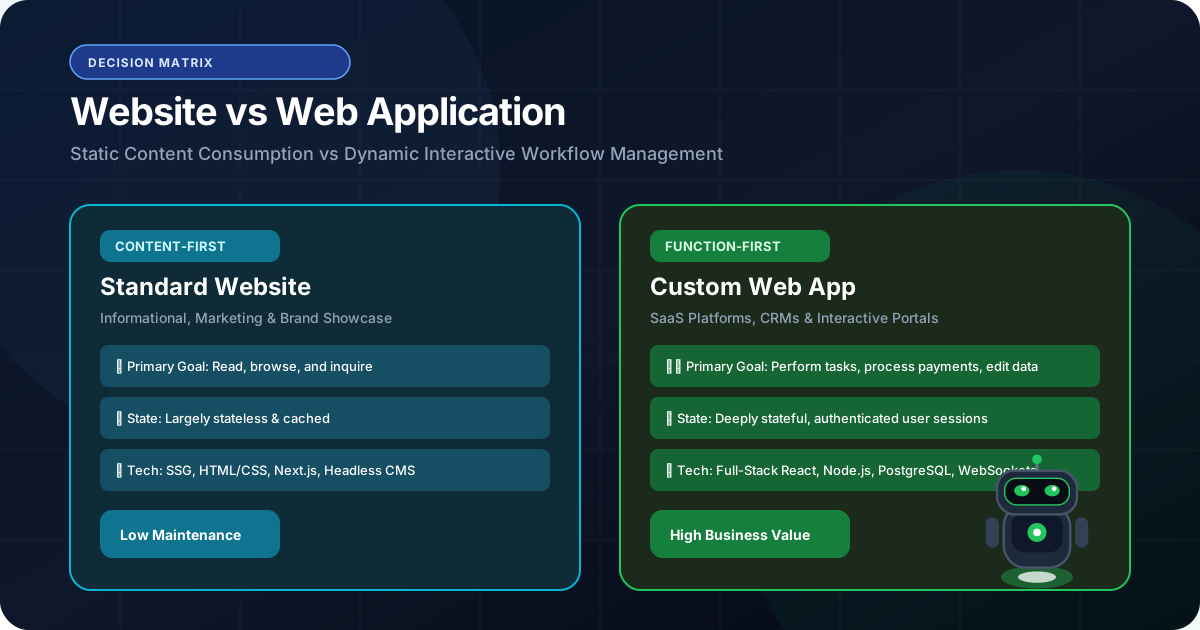
Website vs Web Application: What Is the Difference?
What is the difference between a website and a web application? Compare architecture, costs, user interactivity, databases, and business objectives.
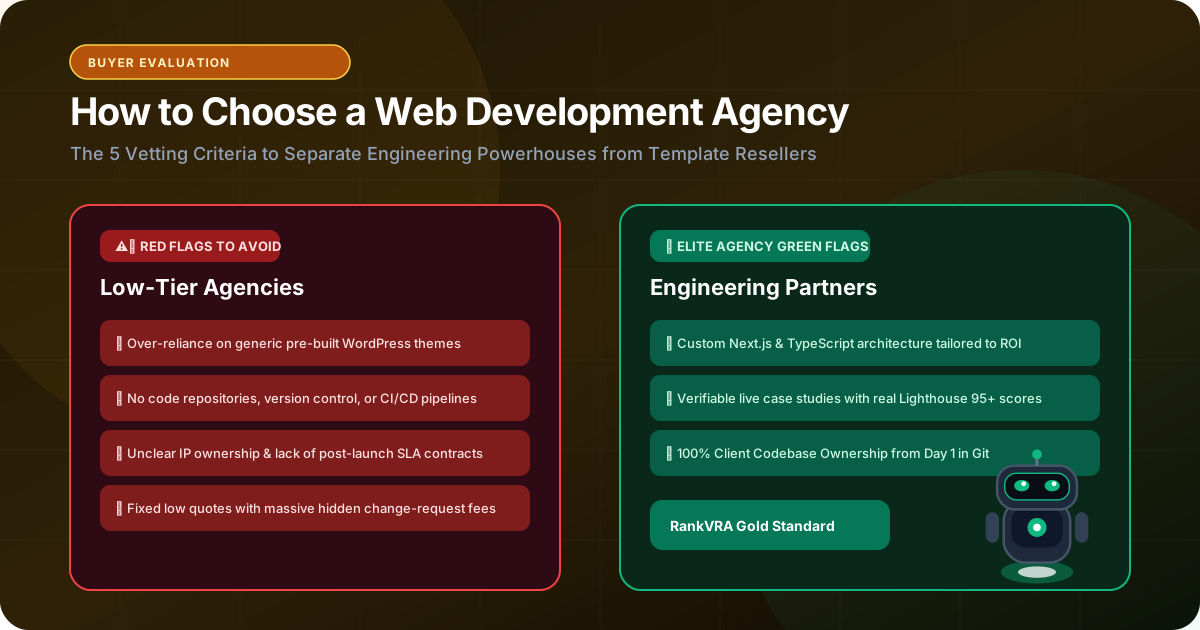
How to Choose a Web Development Company for Your Business: The Due Diligence Guide
Learn how to choose the right web development company. Avoid cheap template traps, evaluate engineering depth, ensure 100% code ownership, and protect your software investment.