
How Third-Party API Integrations Improve Business Automation: A Technical Deep Dive
Connecting CRM pipelines, ERP accounting, WhatsApp bots, and payment rails into a resilient, automated software ecosystem.

- 1. The Operational Cost of Disconnected Business Tools
- 2. The 4 Highest-ROI Third-Party API Categories
- 3. Single Direction vs Bidirectional Data Synchronization
- 4. Engineering API Resilience: Queues, Retries & Idempotency
- 5. Comprehensive Enterprise Integration Matrix
- 6. Security Best Practices: Vaulting Secrets & Rate Limits
- 7. The Business Process Automation Audit Checklist
In a fast-growing commercial business, no software platform operates in isolation. Your marketing runs on Google Ads and Meta; your sales pipeline lives in HubSpot or Salesforce; your customer billing processes through Stripe; your communication flows through WhatsApp; and your inventory and accounting are tracked in QuickBooks or an ERP. Yet, in far too many companies, the 'bridge' connecting these powerful systems is a team of administrative employees spending hours every week manually copying names, phone numbers, policy details, and invoice numbers from one browser tab into another. This manual data shuffling slows customer response times, introduces human typographical errors, and caps company growth. This guide details how professional third-party API integration automates core business workflows, protects data integrity, and scales operational capacity without expanding overhead.
Third-party API integration is the practice of connecting custom web applications to specialized external software (HubSpot, Stripe, QuickBooks, Meta WhatsApp) via secure, documented endpoints and event webhooks—eliminating manual data entry, synchronizing customer records across departments, and enabling end-to-end business automation.
1. The Operational Cost of Disconnected Business Tools
Why data silos destroy profit margins and slow customer response
Consider the journey of an inbound lead at an unintegrated company:
A prospective customer submits an inquiry on your website at 8:00 PM. The form generates an email that sits in a general inbox until 9:30 AM the next morning. An administrative assistant reads the email, manually creates a new deal in the CRM, and emails the sales rep. The sales rep calls the lead at 11:00 AM—only to find the customer already hired a competitor who replied within 2 minutes.
In contrast, in an automated ecosystem powered by custom API pipelines, the moment the user clicks submit:
1. An API call creates an enriched lead record in the CRM.
2. An automated WhatsApp Business Cloud API bot sends a personalized qualification message to the customer's phone within 20 seconds.
3. A webhook alerts the on-duty sales rep's smartphone with a 1-tap call button.
Automated API integration compresses a 15-hour manual delay into a 20-second automated execution.
2. The 4 Highest-ROI Third-Party API Categories
Where software connections deliver the highest operational leverage
Across our client engineering projects in the US, UK, Canada, and India, four integration categories deliver immediate commercial returns:
• CRM & Pipeline Automation (HubSpot, Salesforce, Zoho): Automatically mapping website forms, quote estimators, and client portal events to CRM deals, updating stages, and attributing marketing campaigns.
• Financial & Payment Rails (Stripe, Razorpay, QuickBooks): Creating customer payment profiles, charging recurring subscriptions, issuing automated tax receipts, and recording ledger transactions in real time.
• Communication & Messaging (Meta WhatsApp Cloud API, Twilio): Triggering automated two-factor authentication codes, appointment reminders, and automated support triage directly to customer smartphones.
• Logistics & Fulfillment (FedEx, DHL, Shiprocket): Generating live shipping rate quotes, generating printable shipping labels, and listening for delivery status webhooks.
3. Single Direction vs Bidirectional Data Synchronization
Ensuring changes in either system reflect across your entire organization
Beginner integrations are often unidirectional (one-way): data flows from your website into the CRM, but changes made inside the CRM never update the website.
Enterprise full-stack engineering implements Bidirectional Synchronization:
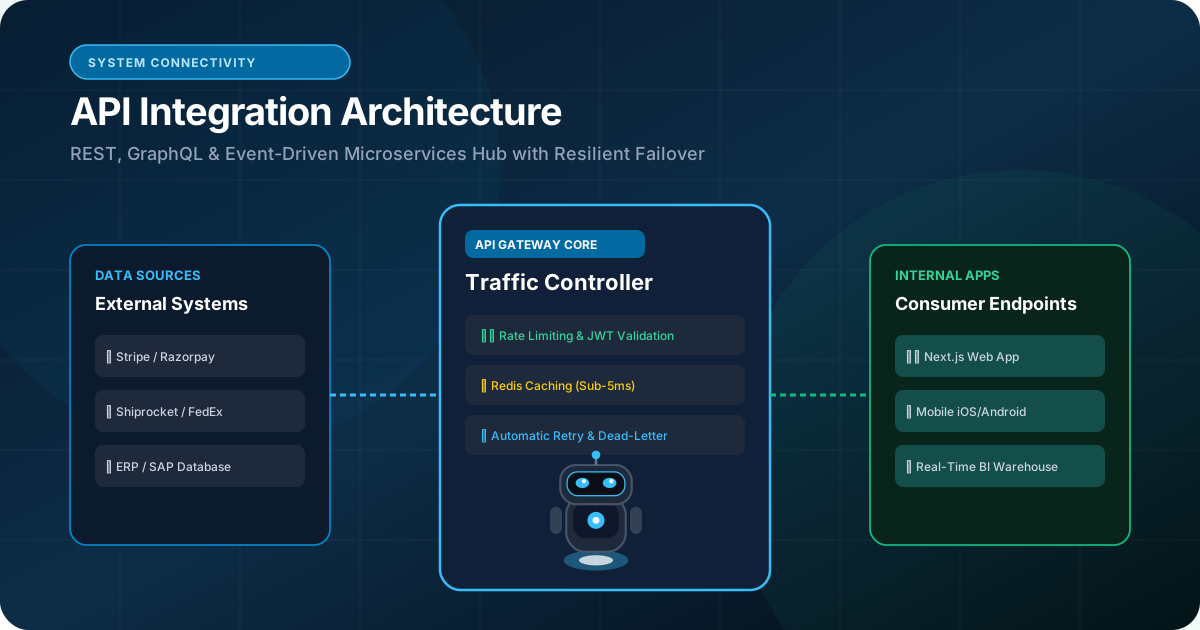
• When a client updates their shipping address inside their web portal, an outbound API call updates the CRM and ERP in real time.
• Conversely, when a sales manager marks an invoice as 'Paid' inside QuickBooks, a webhook fires to your web application, automatically updating the client's portal access and sending a receipt.
To prevent infinite update loops, senior architects implement cryptographic state hashes and source-tagging on all data exchanges.
4. Engineering API Resilience: Queues, Retries & Idempotency
Defending business workflows against third-party outages and network drops
Third-party APIs are maintained by external vendors and will occasionally experience outages, latency spikes, or rate-limit throttling (HTTP 429 Too Many Requests).
A resilient integration architecture incorporates three safeguards:
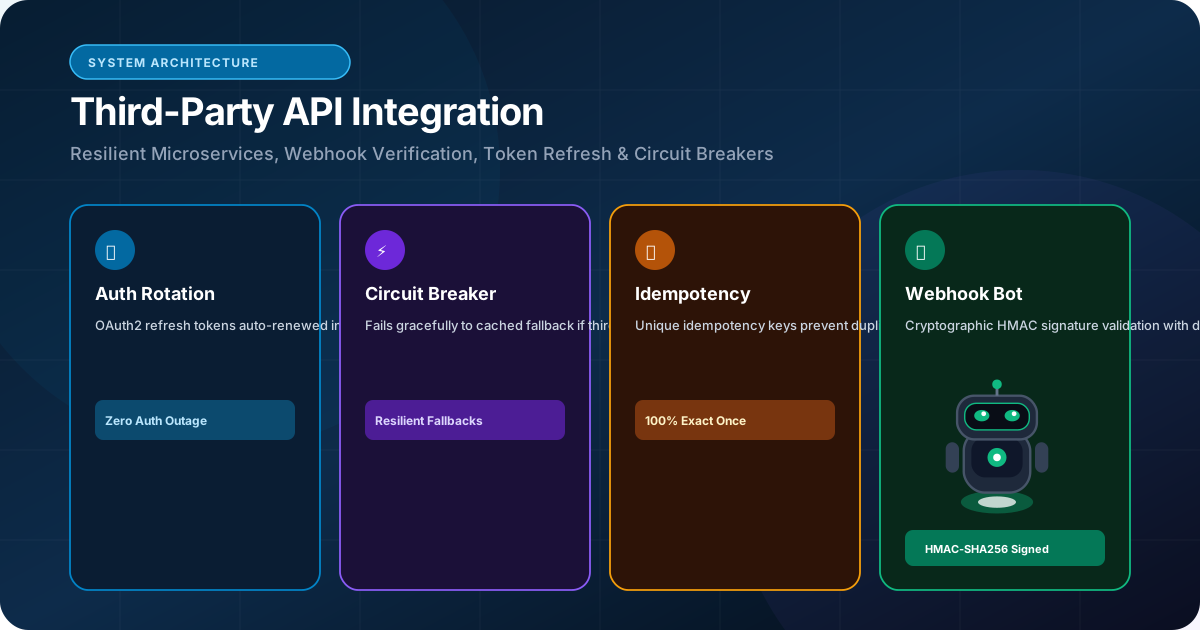
• Idempotency Keys: Passing unique UUID transaction keys with every API request. If a temporary network glitch causes your server to retry a payment or lead creation, the external system recognizes the key and avoids duplicate charges or twin records.
• Asynchronous Queue Workers (BullMQ / Redis): Decoupling outbound API calls into background task queues. If the CRM API is slow, your website user experiences zero lag.
• Exponential Backoff Retries: Automatically retrying failed requests at 2s, 4s, 8s, 16s intervals before alerting the engineering team.
5. Comprehensive Enterprise Integration Matrix
Representative protocols and operational benefits across common third-party tools
The table below illustrates common business software integrations engineered by RankVRA:
| Target Software | API Architecture | Operational Trigger | Business Outcome |
|---|---|---|---|
| HubSpot / Salesforce | REST & GraphQL APIs | Website lead form / Quote wizard | Instant CRM lead creation, rep assignment, 0 data entry |
| Stripe / Razorpay | REST + Signed Webhooks | Checkout completion / Subscription renewal | Instant payment capture, automated invoicing, PCI-DSS compliance |
| WhatsApp Cloud API | Meta Cloud Graph API | Form submit / Order status change | Sub-30s customer engagement, 4x higher qualification rate |
| QuickBooks / Xero | REST + OAuth2 Tokens | Contract signed / Order completed | Automated ledger entry, tax compliance, zero manual accounting |
| Google Calendar / Calendly | REST Webhooks | Qualified lead meeting booking | Automated team calendar sync, zoom link dispatch, 0 scheduling back-and-forth |
6. Security Best Practices: Vaulting Secrets & Rate Limits
Protecting proprietary credentials and preventing API quota exhaustion
Integrating with external tools requires handling sensitive API keys and OAuth2 client secrets. Secure engineering demands strict protocols:
• Cloud Key Vaulting: Storing all third-party API credentials in encrypted environment key vaults (AWS Secrets Manager or Vercel Environment Variables)—never checked into GitHub source repositories.
• Webhook Signature Verification: Validating HMAC SHA-256 signatures on every inbound webhook to ensure payloads originated from the genuine vendor rather than an attacker.
• Rate-Limit Budgeting: Implementing in-memory token buckets to respect vendor rate limits (e.g., maximum 10 requests per second), queuing surplus requests smoothly.
7. The Business Process Automation Audit Checklist
Identify which manual workflows in your company should be automated via APIs
Review your operational workflows against these 5 diagnostic questions:
1. Does an employee spend more than 30 minutes a day copying data between web forms, CRMs, or spreadsheets?
2. Does it take more than 5 minutes for an inbound website lead to reach an active sales rep?
3. Are customer payments manually matched to accounting invoices at the end of the month?
4. Do customers frequently call or email to ask: 'What is the status of my order/application?'
5. Have customer records ever gone missing or been duplicated due to human error?
If you answered 'YES' to any of these questions, your business is losing money to operational friction that custom API integration solves permanently.
The Bottom Line & Next Steps
Third-party API integration is the ultimate business multiplier. By transforming isolated software subscriptions into a cohesive, automated ecosystem, you eliminate manual data entry, accelerate customer response times, prevent human errors, and scale your operational volume without hiring additional administrative staff. If your business is ready to connect its website, CRM, ERP, and payment systems into an automated engine, discuss your API integration requirements with RankVRA today.
Questions Business Leaders Ask About third party API integration
Can custom API integrations replace tools like Zapier or Make?▾
Yes. While Zapier is helpful for basic personal automations, it introduces latency (5 to 15 minute delays), per-task recurring subscription fees that scale rapidly, and security limitations. Custom API integrations execute in milliseconds, cost nothing in per-task fees, and handle complex enterprise business logic securely.
What happens if an external software changes its API version?▾
Established enterprise platforms (like Stripe, HubSpot, and Salesforce) support long-term API versioning, giving developers 12 to 24 months advance notice before deprecating endpoints. As part of our maintenance support, RankVRA updates API contracts smoothly with zero application downtime.
Is our customer data secure when syncing across third-party APIs?▾
Yes. All data transferred between your web application and third-party APIs is encrypted in transit using TLS 1.3 encryption. We store API tokens securely in cloud key vaults and verify webhook signatures to prevent tampering.

Written by Naveen Panchal
AuthorFounder & Lead Technical Architect, RankVRA
Naveen Panchal is the Founder and Technical Director of RankVRA. He specializes in full-stack web engineering, Next.js architecture, and high-performance digital systems for clients across the US, UK, Canada, and India.
Explore Core Commercial Capabilities
REST, GraphQL & third-party business automation
WhatsApp Business API & intelligent workflow bots
Custom business portals & operational software
Bespoke sales pipelines & customer lifecycle software
Unified frontend and backend systems
- OWASP Foundation: OWASP API Security Top 10 GuidelinesOfficial Reference
- Stripe Developer Platform: Stripe Webhooks & Event Handling Best PracticesOfficial Reference
- HubSpot Developers: HubSpot API Architecture OverviewOfficial Reference
Discuss Your API Integration
Connect your website directly to your CRM, ERP, payment gateway, or WhatsApp communication pipeline. Speak with RankVRA to architect an automated, resilient software ecosystem.
Related Growth Blueprints
Explore more strategic articles from the RankVRA engineering desk.
How API Integration Can Connect Your Website With Business Tools
Discover how website API integration eliminates manual data entry, automates lead hand-offs, syncs payments, and connects your web application to enterprise tools.
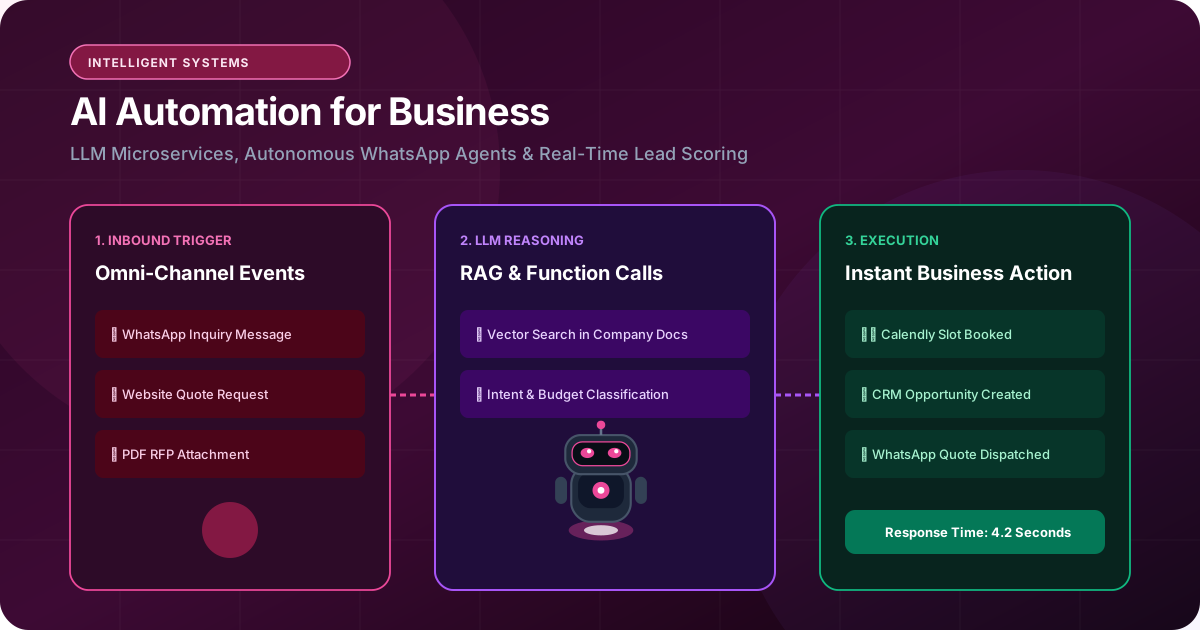
How AI Automation Can Transform a Business Website and Web Application
Discover how AI automation transforms static websites into intelligent business engines. Learn how to deploy AI lead triage, WhatsApp Business bots, and LLM workflows.
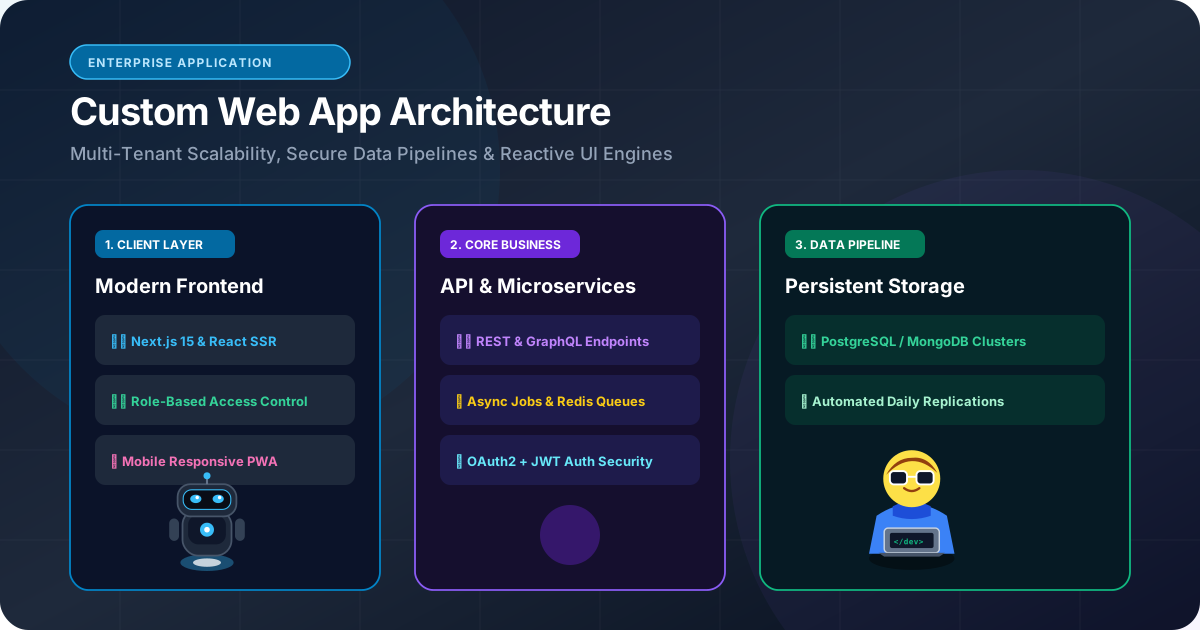
Custom Web Application Development: When Should a Business Build a Custom Web App?
When should a business build custom web applications instead of subscribing to SaaS? Learn how custom portals, wholesale dashboards, and bespoke workflows deliver compounding ROI.