
How AI Automation Can Transform a Business Website and Web Application
A founder's blueprint for integrating LLM agents, automated lead triage, WhatsApp bots, and intelligent workflows into digital platforms.

- 1. Moving Beyond Generic Chatbots: Real Business AI
- 2. The 4 High-Impact AI Automations for Web Platforms
- 3. Official WhatsApp Cloud API & Instant Lead Triage
- 4. Retrieval-Augmented Generation (RAG) on Private Company Data
- 5. Generic Chatbot vs Custom AI Agent Architecture
- 6. Dangerous Mistakes When Deploying Business AI
- 7. The 5-Step AI Automation Implementation Roadmap
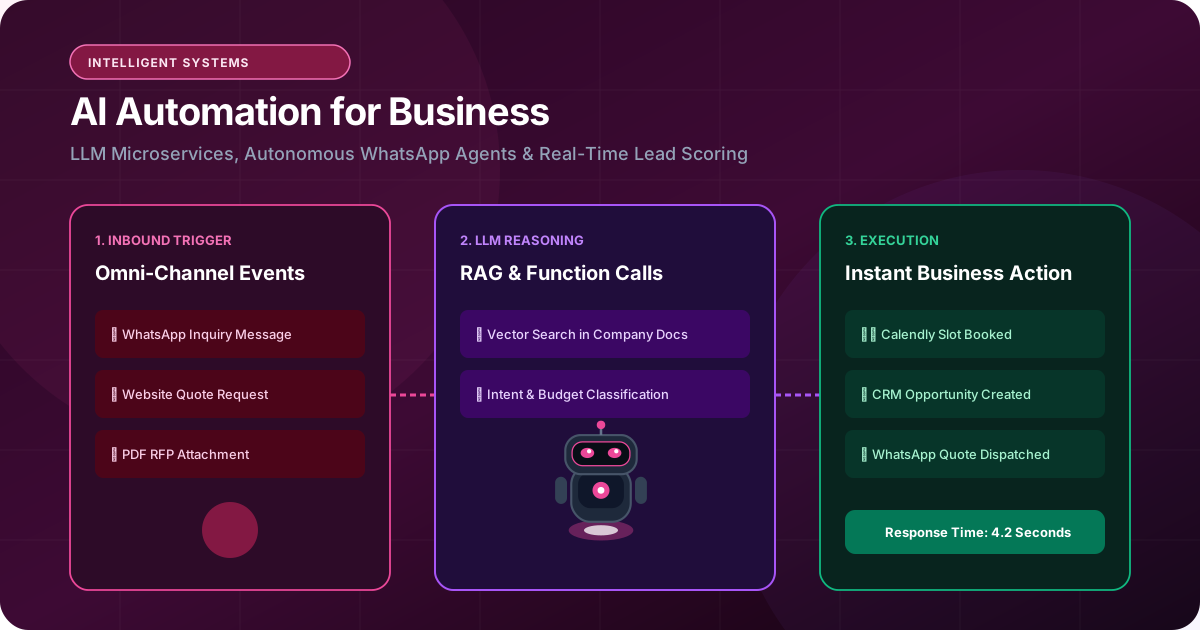
Over the past three years, artificial intelligence has transitioned from an experimental research curiosity into a practical commercial weapon. Yet, when most business owners think of AI on a website, they envision annoying, generic chat widgets that pop up in the corner, spit out canned unhelpful answers, and frustrate visitors. That is not genuine AI automation. Genuine AI automation for business connects secure language models directly to your company's operational databases, appointment scheduling engines, and communication channels. Instead of forcing prospects to wait 12 hours for an email reply, an intelligent web application can answer detailed pricing questions, verify inventory or service availability, qualify buyer intent, and schedule consultations in under 30 seconds. This guide details how to architect and deploy practical AI workflows that drive real pipeline revenue.
AI automation transforms modern websites from passive digital brochures into proactive business engines. By integrating Large Language Models (LLMs) with private enterprise data, official messaging APIs (like WhatsApp Cloud API), and CRM workflows, businesses can qualify leads in under 30 seconds, parse documents automatically, and operate 24/7 without expanding customer support headcount.
1. Moving Beyond Generic Chatbots: Real Business AI
Why scripted decision-tree bots fail and context-aware LLMs succeed
For a decade, website chatbots operated on rigid if/then decision trees. If a user asked a question phrased slightly differently from the programmed script, the bot responded with: 'Sorry, I did not understand that. Please email support@company.com.' Visitors quickly learned to close those widgets immediately.
Modern AI automation leverages Large Language Models (such as OpenAI's GPT-4o, Google Gemini 1.5 Pro, or Anthropic Claude 3.5 Sonnet) combined with Retrieval-Augmented Generation (RAG).
These models do not simply regurgitate canned lines; they comprehend semantic intent, recognize customer urgency, extract structured entities (such as dates, budgets, and project specifications), and formulate natural, accurate responses grounded strictly in your proprietary company documentation.
2. The 4 High-Impact AI Automations for Web Platforms
Where AI integration delivers immediate, measurable return on investment
When integrating AI into custom web application development, four operational use cases consistently generate the highest ROI:
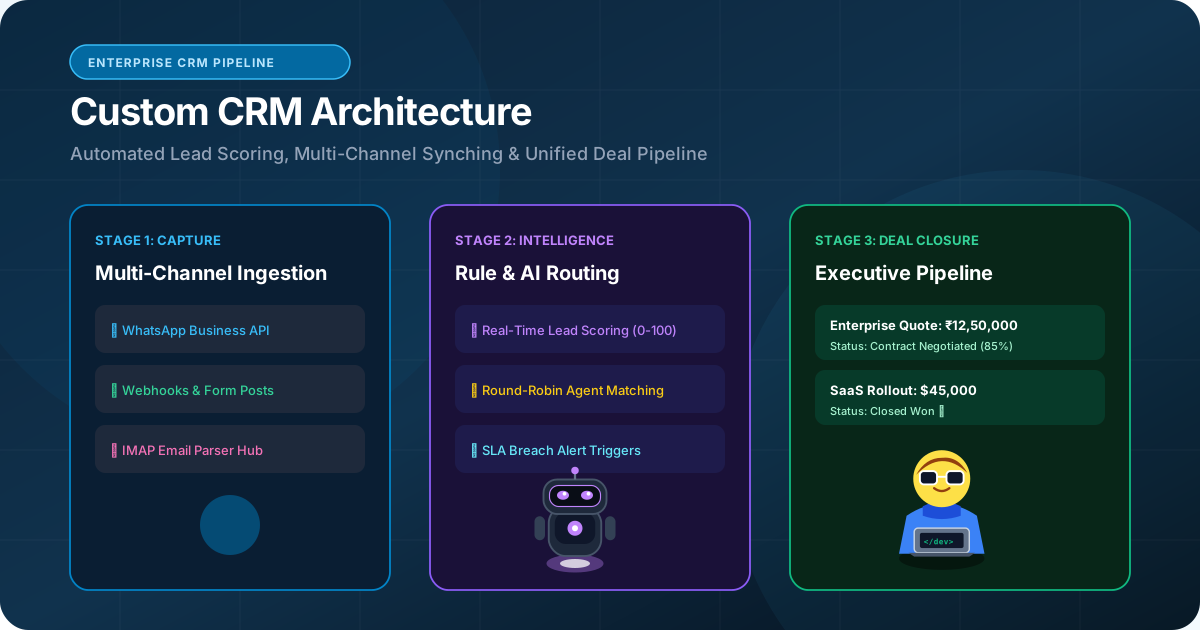
• Instantaneous Lead Qualification & Intent Scoring: When a visitor submits an inquiry or enters an interactive conversation, an AI microservice evaluates their industry, company size, urgency, and budget. High-intent commercial leads are instantly flagged with priority routing directly to executive sales reps.
• Automated Document Ingestion & RFP Parsing: In industries like commercial insurance, manufacturing, and legal services, prospective clients frequently upload dense PDF specifications or RFP documents. An AI pipeline can extract key parameters, populate database fields, and generate an executive summary in seconds.
• Intelligent Multi-Lingual Customer Support: Operating seamlessly across global English-speaking markets (US, UK, Canada) and regional languages in India, answering complex technical questions 24/7 without hiring round-the-clock support shifts.
• Dynamic Workflow Automation: Triggering backend actions—such as generating a customized quote PDF, syncing contact data to HubSpot via API integration, and booking an appointment on Google Calendar—entirely through natural conversation.
3. Official WhatsApp Cloud API & Instant Lead Triage
Capitalizing on conversational commerce across India and international markets
In markets like India and growing international business corridors, email is increasingly viewed as slow, while WhatsApp is immediate.
At RankVRA, one of our most successful engineering deployments is connecting business web applications directly to Meta's official WhatsApp Business Cloud API.
Here is the high-converting user journey we engineer:
1. A commercial prospect lands on your high-speed Next.js web application and clicks 'Chat with our Engineering Desk' or submits an inquiry.
2. Within 15 seconds, your official verified WhatsApp agent initiates an intelligent conversation: 'Hi Sarah, thank you for reaching out regarding custom portal development for your team. Are you looking to launch an MVP or replace an existing legacy system?'
3. The prospect replies naturally on their phone. The AI agent gathers their timeline, user count, and technical preferences.
4. The AI logs the complete transcript into your CRM, updates lead status to 'Highly Qualified', and sends an immediate SMS/Slack alert to your sales director with a 1-click phone connection link.
This workflow routinely increases lead-to-consultation conversion rates by 4x to 7x compared to static contact forms.
4. Retrieval-Augmented Generation (RAG) on Private Company Data
Eliminating AI hallucinations by anchoring answers to verified corporate documentation
The #1 concern business leaders express about deploying AI is hallucination—what if the AI invents fake pricing, makes unrealistic promises, or misquotes legal warranties?
Professional full-stack AI development solves this completely through Retrieval-Augmented Generation (RAG):
• Knowledge Base Ingestion: Your company's verified documentation (product catalogs, pricing guidelines, service agreements, case studies) is chunked, converted into high-dimensional vector embeddings, and stored in a specialized vector database (such as PostgreSQL with pgvector or Pinecone).
• Semantic Vector Search: When a user asks a question, the application first searches your private database to retrieve the top 3 most relevant factual paragraphs.
• Grounded Context Injection: The application constructs a secure system prompt: 'You are an authoritative representative of Company X. Answer the user's question using ONLY the following verified context. If the answer is not explicitly stated in the context, politely state that a senior specialist will follow up.'
This architecture ensures 100% factual fidelity while preserving the fluent, natural conversational capabilities of modern LLMs.
5. Generic Chatbot vs Custom AI Agent Architecture
Understanding the technological gap between superficial widgets and integrated AI
The table below contrasts standard low-end chatbot scripts with enterprise-grade custom AI automation:
| Feature / Dimension | Generic Third-Party Chatbot | Custom AI Agent (RankVRA) |
|---|---|---|
| Underlying Technology | Rigid If/Then Decision Trees | State-of-the-Art LLM (GPT-4o / Claude / Gemini) + RAG |
| Knowledge Grounding | Generic Static Answers | Private Vector DB (pgvector) of Your Exact Business Docs |
| CRM & Database Integration | Basic Email Notification Only | Two-Way Bidirectional API Sync with HubSpot / Salesforce |
| Messaging Channel Reach | Restricted to Small Browser Pop-Up | Omnichannel: Browser, WhatsApp Cloud API, SMS |
| Data Privacy & Security | Shared Vendor Servers | Zero-Data-Retention Enterprise Cloud Pipelines |
| Lead Conversion Impact | Marginal (<2% Form Completion) | Compounding (Sub-30s Response, 4x Higher Conversion) |
6. Dangerous Mistakes When Deploying Business AI
Avoid these operational traps that alienate customers and expose data
To safeguard your brand reputation, avoid these common deployment errors:
• Deploying Without Human Fallback: Never build an AI conversational flow without an effortless 'Speak to a Human' escape hatch. If a customer expresses frustration, the system should immediately transfer the chat to a live rep.
• Exposing Unsanitized API Keys: Never call AI model endpoints directly from client-side React code. API keys must always be sequestered inside a secure backend development environment to prevent theft and unauthorized billing charges.
• Ignoring Data Privacy Regulations: Ensure your AI provider agreements include zero-data-retention clauses so customer conversations are never used to train public foundation models.
7. The 5-Step AI Automation Implementation Roadmap
How RankVRA engineers custom AI workflows from audit to production
At RankVRA, we implement business AI through a proven 5-stage deployment methodology:
1. Workflow & Bottleneck Audit: Identifying the exact repetitive operational tasks (lead qualification, support triage, document review) consuming the most employee hours.
2. Knowledge Base Structuring: Cleaning, formatting, and indexing your product catalogs, FAQs, and service guidelines into a secure vector database.
3. Microservice & API Engineering: Developing lightweight, high-speed Python (FastAPI) or Node.js serverless functions to orchestrate model calls, embeddings, and prompt guardrails.
4. Omnichannel User Interface Integration: Embedding the conversational interface into your Next.js web application and binding it to Meta's WhatsApp Cloud API.
5. Telemetry & Continuous Evaluation: Monitoring conversation quality, latency, user satisfaction scores, and conversion hand-offs in real time.
The Bottom Line & Next Steps
AI automation is not about replacing human relationship-building; it is about eliminating operational latency. By deploying intelligent, context-aware AI agents on your website and messaging channels, you ensure that every prospective client receives an instantaneous, authoritative, and frictionless response the moment their buying intent is highest. If your business is ready to explore custom AI workflows and WhatsApp automation, discuss your project with RankVRA today.
Questions Business Leaders Ask About AI automation for business
How much does it cost to implement custom AI automation for a business?▾
Costs depend on workflow complexity. A streamlined AI lead triage agent with WhatsApp Business Cloud API integration typically ranges from $3,000 to $7,000 in one-time engineering, plus modest ongoing API compute costs (often under $50 to $150 per month based on conversation volume).
Can an AI agent hallucinate and give our customers wrong pricing?▾
Not when architected properly with Retrieval-Augmented Generation (RAG) and strict system guardrails. We configure the model to source answers strictly from verified database records and mandate a human hand-off whenever an inquiry falls outside approved parameters.
Do our team members need coding skills to update the AI's knowledge base?▾
No. We build intuitive admin dashboards where non-technical staff can upload updated PDF brochures, adjust pricing matrices, or add new FAQ answers in seconds with automated re-indexing.

Written by Naveen Panchal
AuthorFounder & Lead Technical Architect, RankVRA
Naveen Panchal is the Founder and Technical Director of RankVRA. He specializes in full-stack web engineering, Next.js architecture, and high-performance digital systems for clients across the US, UK, Canada, and India.
Explore Core Commercial Capabilities
WhatsApp Business API & custom AI workflow engineering
Custom portals and operational business software
Connect CRMs, payment gateways & third-party tools
Scalable Python (FastAPI) & Node.js server architectures
Modern React & Next.js user interfaces
- Meta for Developers: Meta WhatsApp Business Cloud API DocumentationOfficial Reference
- OpenAI: OpenAI Platform & Retrieval DocumentationOfficial Reference
- OWASP Foundation: OWASP Top 10 for Large Language Model ApplicationsOfficial Reference
Discuss an AI Automation Project
Ready to deploy intelligent lead triage, WhatsApp conversational agents, and automated workflows on your web platform? Consult directly with RankVRA to architect an enterprise-grade AI solution.
Related Growth Blueprints
Explore more strategic articles from the RankVRA engineering desk.
How API Integration Can Connect Your Website With Business Tools
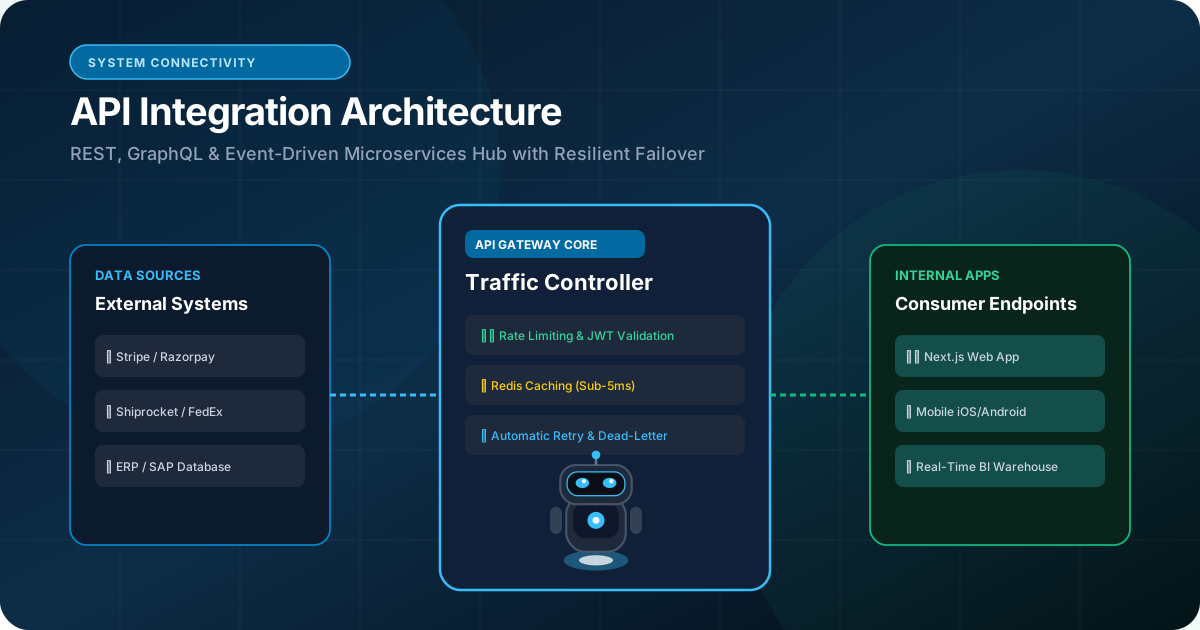
Discover how website API integration eliminates manual data entry, automates lead hand-offs, syncs payments, and connects your web application to enterprise tools.
Custom Web Application Development: When Should a Business Build a Custom Web App?
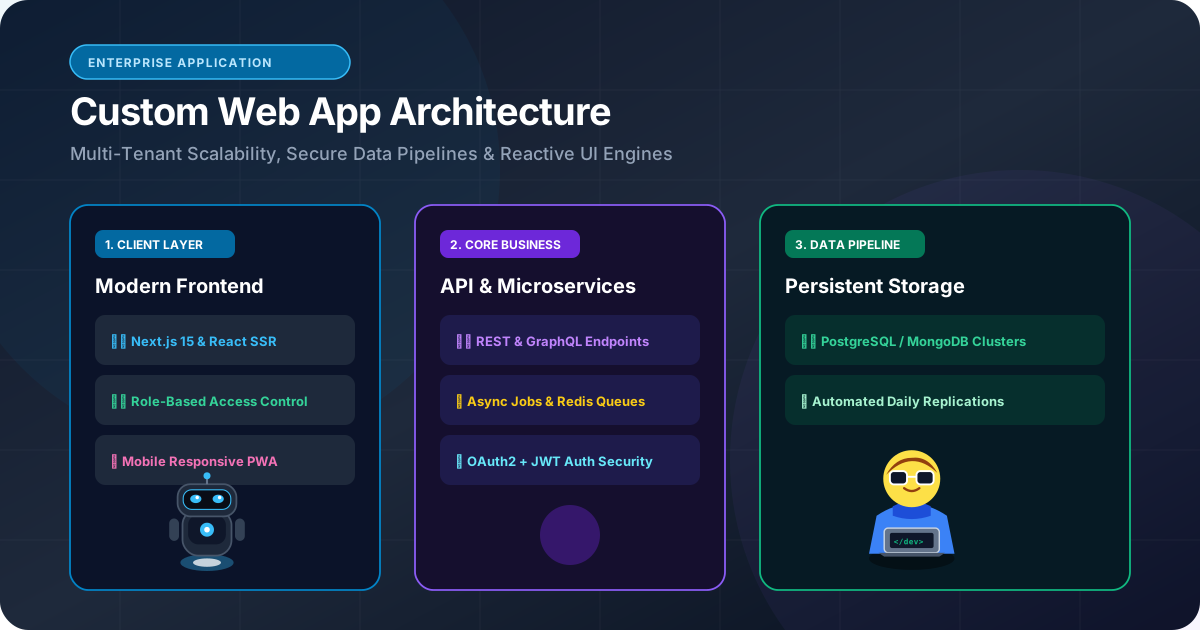
When should a business build custom web applications instead of subscribing to SaaS? Learn how custom portals, wholesale dashboards, and bespoke workflows deliver compounding ROI.
What Is Backend Development and Why Is It Important for Modern Web Applications?
Demystify backend development. Discover how server architectures, relational databases, Node.js, Python, and OWASP security protect and scale business web applications.