
What Is SaaS Development? A Complete Guide to Building a SaaS Web Application
A founder's roadmap to multi-tenant database architecture, Stripe subscription billing, user onboarding, and technical scalability.

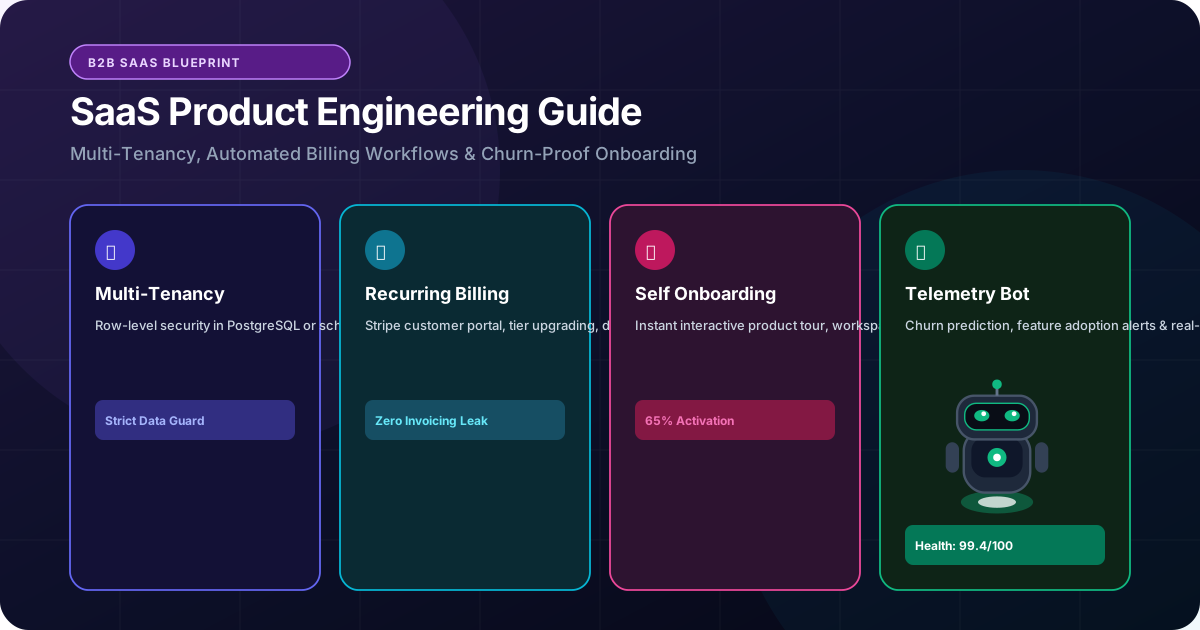
- 1. What Distinguishes SaaS Development from Standard Web Apps
- 2. The Multi-Tenancy Architecture Dilemma: Shared vs Isolated
- 3. The 5 Core Pillars of a Production SaaS Platform
- 4. Engineering the Subscription & Billing Engine
- 5. Multi-Tenant Database Architecture Comparison
- 6. The 4-Stage SaaS MVP Development Playbook
- 7. The Enterprise SaaS Technical Launch Checklist
Building a Software-as-a-Service (SaaS) product is widely recognized as one of the most profitable business models in the global digital economy. High gross margins, predictable Monthly Recurring Revenue (MRR), negative churn potential, and immense valuation multiples make SaaS the holy grail for founders and corporate innovators. However, building a commercial SaaS product is vastly more demanding than building a bespoke internal company tool. A SaaS web application must serve thousands of separate organizations concurrently, strictly isolate sensitive tenant data, automate subscription billing and prorations, support multi-tiered role permissions, and maintain 99.9% uptime. This comprehensive guide outlines the architectural foundations and development lifecycle required to build a scalable, enterprise-ready SaaS web application.
SaaS (Software-as-a-Service) development is the engineering discipline of building cloud-hosted web applications that serve multiple independent business customers (tenants) from a single shared software infrastructure, monetized through recurring subscription tiers and automated self-service billing.
1. What Distinguishes SaaS Development from Standard Web Apps
The unique engineering challenges of multi-tenant subscription software
In a custom single-tenant application, all database tables belong to one organization. If a query forgets to filter by company ID, no data leak occurs because there is only one company.
In SaaS development, your platform operates as a shared apartment complex: thousands of independent corporate tenants live inside the same software building.
Every single database read, update, background job, and API endpoint must enforce strict tenant boundaries. If Tenant A can ever see a single document or invoice belonging to Tenant B, your company faces catastrophic liability and immediate commercial collapse.
SaaS engineering is the discipline of architecting bulletproof tenant isolation, automated self-service onboarding, and recurring financial billing on a scalable cloud foundation.
2. The Multi-Tenancy Architecture Dilemma: Shared vs Isolated
Comparing the three primary multi-tenant database models
When architecting a SaaS platform, technical leaders must choose between three database isolation strategies:
1. Database-Per-Tenant: Every customer receives a physically separate database instance. This provides maximum security isolation and simple per-customer backups, but causes high infrastructure costs and complex schema migrations across hundreds of databases.
2. Schema-Per-Tenant: A single database instance with separate PostgreSQL schemas for each tenant. A viable middle ground for enterprise B2B SaaS, though connection pooling and migration management require senior DevOps tooling.
3. Shared Database with Row-Level Security (RLS): All tenants share the same database tables, with every row containing a mandatory tenant_id foreign key. Using PostgreSQL native Row-Level Security (RLS), the database engine automatically restricts queries to only rows matching the authenticated tenant's ID.
Model #3 is the modern industry standard for 90% of B2B SaaS applications, delivering optimal cost efficiency, simple global analytics, and instant tenant provisioning.
3. The 5 Core Pillars of a Production SaaS Platform
Essential software subsystems required before launching to paying subscribers
Beyond your proprietary core features, every production SaaS platform requires five foundational subsystems:
• Self-Service Tenant Onboarding: A frictionless registration flow where new users can sign up, create an organization workspace, invite team members, and configure initial preferences in under 3 minutes.
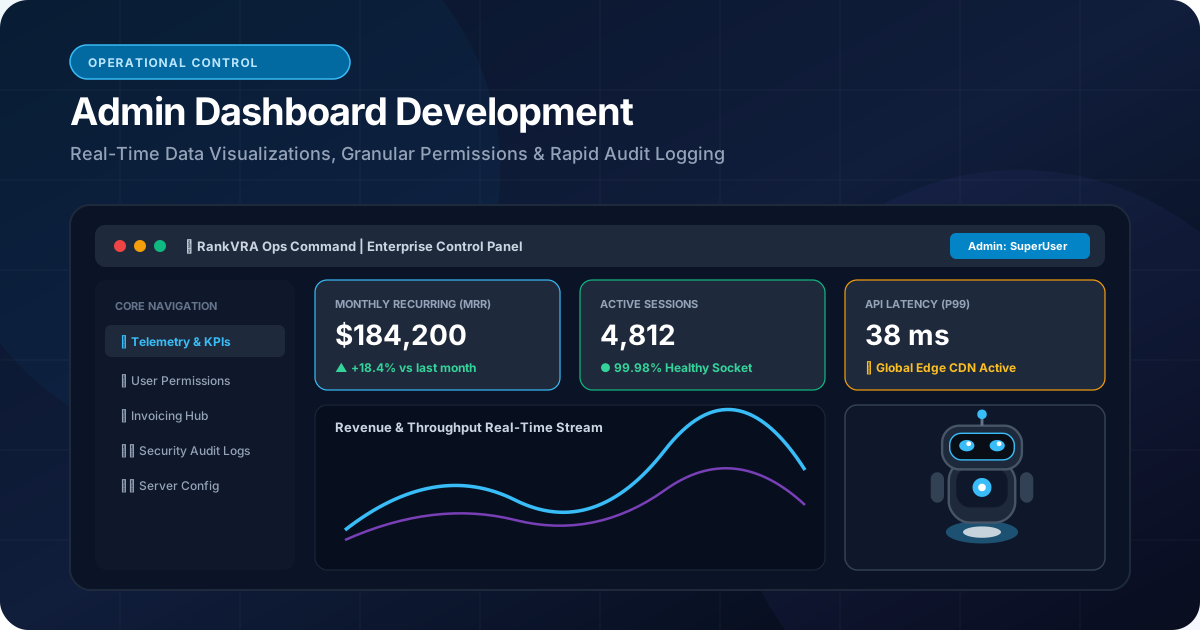
• Role-Based Access Control (RBAC): A granular permissions matrix supporting Organization Owners, Admins, Standard Users, and Read-Only Auditors.
• Automated Subscription Billing (Stripe Billing): Managing monthly/annual billing cycles, credit card vaults, automated invoice generation, and tier upgrade prorations.
• Audit Logging & Activity Feeds: Recording immutable, timestamped logs of every significant operational action (user invites, permission changes, data exports) for enterprise compliance.
• Usage Metering & Tier Enforcement: Automatically tracking usage limits (e.g., number of active projects, API calls, or team seats) and triggering upgrade prompts when limits are reached.
4. Engineering the Subscription & Billing Engine
Integrating Stripe Billing for frictionless recurring revenue
Building a subscription billing engine from scratch is an anti-pattern. Enterprise SaaS development integrates with dedicated engines like Stripe Billing via API integration:
• Webhook Event Orchestration: Listening for critical Stripe webhook events: invoice.payment_succeeded (extends tenant subscription access), customer.subscription.updated (adjusts feature tier), and invoice.payment_failed (triggers dunning emails).
• Customer Self-Service Portal: Redirecting users to Stripe's hosted Customer Portal where they can securely update payment methods, download historical PDF tax invoices, or cancel subscriptions without requiring developer intervention.
• Dunning & Churn Prevention: Automatically retrying failed card payments over a 7-day schedule with automated warning banners inside the web app before downgrading tenant access.
5. Multi-Tenant Database Architecture Comparison
Evaluating operational trade-offs across multi-tenant models
The table below contrasts the three primary multi-tenant architectural patterns:
| Architecture Pattern | Infrastructure Cost | Security Isolation | Schema Migration Complexity | Best Suited For |
|---|---|---|---|---|
| Shared DB + Row-Level Security (RLS) | Lowest (Shared Cloud DB) | High (Database Engine Enforced RLS) | Simple (Single migration run) | High-Growth B2B SaaS, Startups, Mid-Market |
| Schema-Per-Tenant | Moderate | Very High (Schema separation) | Moderate (Loop over all schemas) | Regulated B2B Software with strict compliance |
| Database-Per-Tenant | Highest (Dedicated DB instances) | Absolute Maximum (Physical separation) | High (Manage hundreds of DB instances) | High-Ticket Enterprise Contracts ($50k+/year/tenant) |
6. The 4-Stage SaaS MVP Development Playbook
How to launch a validated product in 10 to 14 weeks without over-engineering
At RankVRA, we guide SaaS founders through a disciplined four-stage development playbook:
Stage 1: Core Problem & Workflow Blueprinting (Weeks 1–2): Identifying the single core operational workflow that solves acute customer pain. Designing normalized database schemas and user journey wireframes.
Stage 2: Foundation & Authentication (Weeks 3–5): Setting up Next.js App Router, PostgreSQL database with Row-Level Security, multi-tenant workspace isolation, and team invite mechanisms.
Stage 3: Core Feature Engineering & Billing (Weeks 6–10): Building the primary proprietary tool, integrating Stripe subscription tiers, and implementing usage-limit enforcement.
Stage 4: Security Hardening, QA & Deployment (Weeks 11–12): Conducting automated end-to-end testing, OWASP vulnerability hardening, setting up Sentry error monitoring, and launching to initial beta customers.
7. The Enterprise SaaS Technical Launch Checklist
Non-negotiable architectural requirements before onboarding paying subscribers
Ensure your SaaS development partner addresses each of these technical requirements:
• Bulletproof Tenant Isolation: Have automated integration tests verified that queries from Organization A can never return data from Organization B?
• Automated Daily Database Backups: Are point-in-time recovery (PITR) backups automated across multi-region cloud storage?
• Resilient Webhook Processing: Are Stripe billing webhooks verified with HMAC SHA-256 signatures and processed through an asynchronous queue?
• Custom Subdomain Mapping: Does the application support tenant vanity URLs (e.g., acme.yourplatform.com)?
• Zero-Downtime Deployment: Are Next.js updates and database migrations deployed continuously via automated CI/CD pipelines without interrupting active user sessions?
• Responsive Mobile Dashboard: Is the SaaS interface fully responsive across smartphone viewports for executives managing tasks on the go?
The Bottom Line & Next Steps
SaaS development represents the pinnacle of modern software engineering: a harmonious combination of multi-tenant database isolation, sub-second user experience, automated financial mechanics, and scalable cloud infrastructure. When built on proven foundations—Next.js, TypeScript, PostgreSQL, and Stripe—your SaaS platform becomes an enduring, highly scalable digital asset capable of generating compounding monthly recurring revenue. If you are ready to architect and build a commercial SaaS application, discuss your product vision with RankVRA today.
Questions Business Leaders Ask About SaaS development
How much does it cost to build a SaaS MVP web application?▾
A focused B2B SaaS MVP—including multi-tenant authentication, workspace management, core proprietary workflow tool, Stripe billing integration, and admin portal—typically requires an investment of $25,000 to $50,000 across a 10 to 14 week engineering lifecycle.
Can an existing single-tenant web application be converted into a multi-tenant SaaS?▾
Yes. Refactoring involves adding tenant_id foreign keys across all database tables, implementing PostgreSQL Row-Level Security (RLS), restructuring authentication middleware, and adding workspace switcher UI components.
What tech stack is best for building a modern SaaS application?▾
The modern gold standard is Next.js (App Router with TypeScript) for the full-stack frontend and server actions, PostgreSQL (with Supabase or AWS RDS) for relational multi-tenant persistence, Redis for caching and queues, and Stripe for automated subscription billing.

Written by Naveen Panchal
AuthorFounder & Lead Technical Architect, RankVRA
Naveen Panchal is the Founder and Technical Director of RankVRA. He specializes in full-stack web engineering, Next.js architecture, and high-performance digital systems for clients across the US, UK, Canada, and India.
Explore Core Commercial Capabilities
Multi-tenant software-as-a-service platforms
Bespoke business portals & operational software
Unified client-to-database engineering
Node.js, Python & scalable database architecture
Zero-trust session security & vulnerability defense
- Amazon Web Services: AWS Multi-Tenant SaaS Architecture Best PracticesOfficial Reference
- Stripe Developer Platform: Stripe Billing: SaaS Subscription Modeling GuideOfficial Reference
- PostgreSQL Global Development Group: PostgreSQL Row Level Security (RLS) DocumentationOfficial Reference
Discuss Your SaaS Product
Ready to turn your software vision into a recurring revenue engine? Consult directly with RankVRA Founder & Lead Technical Architect Naveen Panchal to design your multi-tenant architecture and roadmap your SaaS MVP.
Related Growth Blueprints
Explore more strategic articles from the RankVRA engineering desk.
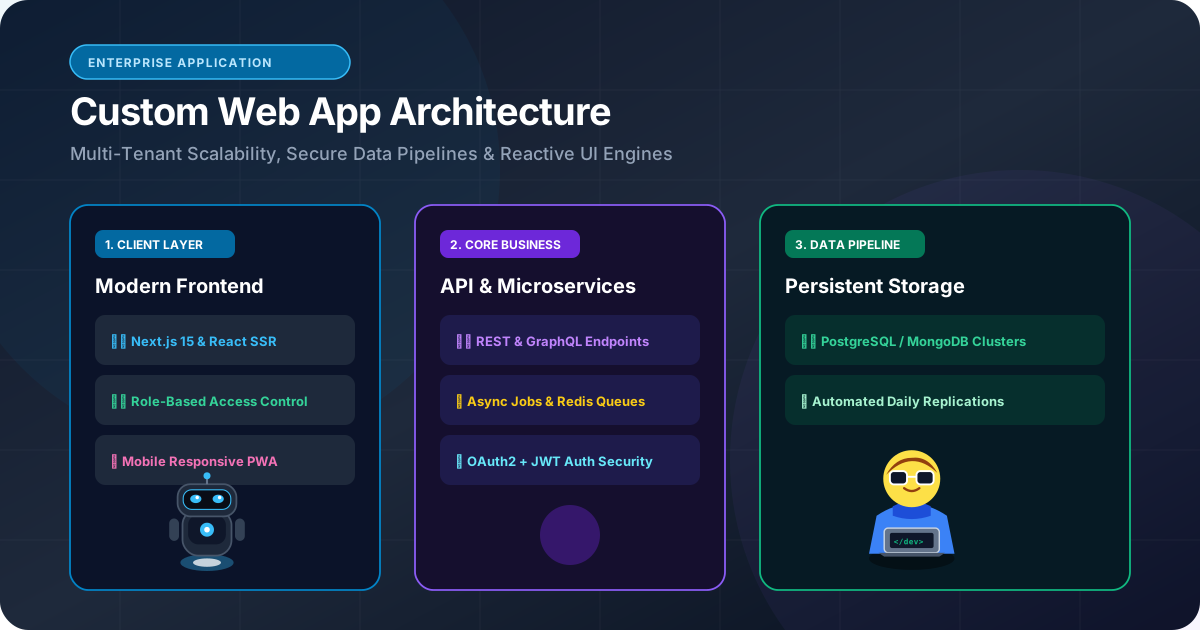
Custom Web Application Development: When Should a Business Build a Custom Web App?
When should a business build custom web applications instead of subscribing to SaaS? Learn how custom portals, wholesale dashboards, and bespoke workflows deliver compounding ROI.
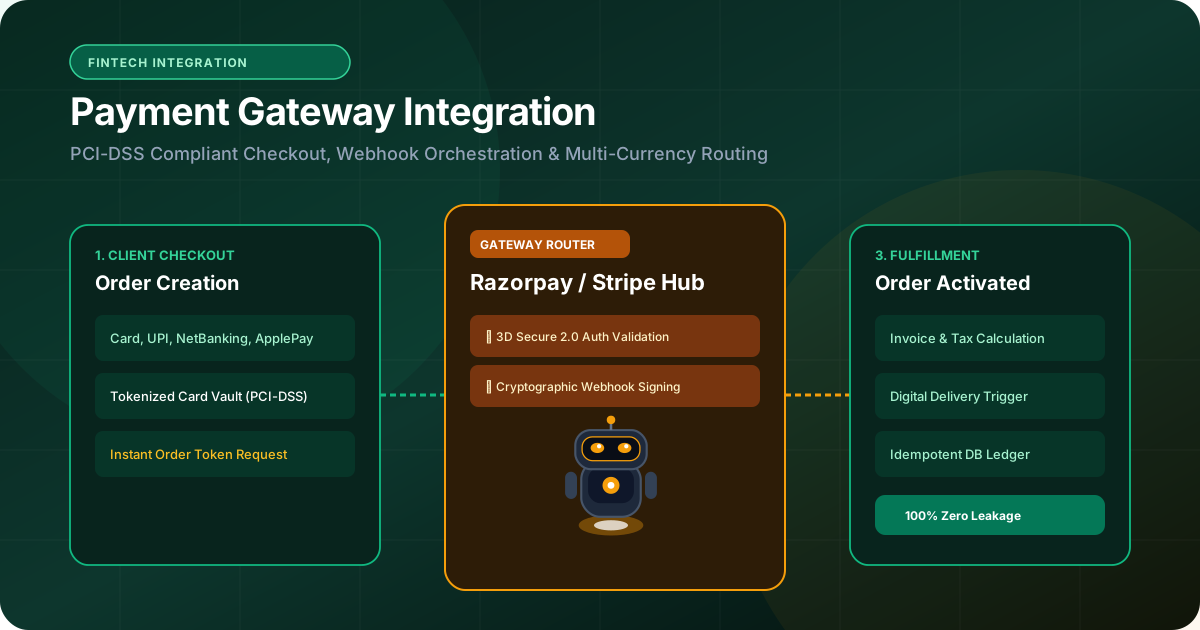
How to Integrate Payment Gateways Into a Website or Web Application
Learn how to integrate payment gateways securely. Master Stripe, Razorpay, webhook verification, recurring billing, and PCI compliance for websites and web apps.
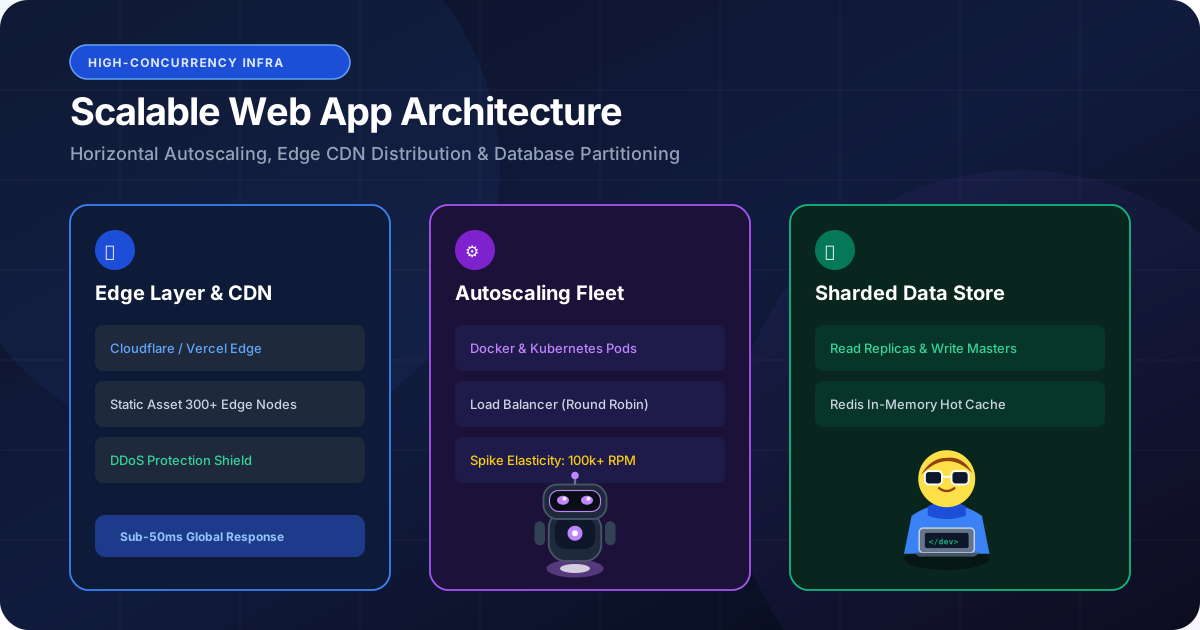
How to Build a Scalable Web Application for a Growing Business
Learn how to architect scalable web applications. Discover proven strategies for horizontal scaling, database read replicas, Redis caching, and zero-downtime growth.