
Local SEO Guide: How to Get Your Business Found on Google Maps & Search
The definitive playbook for dominating the Google Maps 3-Pack, mastering Google Business Profile, and driving verified local customer inquiries.

- 1. What Is Local SEO and Why Does It Matter?
- 2. Google Business Profile Optimization (The Core Asset)
- 3. NAP Consistency & Local Directory Citations
- 4. Review Velocity & Customer Feedback Strategy
- 5. Geo-Targeted Keywords & Multi-Location Page Architecture
- 6. LocalBusiness Schema & Technical Geo-Signals
- 7. Common Local SEO Mistakes That Destroy Visibility
- 8. The Practical Local SEO Implementation Checklist
When local customers need an urgent service—whether it is a specialized medical clinic, an industrial machinery repair specialist, a boutique luxury hotel, or an emergency commercial contractor—their first action is pulling out a smartphone and searching Google. The businesses that appear in the coveted Google Maps 3-Pack capture over 60% of all mobile clicks and phone inquiries. If your company is buried beneath competitors on Google Maps or missing from local search results, you are leaking high-value foot traffic and qualified phone calls daily. Local SEO is not about broad vanity traffic; it is about capturing prospective buyers within your exact geographic radius at the exact moment they are ready to transact. This actionable guide provides the complete blueprint to dominate local search rankings and scale your regional revenue.
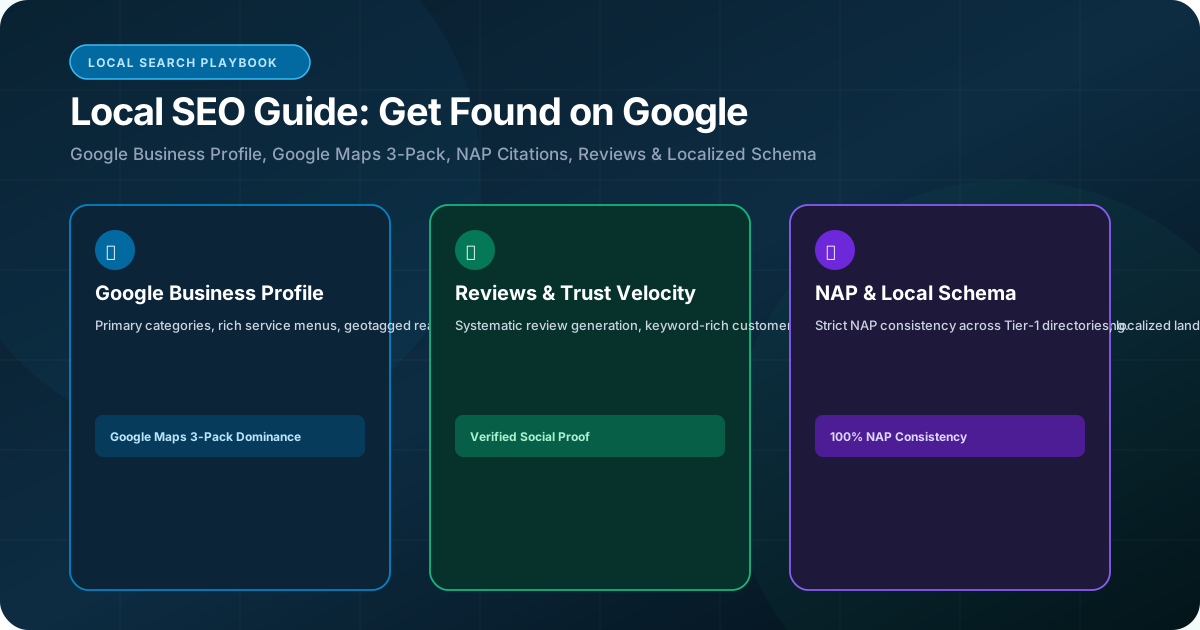
Local SEO is the specialized optimization practice of increasing search visibility for businesses serving a specific geographic market. Winning in local search requires optimizing your Google Business Profile (accurate primary category, geotagged images, regular posts), maintaining 100% NAP (Name, Address, Phone) consistency across Tier-1 directories, generating a steady velocity of detailed customer reviews, and deploying localized Schema.org structured data on your website.
1. What Is Local SEO and Why Does It Matter?
How Google calculates proximity, prominence, and relevance
Local SEO is the strategic discipline of optimizing a business's online presence to earn visibility for queries with localized commercial intent (e.g., 'commercial HVAC contractor near me' or 'boutique heritage hotel in Udaipur').
Unlike traditional organic search algorithms that evaluate global authority, Google's local search algorithm weighs three primary criteria: Proximity (how physically close the business is to the searcher or specified geo-location), Relevance (how well the business's profile and website match the search query), and Prominence (the business's overall brand reputation, review volume, directory citations, and backlink strength).
Winning local search visibility places your business directly into the Google Maps Local 3-Pack—the prominent visual map box displayed at the very top of Google's search results page, positioned above standard organic listings.
2. Google Business Profile Optimization (The Core Asset)
Transforming your Google Business Profile into a lead-generating magnet
Your Google Business Profile (GBP, formerly Google My Business) is the absolute foundation of local search engine performance. An incomplete or unverified profile immediately caps your ranking potential on Google Maps.
Begin by selecting the single most accurate Primary Category for your business. The primary category carries the heaviest algorithmic weight in Google Maps ranking calculations. Supplement this with secondary categories that accurately reflect your peripheral service offerings.
Fill out every available profile field with rigorous detail: business hours, physical address, service areas, direct phone number, website URL, appointment links, and accessibility attributes. Upload high-resolution interior, exterior, team, and work-in-progress photos on a weekly basis, as profiles with frequent authentic photos receive significantly more direction requests and phone calls.
Adding unsolicited keywords to your official business name in Google Business Profile (e.g., 'Apex Legal - Best Divorce Lawyer in Chicago') violates Google's official guidelines and can trigger an immediate profile suspension. Use your genuine, registered legal business name.
3. NAP Consistency & Local Directory Citations
Establishing unbreakable trust signals across the local web
NAP stands for Name, Address, and Phone number. Google verifies your business's physical legitimacy by cross-referencing your NAP data across hundreds of independent web directories, mapping services, and local data aggregators.
Inconsistencies confuse search algorithms. If your address is listed as 'Suite 400' on your website, 'Ste 400' on Yelp, and an outdated old office address on Facebook, Google reduces its algorithmic confidence in your business's true location, dragging down your Maps rankings.
Audit your business citations across primary data aggregators (Data Axle, Neustar Localeze) and Tier-1 general directories (Yelp, Bing Places, Apple Maps, YellowPages, Better Business Bureau), as well as prominent regional and industry-specific business registries.
4. Review Velocity & Customer Feedback Strategy
Generating consistent, authentic customer feedback that feeds Google's algorithm
Customer reviews are both a powerful algorithmic ranking factor and the ultimate conversion catalyst. A business with a 4.8-star rating and 150 authentic reviews will consistently outperform a competitor with a 5.0-star rating and only two reviews.
Google evaluates review quantity, review velocity (how steadily new reviews arrive over time), and review sentiment. When satisfied clients mention specific service names and geographic locations in their reviews (e.g., 'RankVRA engineered our custom B2B web application and handled our technical SEO migration seamlessly'), Google parses these semantic keywords to boost your relevance for those specific services.
Establish an automated post-service review request workflow via SMS or email immediately following a successful project completion. Respond professionally to every review—both positive and negative—demonstrating active customer care and operational transparency.
5. Geo-Targeted Keywords & Multi-Location Page Architecture
Designing high-converting localized landing pages for multi-service areas
If your business serves multiple distinct cities or neighborhoods, you must create dedicated, high-quality location landing pages rather than stuffing every town name onto a single homepage.
Each location page must feature genuinely unique, valuable local content: localized case studies, photos of local projects, customer testimonials from that specific area, driving directions, local staff bios, and unique service descriptions. Never duplicate identical copy across 20 location pages and merely swap the city name, as Google's helpful content systems penalize low-effort doorway pages.
Ensure each location page links directly to its corresponding Google Business Profile listing and embeds a responsive Google Map of your physical service area.
6. LocalBusiness Schema & Technical Geo-Signals
Embedding structured data to communicate unambiguous machine-readable geo-data
Structured data (Schema.org JSON-LD) provides search engine spiders with explicit, unambiguous facts about your company's physical operations. Every local business website should implement comprehensive `LocalBusiness` (or specialized subtypes like `MedicalBusiness`, `Hotel`, or `LegalService`) schema markup.
Your JSON-LD structured data graph should define your exact latitude and longitude geo-coordinates, complete postal address, official phone number, operating hours, accepted payment methods, service catalog, and customer review aggregates.
By embedding valid schema markup in the `<head>` of your website, you enable Google to effortlessly verify your NAP information against your Google Business Profile, cementing your local topical and geographic authority.
7. Common Local SEO Mistakes That Destroy Visibility
Avoiding fatal pitfalls that trigger algorithmic penalties or GBP suspensions
Many businesses unknowingly sabotage their local search visibility by employing outdated or prohibited tactics. The most prevalent mistakes include:
Using virtual offices, UPS Store mailboxes, or co-working spaces as physical addresses to game proximity in towns where you have no actual staff or physical operations. Google actively suspends profiles that fail to verify real physical premises.
Failing to monitor and merge duplicate Google Business Profiles. Duplicate listings split review equity and confuse search crawlers.
Neglecting website mobile responsiveness and load speeds. Over 70% of local searches originate on mobile devices; if your mobile site is slow or difficult to navigate, prospective clients click back to Google Maps and call your competitor.
8. The Practical Local SEO Implementation Checklist
A systematic 10-point checklist to audit and optimize your local search footprint
Use this practical checklist to ensure your business covers all foundational requirements for Google Maps and local search dominance.
| Step # | Action Item | Target Component | Status / Requirement |
|---|---|---|---|
| 1 | Claim & Verify Google Business Profile | GBP Dashboard | 100% verified with postcard, phone, or video |
| 2 | Optimize Primary & Secondary Categories | GBP Categories | Select most specific primary category; add 3–5 relevant secondary |
| 3 | Audit NAP Consistency Across Web | Tier-1 Directories | Exact character-for-character match on address & phone |
| 4 | Embed LocalBusiness Schema.org | Website Header | Valid JSON-LD with geo-coordinates, address, and hours |
| 5 | Build Dedicated Local Service Pages | Website Architecture | Unique, localized copy for each primary city served |
| 6 | Implement Review Generation System | Customer Journey | Automated SMS/Email review requests sent post-service |
| 7 | Weekly GBP Photo & Update Posting | GBP Updates | Upload real workplace photos, project wins, and offers |
| 8 | Local Geo-Citations & Press Mentions | Digital PR | Local Chamber of Commerce, trade registries, and news sites |
| 9 | Mobile Optimization & Click-to-Call | UX Engineering | Prominent tap-to-call phone buttons and fast mobile load times |
| 10 | Monitor Search Console & GBP Insights | Analytics | Track phone call triggers, direction requests, and discovery queries |
The Bottom Line & Next Steps
Local SEO is the lifeblood of regional customer acquisition. When your business consistently appears at the top of the Google Maps 3-Pack and localized organic search results, you establish an automated pipeline of inbound phone calls, appointment bookings, and high-value inquiries. At RankVRA, we specialize in comprehensive local search architectures—from Google Business Profile optimization and localized schema engineering to citation cleanup and conversion-focused web development. Explore our local search services today to capture dominant visibility in your market.
Questions Business Leaders Ask About local SEO
How long does it take to rank in the Google Maps 3-Pack?▾
With a fully verified Google Business Profile, accurate categorization, and consistent NAP citations, businesses often see noticeable movement within 4 to 8 weeks. Highly competitive metropolitan markets typically require 3 to 6 months of steady review generation and local link building to secure top positions.
What is the single most important factor for ranking on Google Maps?▾
The primary category selected in your Google Business Profile is the single heaviest algorithmic ranking factor for relevance. This is closely followed by physical proximity to the searcher, review volume and sentiment, and the consistency of your business's NAP citations across the web.
Can I do local SEO if my business does not have a physical storefront?▾
Yes. Google accommodates Service Area Businesses (SABs)—such as plumbers, mobile consultants, or contractors who travel to clients—by allowing you to hide your physical address on your Google Business Profile and define specific geographic service boundaries instead.
Why is NAP consistency so critical for local SEO?▾
NAP consistency establishes trust and algorithmic certainty. When Google observes identical business name, address, and phone number data across hundreds of trusted directories, its confidence in your physical legitimacy increases, directly boosting your local ranking authority.
How many Google reviews do I need to outrank my local competitors?▾
There is no static number; your goal should be to exceed the average review count of the top 3 ranking competitors in your local market while maintaining a higher rating (ideally 4.7+ stars) and demonstrating continuous, steady review velocity.
How do I choose the best local SEO service partner for my business?▾
Look for an agency that provides transparent citation reporting, understands technical schema markup, refuses to use fake addresses or spam reviews, and focuses on driving verified phone calls and booked appointments rather than empty impressions.

Written by Naveen Panchal
AuthorFounder & Lead Technical Architect, RankVRA
Naveen Panchal is the Founder and Technical Director of RankVRA. He specializes in full-stack web engineering, Next.js architecture, and algorithmic search optimization for high-growth enterprises.
Explore Core Commercial Capabilities
- Google Support: Google Business Profile GuidelinesOfficial Reference
- Google Support: Improve Your Local Ranking on GoogleOfficial Reference
- Schema.org: Schema.org LocalBusiness DocumentationOfficial Reference
Ready to Dominate the Google Maps 3-Pack in Your City?
Stop losing local customers to competitors. Let RankVRA's local search specialists optimize your Google Business Profile, audit your citations, and turn local searches into daily inbound phone calls.
Related Growth Blueprints
Explore more strategic articles from the RankVRA engineering desk.
How to Improve Your Google Rankings: A Complete SEO Guide for Businesses
Learn how to improve Google rankings with this complete SEO guide for businesses. Discover proven strategies for technical SEO, content quality, and backlinks.

Technical SEO Checklist: 25 Critical Fixes for Your Website
Use this comprehensive 25-point technical SEO checklist to fix crawl errors, optimize Core Web Vitals, resolve indexation issues, and boost Google rankings.
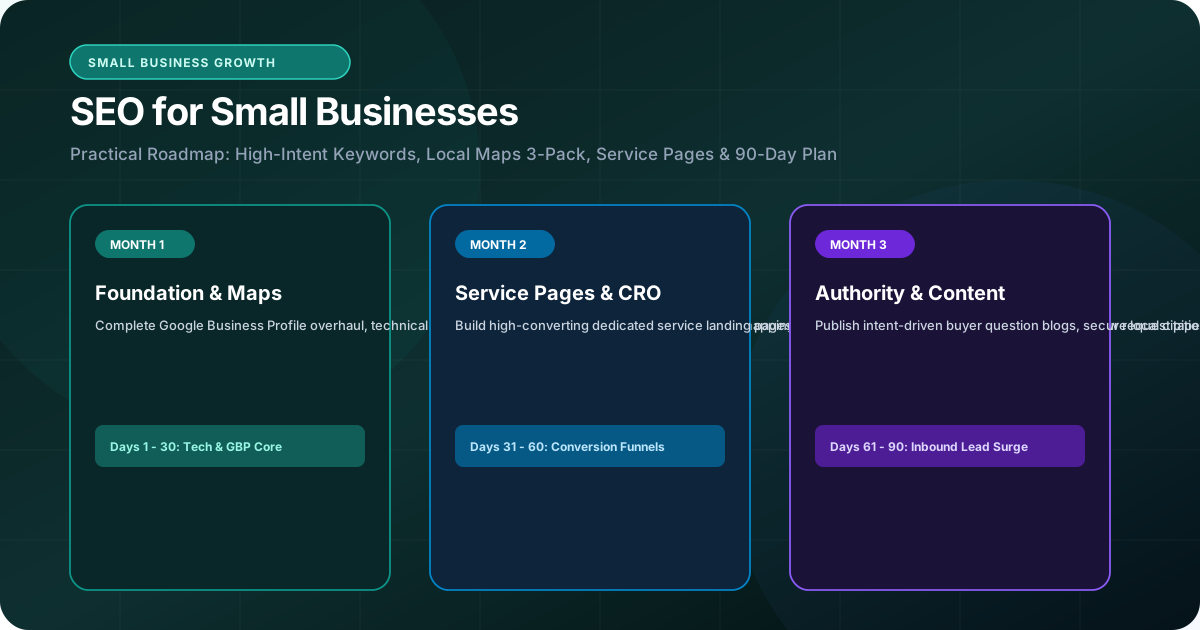
SEO for Small Businesses: A Practical Strategy to Get More Customers from Google
Discover a practical, affordable SEO strategy for small businesses. Follow our 90-day plan to optimize Google Business Profile, rank for local searches, and get leads.
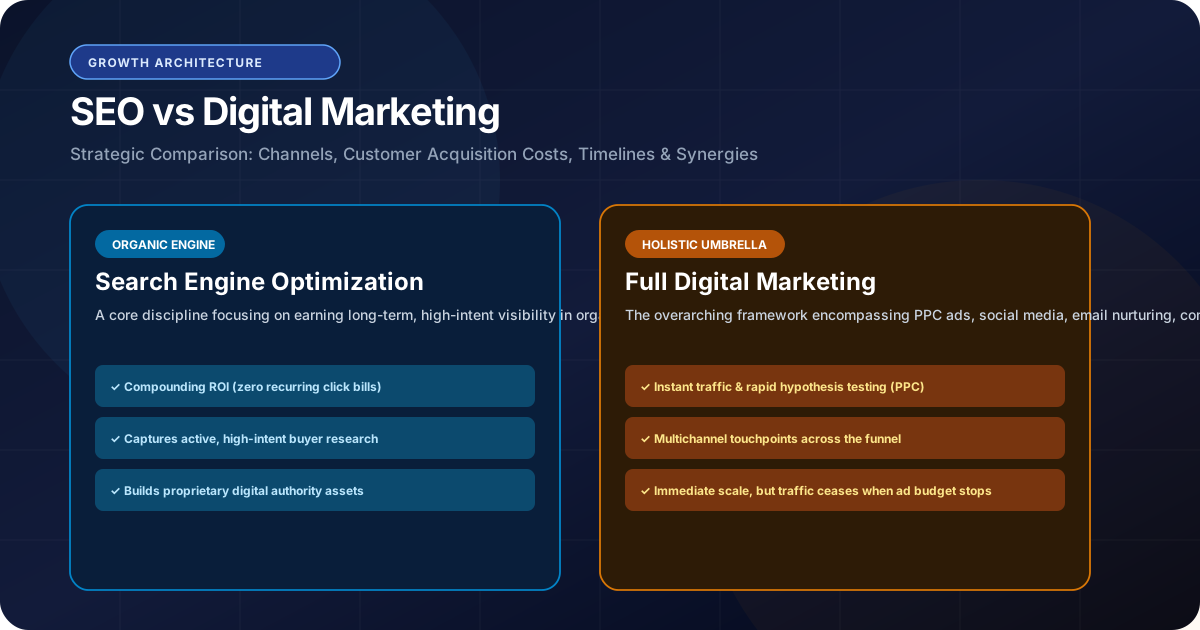
SEO vs Digital Marketing: What's the Difference and Which Does Your Business Need?
Understand SEO vs digital marketing. Learn the differences in cost, timelines, and strategy, and discover which approach drives the highest ROI for your business.