
SEO vs Digital Marketing: What's the Difference and Which Does Your Business Need?
A strategic comparison of channels, customer acquisition costs, compounding ROI, and how to build an integrated marketing growth engine.

- 1. Defining SEO and Digital Marketing: The Core Difference
- 2. SEO vs PPC Paid Advertising: The Compounding Equation
- 3. SEO vs Social Media & Content Marketing
- 4. How SEO Functions Inside an Omnichannel Digital Strategy
- 5. Cost Considerations, Timelines & ROI Comparison
- 6. When Should Your Business Prioritize SEO vs Paid Marketing?
- 7. Building an Integrated Marketing Engine with RankVRA
When business leaders look to expand their online footprint and generate qualified sales leads, they inevitably face a critical strategic dilemma: should they invest their budget into Search Engine Optimization (SEO) or launch a broader digital marketing campaign? Often, these terms are used interchangeably by marketing agencies, creating confusion about deliverables, costs, and expected outcomes. Understanding the distinction between SEO and digital marketing is not merely an academic exercise—it dictates how efficiently you allocate capital, how quickly you generate pipeline revenue, and whether your business builds enduring, proprietary digital assets. This guide deconstructs the mechanisms, costs, and strategic trade-offs of both approaches to help you make an informed decision for your company's growth.
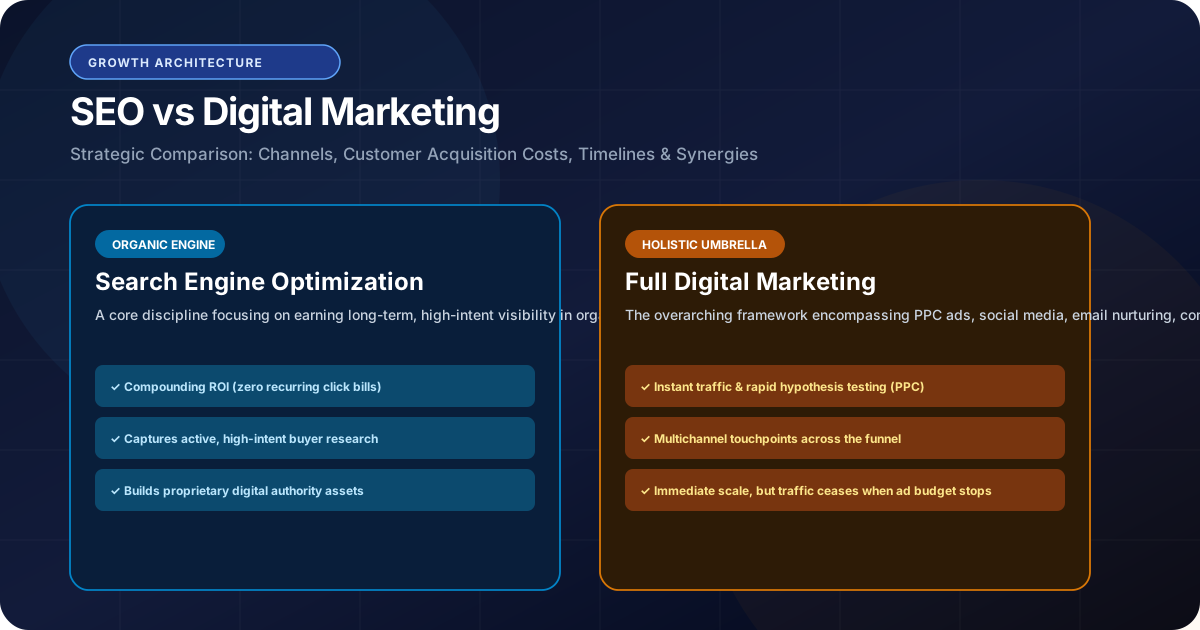
The primary difference between SEO and digital marketing is scope: SEO (Search Engine Optimization) is a specialized channel focused exclusively on earning organic visibility in search engine algorithms, whereas digital marketing is the broad umbrella encompassing all online customer acquisition strategies, including SEO, paid advertising (PPC), social media, email funnels, and content marketing.
1. Defining SEO and Digital Marketing: The Core Difference
A specialized organic discipline versus an overarching acquisition umbrella
To understand the relationship between SEO and digital marketing, think of digital marketing as an entire sports franchise, while SEO is a star specialized player on the team. Digital marketing is the macro-discipline encompassing every tactic, channel, and platform used to attract, engage, and convert customers over the internet.
Search Engine Optimization (SEO), on the other hand, is a focused technical and editorial discipline within digital marketing. Its sole mission is to optimize your web assets so that search engines like Google and Bing index, rank, and present your pages at the top of organic search results for commercial, high-intent queries.
While digital marketing covers paid channels (Google Ads, Meta Ads), outbound email campaigns, influencer sponsorships, and social media management, SEO focuses exclusively on earned organic search equity. You do not pay Google when a prospective buyer clicks your organic search result.
All SEO is digital marketing, but not all digital marketing is SEO. Investing in digital marketing without SEO is like building a retail store without a street entrance; investing in SEO without broader digital marketing leaves your brand vulnerable to channel concentration risk.
2. SEO vs PPC Paid Advertising: The Compounding Equation
Comparing organic compounding equity with immediate pay-per-click traffic
The most common point of comparison in digital marketing is SEO versus Pay-Per-Click (PPC) advertising, such as Google Search Ads. Both channels place your website before users searching for specific keywords, but their economic models and longevity are fundamentally opposite.
With PPC advertising, traffic begins the instant your campaign is launched and funded. However, the moment your daily ad spend is exhausted, your traffic drops to zero immediately. Furthermore, as competitive bidding intensifies, Customer Acquisition Costs (CAC) on platforms like Google Ads and LinkedIn steadily inflate year after year.
In contrast, search engine optimization requires upfront engineering, content creation, and technical optimization. While it takes several months to gain initial traction, the organic traffic it generates compounds over time. An authoritative, well-ranked article or service page continues delivering qualified inquiries month after month without incurring incremental cost-per-click fees.
4. How SEO Functions Inside an Omnichannel Digital Strategy
The central organic engine connecting user touchpoints
High-performing businesses rarely treat SEO and digital marketing as an either/or choice. Instead, they engineer an integrated, multi-channel growth flywheel where each channel reinforces the other.
For example, when a prospective customer first discovers your company through a Google organic search article, your website drops a tracking pixel. Your digital marketing team can then serve targeted retargeting ads on LinkedIn or Google Display, reinforcing your value proposition.
Similarly, insights gained from paid search campaigns—such as high-converting ad copy, profitable keyword phrases, and negative search queries—can be immediately fed into your SEO content strategy to prioritize new pillar guides and landing pages.
5. Cost Considerations, Timelines & ROI Comparison
Detailed comparison across acquisition channels
Evaluating whether to invest in SEO or broader digital marketing channels requires examining the financial profile, implementation timeline, and return on investment (ROI) dynamics of each approach.
| Channel Dimension | Search Engine Optimization (SEO) | Pay-Per-Click Ads (PPC) | Social Media Marketing | Content Marketing |
|---|---|---|---|---|
| Primary Mechanism | Organic algorithmic positioning | Paid keyword auction bidding | Algorithmic feed distribution | High-value asset publication |
| Time to First Results | 3–6 months for compounding momentum | Immediate (within 24–48 hours) | 1–3 months for audience traction | 2–4 months for asset distribution |
| Cost Structure | Fixed investment in tech & content | Variable ongoing cost per click | Content production & community management | Deep editorial & technical creation |
| Long-Term Durability | High (compounds over years) | Zero (traffic stops when budget ends) | Low (feed lifespan is 24–48 hours) | High (evergreen authority assets) |
| User Purchase Intent | Very high (active search for solutions) | High (keyword-targeted intent) | Medium-Low (interruption discovery) | Medium-High (research & evaluation) |
6. When Should Your Business Prioritize SEO vs Paid Marketing?
Strategic decision criteria based on runway, cash flow, and market maturity
Your decision to prioritize SEO, paid digital advertising, or a blended strategy depends heavily on your company's current stage, available cash flow, and immediate revenue requirements.
Prioritize Paid Digital Marketing (PPC & Paid Social) when: you need immediate revenue validation within 30 days, you are testing a brand new product or market offer, or you are running time-sensitive promotions and seasonal events.
Prioritize SEO when: you want to lower your long-term Customer Acquisition Cost (CAC), your target market actively searches on Google for your solutions, you operate in an industry with high PPC click costs (such as legal, finance, healthcare, or custom software), and you want to build enduring enterprise valuation through proprietary digital real estate.
- Early-Stage Startups with Immediate Cash Needs: Use targeted Google Ads for instant lead testing while concurrently laying the technical SEO foundation.
- Established SMBs and B2B Enterprises: Invest heavily in SEO and content authority to break dependence on recurring monthly ad spend.
- Local Service Providers & Clinics: Combine Google Business Profile Local SEO with targeted localized digital campaigns to dominate regional search.
- High-Ticket B2B Manufacturers & Exporters: Build deep technical SEO pillar pages to attract global procurement searches.
7. Building an Integrated Marketing Engine with RankVRA
Unifying full-stack engineering, algorithmic search, and multi-channel acquisition
At RankVRA, we do not view SEO and digital marketing in silos. A high-converting digital marketing campaign requires a blazing-fast, professionally engineered website to prevent bounce rates. Concurrently, an advanced SEO architecture requires clear conversion funnels, persuasive copywriting, and multi-channel nurturing to turn organic visitors into signed contracts.
Whether you need an authoritative SEO blueprint to dominate Google rankings or a complete, full-funnel digital marketing roadmap, our technical architects and growth strategists craft custom systems tailored to your specific commercial goals.
The Bottom Line & Next Steps
SEO and digital marketing are not opposing strategies; they are complementary engines within a comprehensive customer acquisition machine. While digital marketing delivers immediate reach and multi-channel brand presence, SEO remains the most cost-effective, durable, and compounding driver of qualified inbound leads over the long term. If you are ready to build a marketing strategy customized around your company's revenue targets, talk to the growth specialists at RankVRA today.
Questions Business Leaders Ask About SEO vs digital marketing
Is SEO cheaper than digital marketing?▾
SEO generally requires an upfront investment in technical engineering, content creation, and authority building, but its cost-per-acquisition decreases over time because you do not pay per click. Broad digital marketing campaigns that rely heavily on ongoing paid ad spend require continuous cash infusions to maintain traffic levels.
Can my business succeed with SEO alone without other digital marketing channels?▾
While many B2B companies and local service businesses generate 80% or more of their revenue purely from organic search, relying solely on SEO creates channel concentration risk. Pairing SEO with email nurturing, conversion rate optimization, and selective retargeting delivers a more resilient growth engine.
How do SEO and PPC ads work together?▾
SEO and PPC complement each other effectively: PPC delivers immediate traffic and uncovers high-converting keywords, while SEO captures long-term organic market share for those exact terms, reducing overall blended customer acquisition costs.
Which delivers a faster return on investment: SEO or digital advertising?▾
Digital advertising (such as Google Ads or Meta Ads) delivers faster immediate returns, often within days. However, SEO delivers a significantly higher long-term cumulative ROI because organic search equity continues generating leads long after the initial optimization work is completed.
How do I know whether my business should hire an SEO agency or a digital marketing agency?▾
If your core objective is solving technical crawl issues, ranking higher on Google, and building organic topical authority, partner with an engineering-led SEO specialist. If you require multi-channel ad management, social creative production, and outbound email sequences, choose a full-service digital marketing partner.
How does RankVRA handle SEO vs digital marketing for clients?▾
RankVRA integrates both disciplines: our software engineers build high-performance, SEO-optimized web applications while our growth strategists deploy targeted organic and digital funnels designed to turn clicks into verified commercial inquiries.

Written by Naveen Panchal
AuthorFounder & Lead Technical Architect, RankVRA
Naveen Panchal is the Founder and Technical Director of RankVRA. He specializes in full-stack web engineering, Next.js architecture, and algorithmic search optimization for high-growth enterprises.
Explore Core Commercial Capabilities
- Google Search Central: Google Search Central OverviewOfficial Reference
- Google Developers: Search Engine Optimization (SEO) Starter GuideOfficial Reference
- W3C: Digital Marketing Best PracticesOfficial Reference
Need a Strategy Built Around Your Business Goals?
Stop wasting marketing budget on fragmented tactics. Partner with RankVRA to design a custom organic search and digital marketing architecture that converts visitors into qualified pipeline revenue.
Related Growth Blueprints
Explore more strategic articles from the RankVRA engineering desk.
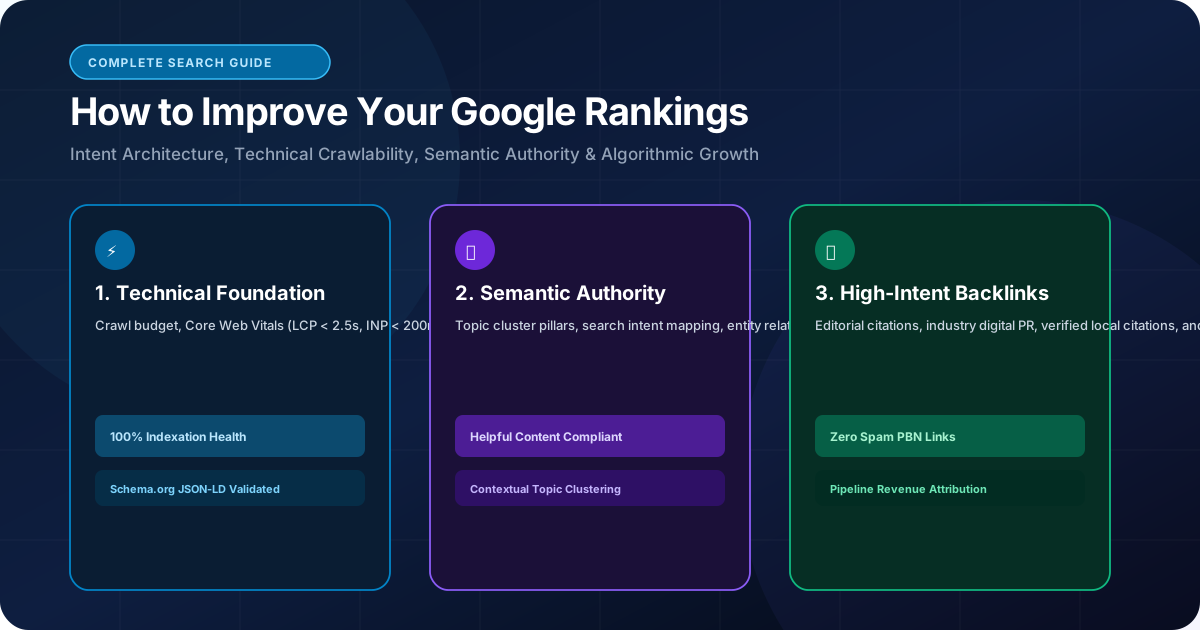
How to Improve Your Google Rankings: A Complete SEO Guide for Businesses
Learn how to improve Google rankings with this complete SEO guide for businesses. Discover proven strategies for technical SEO, content quality, and backlinks.
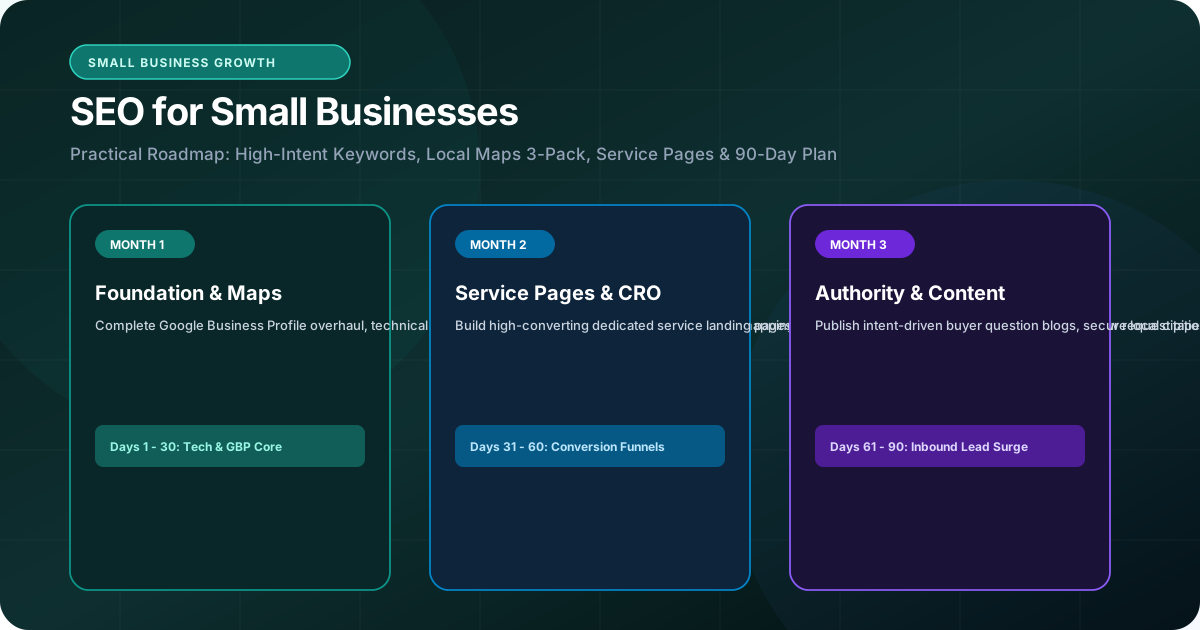
SEO for Small Businesses: A Practical Strategy to Get More Customers from Google
Discover a practical, affordable SEO strategy for small businesses. Follow our 90-day plan to optimize Google Business Profile, rank for local searches, and get leads.
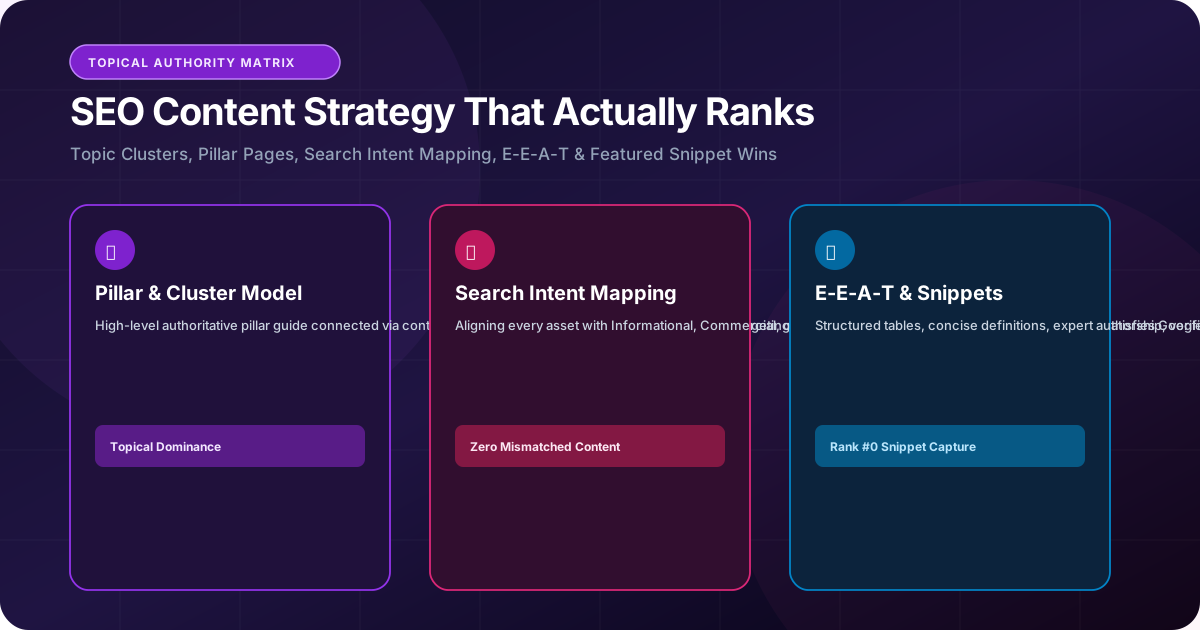
SEO Content Strategy: How to Create Content That Actually Ranks on Google
Learn how to build an SEO content strategy that ranks on Google. Master topic clusters, search intent mapping, pillar pages, and E-E-A-T authority.
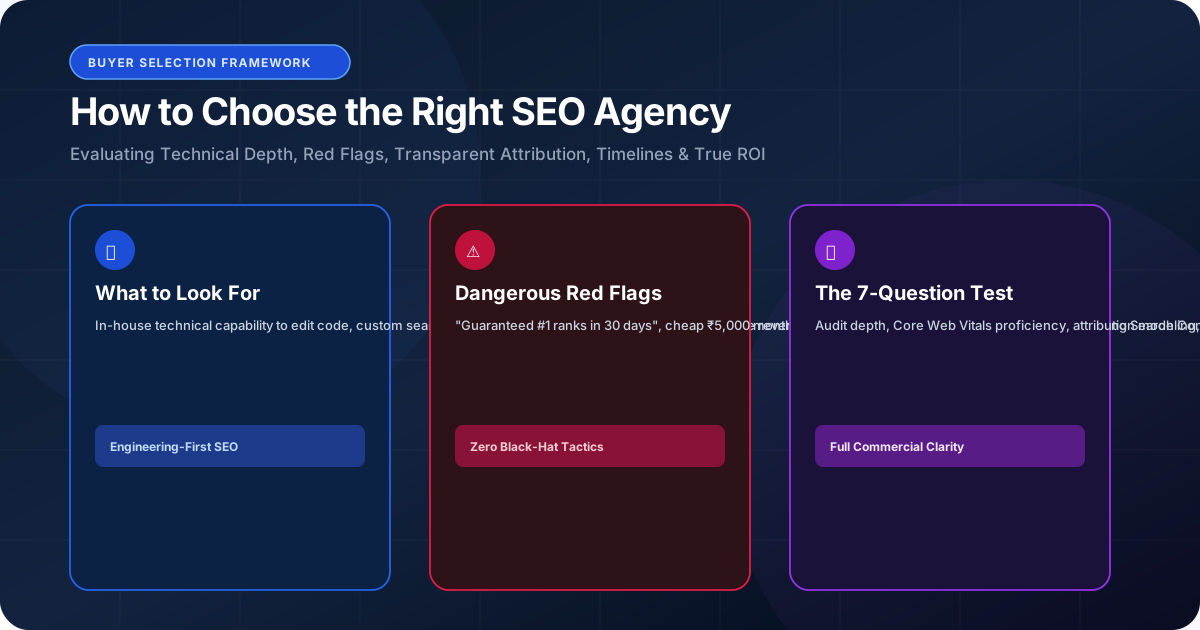
How to Choose the Right SEO Agency for Your Business: The Complete Selection Guide
Learn how to choose the right SEO agency for your business. Discover the essential questions to ask, dangerous red flags to avoid, and realistic pricing models.