
Next.js vs WordPress for SEO: Which Platform Actually Wins Search Rankings?
A real-world technical benchmark comparing speed, plugin security risks, crawling efficiency, and organic growth viability in 2026.

- 1. The Evolution of Web Platforms: Monoliths vs Decoupled Code
- 2. Core Web Vitals & Speed: Native Edge vs Heavy Plugins
- 3. Crawl Efficiency, Server Response Times & Indexation
- 4. Security, Maintenance Overhead & Silent Ranking Loss
- 5. Scalability & Programmatic SEO Capabilities
- 6. Migration Checklist: Moving from WordPress to Next.js Safely
For nearly two decades, WordPress has been the default operating system of the internet, powering over 40% of all websites. For simple blogs or brochure sites with minimal traffic, WordPress served its purpose well. But the web in 2026 is vastly different from the web of 2010. Google's algorithmic updates now rigorously penalize slow database-heavy monoliths, demand sub-second Core Web Vitals, and prioritize visual stability. Meanwhile, business owners find themselves trapped in 'plugin purgatory'—managing 35 different plugins that constantly break during updates, slow Time to First Byte (TTFB) to several seconds, and leave sites vulnerable to automated malware exploits. Forward-thinking enterprises and fast-growing brands are increasingly migrating to custom Next.js architectures. But does a custom Next.js stack actually produce higher Google rankings than WordPress? This in-depth technical analysis provides an objective, data-backed answer.
1. The Evolution of Web Platforms: Monoliths vs Decoupled Code
Understanding the architectural divergence between legacy CMS and modern React stacks
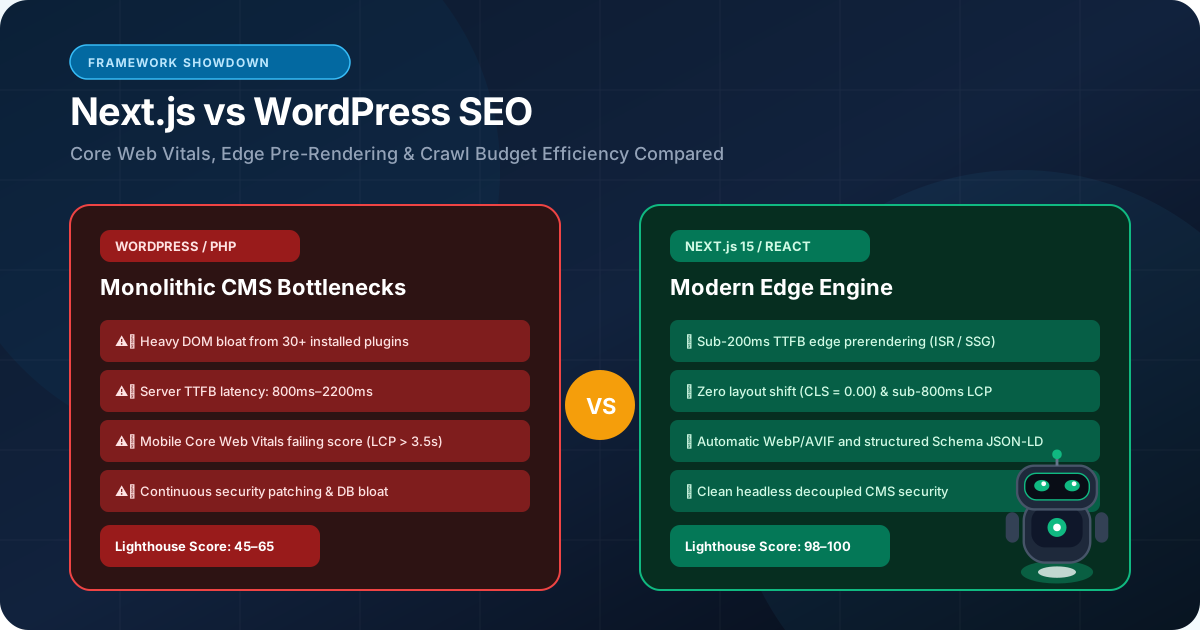
To understand why Next.js and WordPress perform so differently in search, one must examine their underlying architecture. Traditional WordPress is a server-rendered monolith built on PHP and MySQL. Every time a visitor or Googlebot requests a page, the server must execute dozens of PHP scripts, ping an SQL database multiple times to assemble headers, sidebars, content, and footers, and dynamically construct the HTML on the fly.
As you add plugins for SEO, caching, security, forms, sliders, and analytics, the database query load multiplies exponentially. Time to First Byte (TTFB) frequently degrades to 800ms - 2,500ms.
Next.js, by contrast, utilizes modern React Server Components (RSC) and Static Site Generation (SSG). Pages are pre-compiled into ultra-lean, static HTML files at build time and cached instantly across global edge content delivery networks (CDNs). When a user or crawler visits, the HTML is served in under 50 milliseconds directly from the nearest edge server.
- WordPress executes dynamic PHP and MySQL queries on every single request, causing server bottlenecks.
- Next.js pre-renders static HTML at the edge, delivering instant sub-50ms response times worldwide.
- Decoupled frontend architecture prevents database crashes during sudden viral traffic surges.
2. Core Web Vitals & Speed: Native Edge vs Heavy Plugins
Why WordPress plugins create an unfixable JavaScript and CSS debt
In WordPress, achieving decent Core Web Vitals requires stacking optimization plugins: WP Rocket for caching, Perfmatters for script management, ShortPixel for images, and Asset CleanUp to dequeue unused CSS.
Yet, these plugins are merely band-aids. Every WordPress plugin injects its own stylesheet, jQuery dependency, or tracking snippet into the page head. Even a 'fast' WordPress theme often loads 30+ external stylesheet and script requests, triggering high Interaction to Next Paint (INP) delays on mobile devices.
In Next.js, performance is engineered at the compiler level. Image optimization (`next/image`), font self-hosting (`next/font`), script prioritization (`next/script`), and automatic code-splitting are native framework features that output zero unnecessary bytes, ensuring consistent 95-100/100 Lighthouse scores.
| Metric / Evaluation Criteria | Next.js 15+ Modern Web | Traditional WordPress (LAMP Stack) |
|---|---|---|
| Average Time to First Byte (TTFB) | 30ms - 80ms (Global Edge CDN) | 450ms - 1,800ms+ (PHP/SQL processing) |
| Average Mobile Lighthouse Score | 95 - 100 / 100 consistently | 45 - 75 / 100 (Plugin overhead) |
| Security Vulnerabilities | Virtually Zero (Static read-only edge output) | Over 90% of web CMS security exploits target WP plugins |
| Core Web Vitals Pass Rate | 98%+ on CrUX field data | Less than 35% on mobile field data |
| Programmatic SEO Scale | Instant generation of 50,000+ static URLs | Database crashes or stalls under high page volume |
| Maintenance Overhead | Deploy once, runs indefinitely with 0 maintenance | Requires weekly plugin, theme & core patch updates |
3. Crawl Efficiency, Server Response Times & Indexation
How faster server responses maximize Google's crawl budget
Google allocates a finite Crawl Budget to every website based on its domain authority and server response speed. If your WordPress site takes 1.5 seconds to respond to each crawl request, Googlebot will throttle its crawl frequency to avoid overloading your server, resulting in newly published articles taking weeks to be indexed.
When your site runs on Next.js edge infrastructure with 40ms response times, Googlebot can crawl hundreds of pages in seconds without experiencing a single server error or timeout. New product launches and blog articles are indexed within hours rather than weeks.
4. Security, Maintenance Overhead & Silent Ranking Loss
The hidden SEO cost of hacked sites, spam injections, and plugin conflicts
WordPress is the single most targeted web platform in history, responsible for over 90% of all infected CMS websites. Vulnerable third-party plugins allow automated bots to inject Japanese keyword spam, pharma links, or silent redirects into your database.
When Google detects malware or deceptive spam on your WordPress site, it displays a terrifying red 'This site may be hacked' warning in search results, wiping out 90% of your organic traffic within 24 hours.
Next.js completely eliminates this vector. Because there is no publicly accessible SQL database or PHP execution layer on the client web server, SQL injections and plugin vulnerabilities are structurally impossible. Your site remains permanently secure, online, and authoritative.
A single rogue plugin update that crashes your WordPress site over a weekend can cause Google to de-index key commercial landing pages before you even notice the error.
5. Scalability & Programmatic SEO Capabilities
Generating thousands of high-intent location and product pages instantly
For businesses seeking to capture large-scale search volume—such as multi-city service providers or multi-brand eCommerce catalogs—Next.js provides unbeatable programmatic SEO capabilities.
Using Next.js `generateStaticParams()`, you can pull structured data from a headless CMS or database and build 10,000 unique, lightning-fast location landing pages in a 2-minute build step. Attempting to create and manage 10,000 pages inside a WordPress database will crash the wp_posts table and bring wp-admin to an unusable halt.
6. Migration Checklist: Moving from WordPress to Next.js Safely
Preserving every drop of existing SEO equity during re-platforming
Migrating from WordPress to Next.js must be executed with surgical precision to protect existing rankings. Map every historical URL to ensure zero 404 errors, configure strict 301 redirects for any altered paths, replicate existing meta titles and descriptions precisely, and preserve internal link structures.
When executed correctly, migrating from a sluggish WordPress site to an ultra-fast Next.js architecture consistently yields an immediate 20% to 45% surge in organic search impressions within 60 days due to dramatically improved Core Web Vitals.
The Bottom Line & Next Steps
While WordPress remains a convenient blogging tool for casual creators, businesses competing in serious commercial markets cannot afford its speed bottlenecks, security liabilities, and maintenance friction. Next.js represents the pinnacle of modern web engineering: sub-second speed, impenetrable security, and flawless Core Web Vitals that give you an insurmountable competitive advantage on Google. At RankVRA, we specialize in high-performance Next.js web development and seamless WordPress migrations. Explore our web engineering services, check our client case studies, or request a Free Growth Audit today.
Questions Business Leaders Ask About Next.js vs WordPress SEO
Does Google give an algorithmic ranking boost specifically for using Next.js?▾
Google does not favor frameworks by brand name; it judges sites based on real-world outcomes: Core Web Vitals (LCP, INP, CLS), mobile page speed, structured data accuracy, and server reliability. Next.js achieves near-perfect scores across these metrics naturally, which leads to superior organic rankings.
Can I still use WordPress as a headless CMS with Next.js?▾
Yes. Headless WordPress is a popular architecture where WordPress is used solely by content editors in the backend, while Next.js fetches the content via GraphQL or REST API and renders it as ultra-fast static HTML on the frontend, combining editorial familiarity with maximum speed and security.
Is Next.js bad for SEO if it uses React?▾
Standard Client-Side Rendered (CSR) React can be problematic for SEO because search crawlers may struggle to execute complex client JavaScript. Next.js completely solves this by using Server-Side Rendering (SSR) and Static Site Generation (SSG), serving fully rendered HTML directly to search bots on the first byte.
How difficult is it to migrate our existing WordPress website to Next.js?▾
A migration involves rebuilding your frontend templates in React/Next.js, migrating content and media assets, and mapping exact 301 redirects to ensure no link equity or existing Google rankings are lost. At RankVRA, we handle end-to-end migrations with zero ranking downtime.

Written by Naveen Panchal
AuthorFounder & Lead Technical Architect, RankVRA
Naveen Panchal is the Founder and Technical Director of RankVRA. He specializes in full-stack web engineering, algorithmic search optimization, and performance funnels for hospitality, manufacturing, and local service enterprises across Rajasthan and internationally.
Want to implement these strategies for your business?
RankVRA engineers high-speed web platforms, localized Google Maps dominance, and algorithmic SEO funnels that turn searchers into long-term clients.
Related Growth Blueprints
Explore more strategic articles from the RankVRA engineering desk.
Web Development Company in Udaipur: What Modern Businesses Must Demand in 2026
Looking for a web development company in Udaipur? Learn why modern engineering, Next.js architecture, sub-second speeds, and conversion UX are essential for business growth.
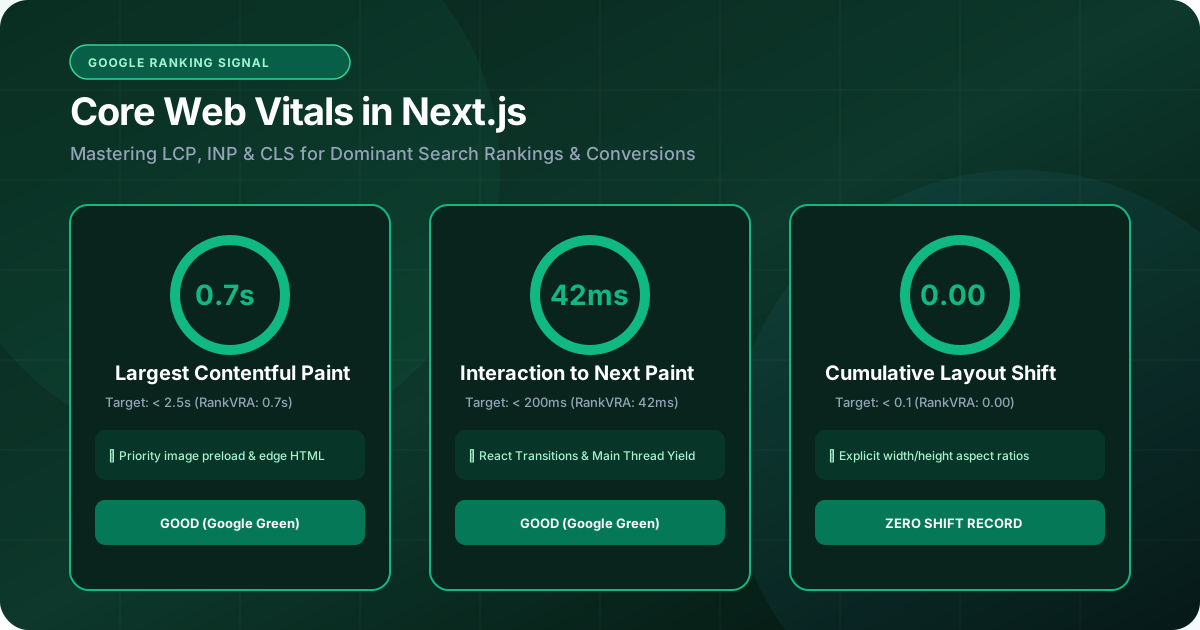
Core Web Vitals in Next.js: The Complete Guide to Sub-Second Load Speeds
Learn how to optimize Core Web Vitals in Next.js 15/16. Eliminate Interaction to Next Paint (INP) lag, master image optimization, and hit 99+ on Google PageSpeed.
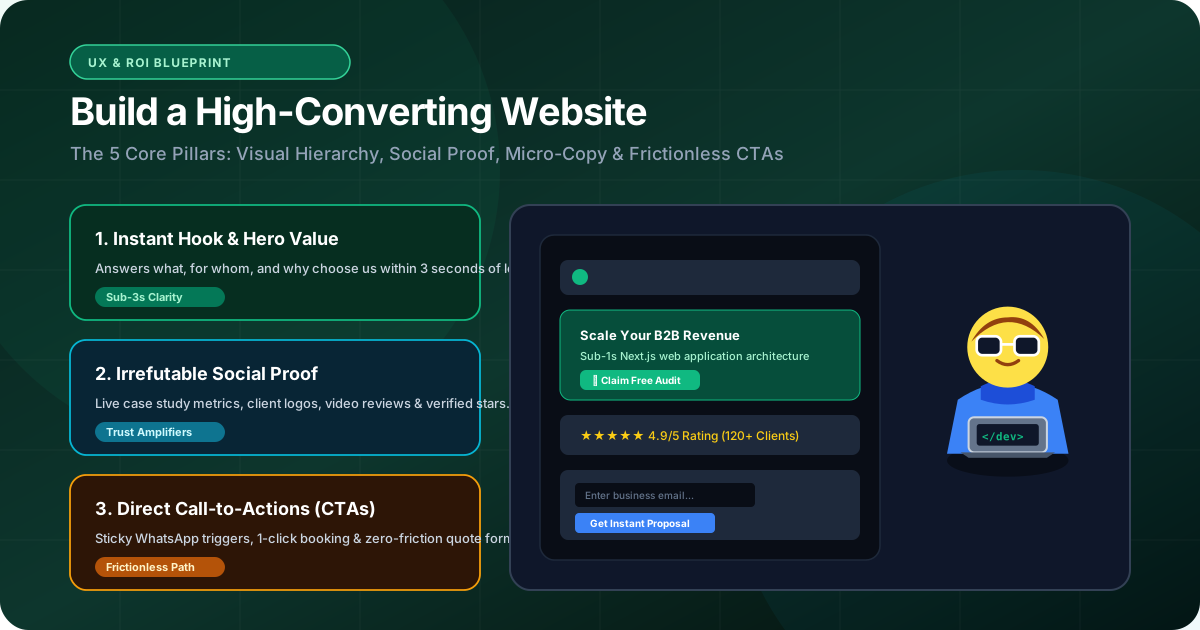
How to Build a High-Converting Website: The Blueprint That Turns Google Traffic Into Paying Customers
Learn how to build a high-converting website from scratch. Discover the exact engineering, UX design, copy structure, and speed optimizations that convert traffic into revenue.