
Frontend vs Backend Development: What Does Your Business Actually Need?
A business executive's guide to dividing technical scope, allocating budgets, and deciding whether to hire frontend, backend, or full-stack partners.

- 1. The Fundamental Division: Client vs Server
- 2. What Frontend Development Solves for Business
- 3. What Backend Development Solves for Business
- 4. How Frontend and Backend Communicate via APIs
- 5. Comprehensive Side-by-Side Comparison Table
- 6. Diagnostic: What Does Your Company Actually Need?
- 7. Why Full-Stack Teams Often Deliver Superior ROI
When business leaders review proposals for custom software, they often see separate budget line items for 'Frontend Engineering' and 'Backend Architecture'. For non-technical founders, CTOs in commercial enterprises, and marketing directors, this separation can seem confusing. Is a beautiful website purely frontend work? If our database is slow, is that a backend bug or a frontend rendering issue? More importantly: if your budget is finite, how should you allocate resources between visual user experience and server-side infrastructure? This guide provides an honest, clear breakdown of frontend vs backend development, helping you invest where it delivers the highest commercial return.
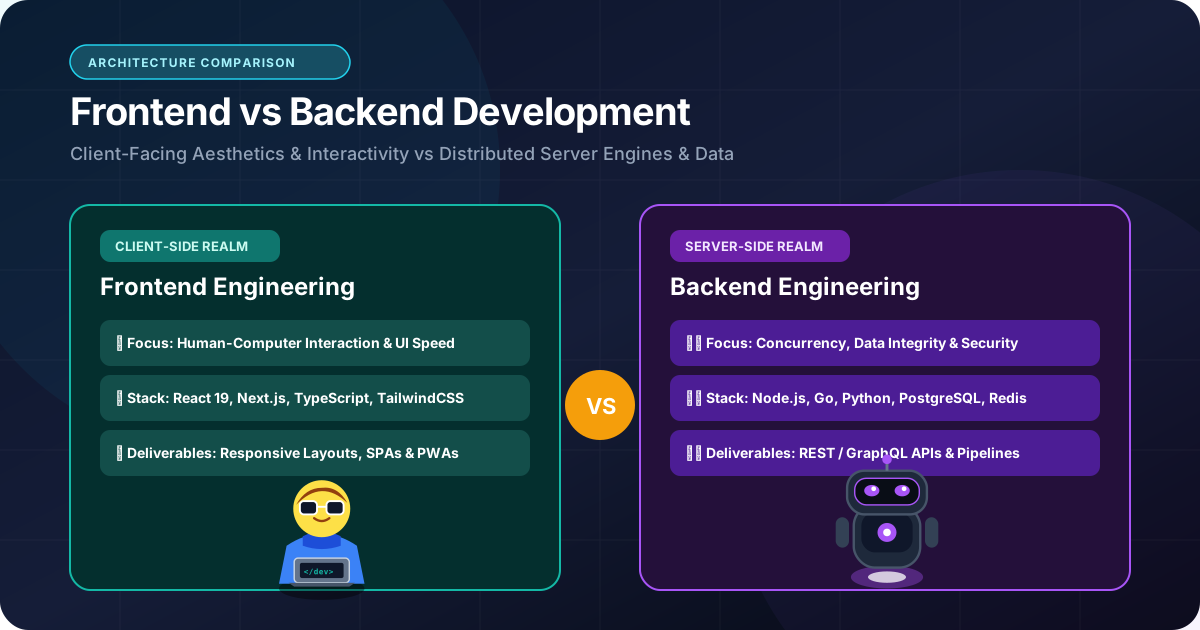
Frontend development focuses on the user-facing interface (typography, layout, speed, accessibility, and conversion funnels), while backend development manages behind-the-scenes server logic (database integrity, security, authentication, and third-party APIs). Most commercial initiatives require both working in harmony.
1. The Fundamental Division: Client vs Server
Understanding the boundary between public browsers and private infrastructure
The simplest way to understand the difference between frontend and backend is through the metaphor of an upscale restaurant:
The Frontend is the dining room. It is the ambiance, the comfortable seating, the elegant menu, the lighting, and the waiter taking your order. It is everything the customer sees, touches, and judges immediately.
The Backend is the commercial kitchen and refrigerated storage in the back. It is where raw ingredients are safely prepped, recipes are executed with precision, health regulations are enforced, and order tickets are tracked. The customer never enters the kitchen, but without it, the restaurant cannot serve a single dish.
In web applications, the dining room is the user's browser (Chrome, Safari, iOS), and the kitchen is your cloud server (AWS, Vercel, PostgreSQL).
2. What Frontend Development Solves for Business
Where first impressions, brand credibility, and visitor conversion are won or lost
Investing in professional frontend development addresses direct commercial outcomes:
• Immediate Trust & Credibility: Within 50 milliseconds of landing on your page, a corporate buyer decides whether your company is institutional or amateurish. Clean typography, consistent margins, and responsive layouts establish immediate trust.
• Frictionless Conversion Paths: High-performing frontends eliminate friction in lead forms, quote calculators, and checkout flows. Every confusing input field or delayed button tap decreases conversion rates by 5% to 15%.
• Mobile-First Responsiveness: With over 60% of commercial searches happening on smartphones in markets like the US, UK, and India, frontend engineers ensure touch targets are easily clickable and layouts never break or shift horizontally.
• Core Web Vitals Compliance: Google directly penalizes websites with poor frontend performance. Frontend engineers optimize asset loading to guarantee Largest Contentful Paint (LCP) under 1.2s and Interaction to Next Paint (INP) under 50ms.
3. What Backend Development Solves for Business
Where data durability, regulatory compliance, and system scale reside
Even the most visually stunning frontend is useless if the backend drops customer records, leaks sensitive financial data, or crashes under traffic spikes. Backend development delivers the bedrock of your business platform:
• Data Security & Access Control: Enforcing Role-Based Access Control (RBAC) so that a standard employee or broker cannot access administrative settings or sensitive payroll records.
• Business Logic & Mathematical Rules: Calculating custom insurance premiums, processing credit card charges via Stripe, or generating compliance-ready PDF agreements.
• System Resilience & Data Integrity: Ensuring that when 500 customers place orders simultaneously, inventory levels decrement accurately without duplicate charges (ACID database guarantees).
• Third-Party Platform Integration: Connecting your application to external ERPs, CRMs (HubSpot, Salesforce), accounting software (QuickBooks), and communication APIs (WhatsApp Cloud API).
4. How Frontend and Backend Communicate via APIs
The digital handshake that binds the two worlds together
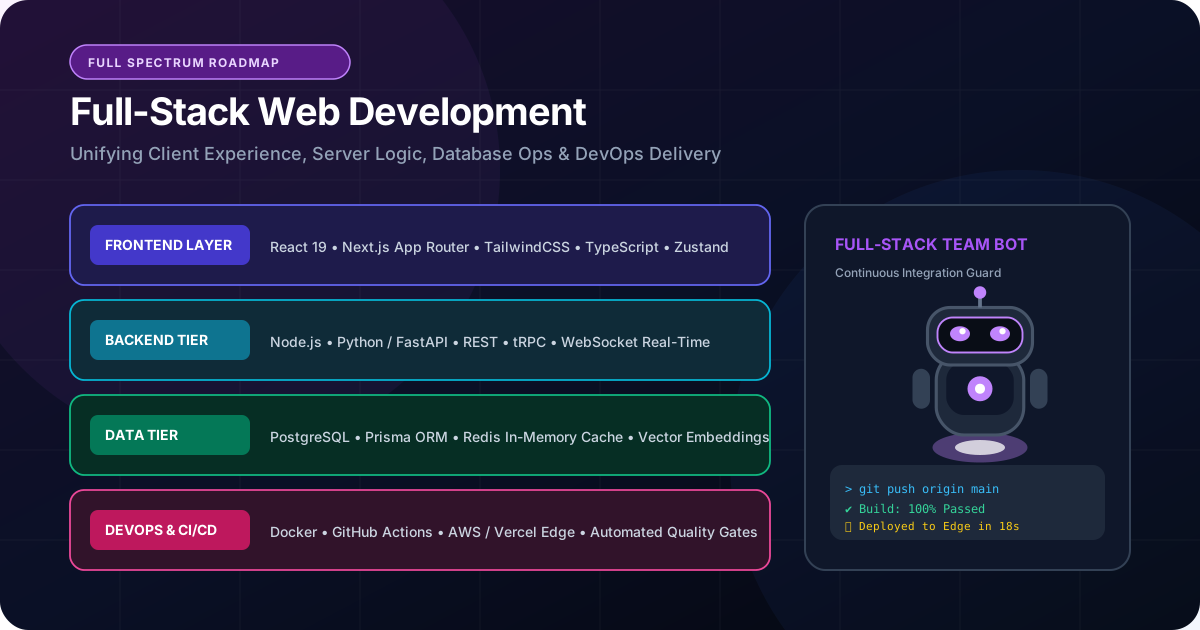
The frontend and backend never touch directly; they communicate across the internet using APIs (Application Programming Interfaces).
When a user fills out a consultation form on RankVRA, the frontend bundles the form fields into a standardized JSON payload and dispatches an encrypted HTTPS request to the server.
The backend receives the request, validates that the email and phone number are valid, authenticates the session, writes the record to PostgreSQL, triggers an instant WhatsApp notification to the sales director, and responds with a 200 OK status code. The frontend receives the 200 OK code and immediately renders a celebratory 'Thank You' confirmation screen.
When both sides adhere to clear, typed contracts (TypeScript), features can be updated independently without breaking the user experience.
5. Comprehensive Side-by-Side Comparison Table
Detailed operational comparison between frontend and backend development
The table below outlines the core differences in tooling, objectives, metrics, and business risks:
| Dimension | Frontend Engineering | Backend Engineering |
|---|---|---|
| Execution Environment | User's Browser (Client Machine / Mobile) | Secure Cloud Server / Container / Serverless |
| Core Languages | HTML5, CSS3, JavaScript, TypeScript | TypeScript (Node.js), Python, Go, SQL |
| Dominant Frameworks | Next.js, React, Tailwind CSS, Vue | Express, NestJS, FastAPI, Django |
| Primary Business Goal | Engagement, Conversion Rate, Core Web Vitals | Data Integrity, Uptime, Security, Processing Speed |
| Data Handled | Rendered UI State, Ephemeral Form Fields | Persistent Relational Records, PII, Financials |
| Primary Failure Risk | High Bounce Rates, Visual Layout Bugs, Broken Forms | Data Breaches, Database Corruption, Server Outages |
| Key Performance Indicator | LCP < 1.2s, INP < 50ms, Form Conversion % | API Response < 100ms, 99.9% Uptime, 0 Data Loss |
6. Diagnostic: What Does Your Company Actually Need?
How to assess your current engineering priorities
To determine whether your immediate investment should lean toward frontend, backend, or both, apply this simple diagnostic:
Scenario A: You have an established backend API or ERP, but your user portal is clunky, slow on mobile, and frustrates customers. You need specialized Frontend Engineering to redesign the UI into a modern Next.js application.
Scenario B: Your website looks decent, but users complain that saving forms takes 10 seconds, customer data frequently goes missing, or you cannot integrate with your CRM. You need Backend Engineering to optimize database schemas, queries, and APIs.
Scenario C: You are building a new client portal, SaaS product, or modern corporate website from scratch. You need Full-Stack Development to engineer both layers cohesively from day one.
7. Why Full-Stack Teams Often Deliver Superior ROI
Eliminating finger-pointing and accelerating feature shipping
When companies hire one agency for design/frontend and another for backend/database, friction is inevitable. When a page loads slowly, the frontend team blames the backend API latency; the backend team blames heavy frontend JavaScript bundles.
By partnering with a full-stack engineering firm like RankVRA, you eliminate vendor finger-pointing. Our team takes singular responsibility for the entire journey: from sub-second Next.js page hydration down to the PostgreSQL database indexes that power it. This unified ownership reduces project delivery times by 30% to 40%.
The Bottom Line & Next Steps
Frontend and backend development are two halves of the same digital coin. A world-class frontend attracts and converts clients, while a fortified backend protects their data and automates your business operations. Understanding how they interconnect empowers you to make informed hiring decisions, budget realistically, and build software that drives measurable revenue. Discuss your web development project with RankVRA today.
Questions Business Leaders Ask About frontend vs backend development
Can one engineer effectively handle both frontend and backend development?▾
Yes. Experienced senior full-stack engineers are proficient across both client interfaces (React/Next.js) and server architectures (Node.js/PostgreSQL). For large-scale enterprise platforms with millions of users, teams often combine full-stack architects with specialized database and UI engineers.
Is frontend or backend development more expensive?▾
Costs are generally comparable. Frontend costs depend on UI complexity, animations, accessibility compliance, and viewport responsiveness. Backend costs depend on database complexity, third-party integrations, security hardening, and regulatory compliance. Both require senior architectural expertise.
Why can't we just use a frontend connected directly to a database without a backend?▾
Connecting a frontend directly to a database exposes your database credentials to anyone inspecting network requests in browser developer tools. A backend server acts as an indispensable security guard, authenticating user permissions and validating data before touching the database.

Written by Naveen Panchal
AuthorFounder & Lead Technical Architect, RankVRA
Naveen Panchal is the Founder and Technical Director of RankVRA. He specializes in full-stack web engineering, Next.js architecture, and high-performance digital systems for clients across the US, UK, Canada, and India.
Explore Core Commercial Capabilities
High-speed React & Next.js user interfaces
Node.js, Python & scalable server architectures
Unified client-to-database engineering
Custom business websites and web platforms
Bespoke portals and operational software
- Mozilla Developer Network: MDN Web Docs: Frontend Web DevelopmentOfficial Reference
- World Wide Web Consortium: W3C Web Standards & ArchitectureOfficial Reference
- OWASP Foundation: OWASP API Security Top 10Official Reference
Discuss Your Web Development Project
Not sure whether your business needs a frontend overhaul, backend modernization, or an end-to-end full-stack build? We audit your current architecture and outline a practical roadmap.
Related Growth Blueprints
Explore more strategic articles from the RankVRA engineering desk.
What Is Full-Stack Web Development? Frontend, Backend and APIs Explained
Demystify full-stack web development. Learn how frontend interfaces, backend servers, relational databases, and REST APIs connect to deliver business web platforms.
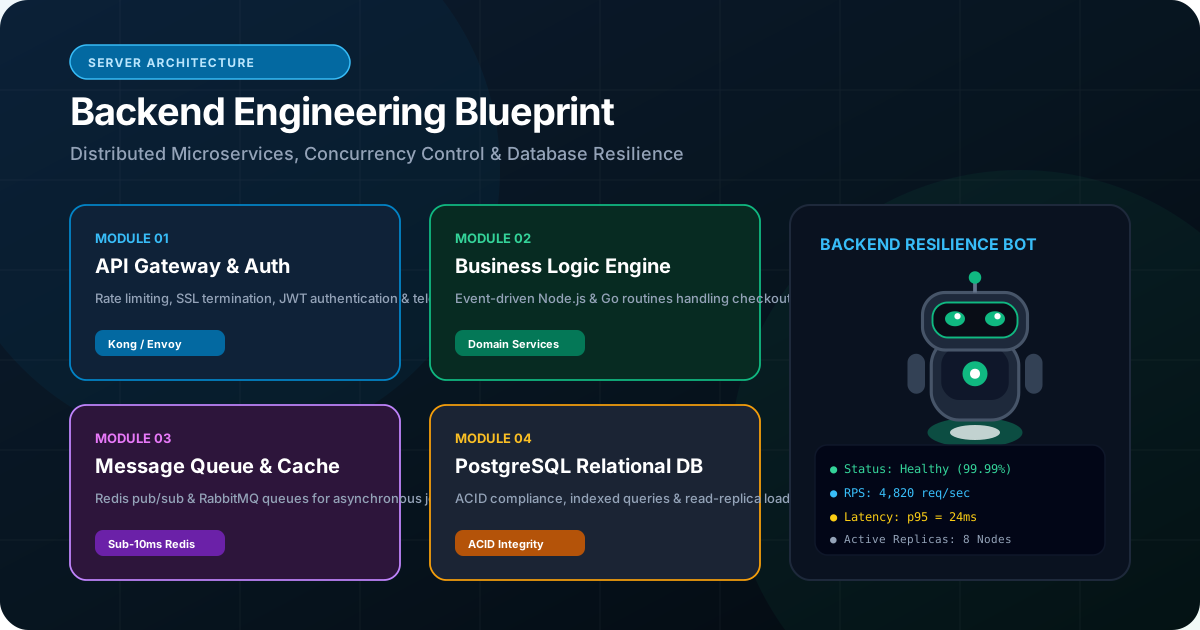
What Is Backend Development and Why Is It Important for Modern Web Applications?
Demystify backend development. Discover how server architectures, relational databases, Node.js, Python, and OWASP security protect and scale business web applications.
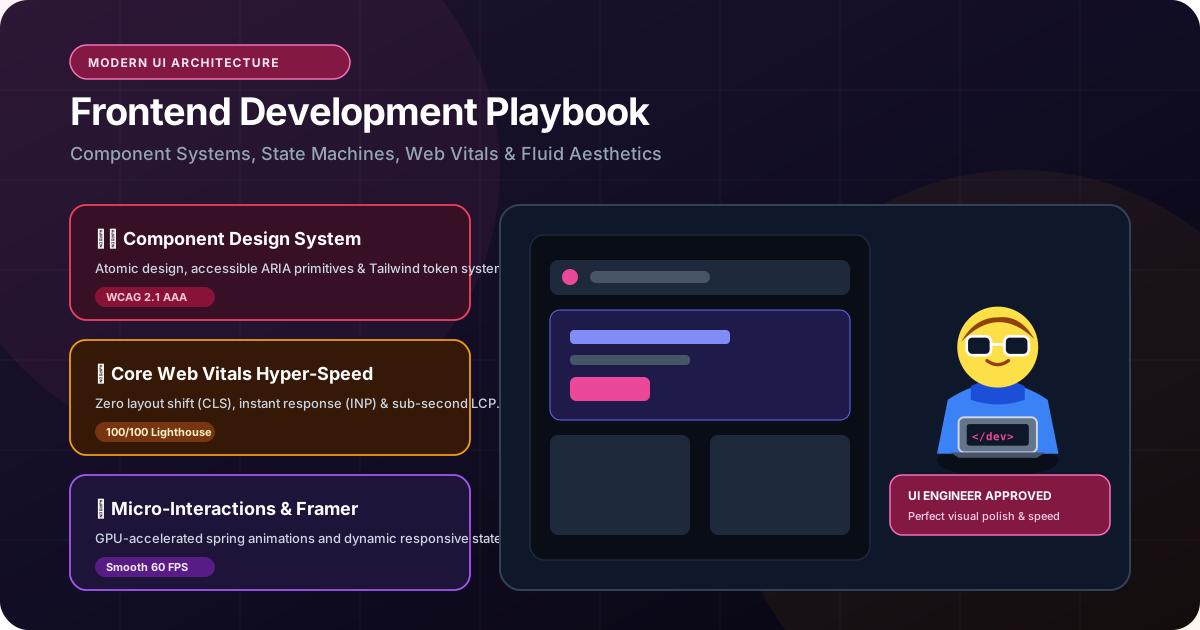
Frontend Development: How Modern Websites Deliver Fast and Interactive Experiences
Learn how modern frontend development combines Next.js, React, and TypeScript to deliver lightning-fast page speeds, mobile responsiveness, and high conversion rates.