
AI Automation for Businesses: How Companies Can Save Time and Scale Operations
A practical guide to intelligent document extraction, CRM workflows, AI customer support, API integrations, and calculating automation ROI.

- 1. What AI Automation Actually Means in Modern Business
- 2. The 6 Most Profitable Business Processes to Automate
- 3. AI Chatbots vs Context-Aware RAG Enterprise Assistants
- 4. Custom API Integrations: The Backbone of Automation
- 5. Designing Resilient Human-in-the-Loop (HITL) Workflows
- 6. Mitigating Hallucinations, Data Privacy & Security Risks
- 7. Calculating Realistic Automation ROI & Identifying Opportunities
- 8. Engineering Custom AI Automation Systems with RankVRA
Every growing enterprise reaches a friction point where manual operational tasks begin to constrain profitability. Highly paid team members spend hours copying lead data across disconnected CRMs, answering repetitive customer support inquiries, parsing PDF invoices, and reconciling spreadsheet reports. While artificial intelligence dominates modern business headlines, much of the discourse revolves around unrealistic hype or superficial consumer tools. In reality, practical AI automation is an engineering discipline: integrating machine learning models, structured APIs, and deterministic business logic into your daily operations to eliminate repetitive labor, slash response times, and scale throughput without exponentially increasing headcount. This comprehensive guide outlines the real-world business applications of AI automation, the technical architecture required to implement them, and how to calculate concrete financial ROI.
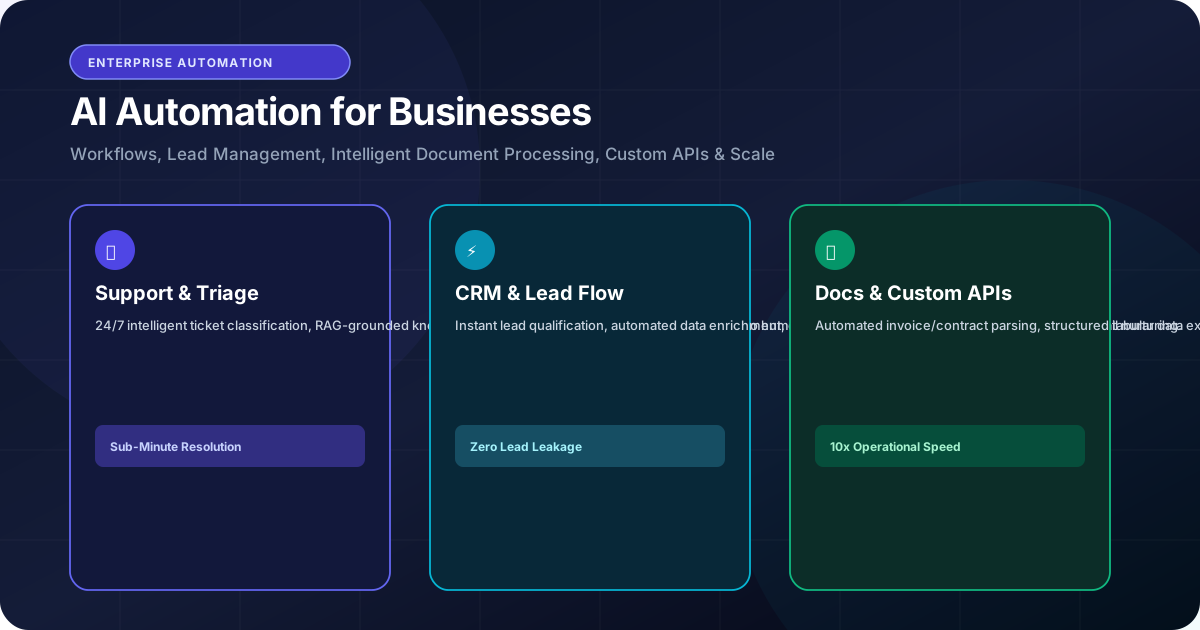
AI automation for businesses combines Large Language Models (LLMs), machine learning algorithms, API integrations, and robotic process automation to execute complex, repetitive business operations with minimal manual intervention. Key practical applications include 24/7 intelligent customer support triage, automated CRM lead qualification, unstructured document parsing (invoices and contracts), and automated executive reporting.
1. What AI Automation Actually Means in Modern Business
Moving beyond prompt engineering to autonomous, API-driven workflows
AI automation for businesses is not about having employees manually type prompts into ChatGPT. It is the architectural integration of Large Language Models (LLMs), natural language processing, computer vision, and backend APIs into autonomous software pipelines.
Traditional robotic process automation (RPA) was brittle: if a form layout changed by two pixels, the automation broke. Modern AI automation introduces semantic understanding, allowing systems to comprehend unstructured text, interpret intent, make rule-bound decisions, and extract clean tabular data from chaotic inputs.
When paired with resilient API integration services, AI automation functions as an intelligent connective tissue between your website, CRM, ERP, payment gateways, and communication channels.
2. The 6 Most Profitable Business Processes to Automate
High-leverage operational workflows ready for immediate deployment
Businesses achieve the fastest payback by automating workflows that are high-volume, data-heavy, and bound by clear operational logic:
1. Inbound Lead Qualification & Routing: When a prospect submits an inquiry, an AI agent instantly enriches the lead profile via third-party APIs, scores buying intent, writes a personalized summary, updates your CRM, and routes high-priority prospects directly to a sales executive's calendar.
2. 24/7 Tier-1 Customer Support Triage: Intelligent support agents resolve 40% to 60% of common customer questions—tracking orders, processing basic returns, explaining technical specifications—while seamlessly escalating complex issues to human specialists with a complete summary.
3. Intelligent Document & Invoice Processing: Extract line items, invoice numbers, tax totals, and vendor details from PDF documents, image scans, and emails, automatically validating figures against your database before posting to accounting software.
4. Dynamic Email Communication & Follow-ups: Automated email sequences that adapt messaging based on prospect behavior, contract milestones, or account status rather than blasting static templates.
5. CRM & Database Synchronization: Eliminating manual data entry by automatically syncing contact details, deal stages, and meeting transcripts across HubSpot, Salesforce, and custom internal databases.
6. Executive KPI Reporting: Automated weekly data aggregations that pull metrics from Google Analytics 4, Stripe, and ad platforms, generating concise executive summaries highlighting revenue trends and anomalies.
3. AI Chatbots vs Context-Aware RAG Enterprise Assistants
Why basic chatbots fail and Retrieval-Augmented Generation succeeds
Generic chatbots trained on public internet data are dangerous for businesses because they can 'hallucinate' inaccurate product details, invent discounts, or misquote company policies.
Enterprise-grade automation utilizes Retrieval-Augmented Generation (RAG). In a RAG architecture, your company's proprietary knowledge base (product documentation, standard operating procedures, price lists, legal terms) is indexed in a secure vector database.
When a query arrives, the system retrieves the exact factual passages from your verified documents and feeds them to the LLM as strict context, ensuring the AI produces 100% accurate, cited, and compliant responses grounded entirely in your company's data.
4. Custom API Integrations: The Backbone of Automation
Connecting disparate software platforms into a cohesive operational ecosystem
An AI model in isolation is powerless; it requires APIs to take concrete actions in the real world. A complete automation workflow connects trigger events (e.g., a new Shopify sale or a signed DocuSign contract) with action APIs across your software stack.
At RankVRA, we engineer robust custom API integrations that bridge legacy enterprise systems, cloud platforms, and modern web applications via secure RESTful and GraphQL endpoints, webhooks, and asynchronous message queues.
This ensures that when an AI parses an invoice or qualifies a lead, it can automatically update accounting databases, trigger payment authorizations, and dispatch SMS alerts without requiring human data re-entry.
5. Designing Resilient Human-in-the-Loop (HITL) Workflows
Balancing autonomous efficiency with human judgment and governance
High-stakes business operations—such as approving large wire transfers, signing legal agreements, or deploying sensitive marketing campaigns—should never operate on 100% unmonitored autonomy.
The gold standard for enterprise automation is Human-in-the-Loop (HITL) architecture. In an HITL workflow, the AI system performs 90% of the cognitive heavy lifting: extracting data, conducting initial analysis, drafting the email, and preparing the transaction.
The prepared draft is then presented to an authorized human manager via an intuitive dashboard or Slack notification. The manager reviews the structured output, clicks 'Approve', and the system completes the transaction.
6. Mitigating Hallucinations, Data Privacy & Security Risks
Protecting proprietary data, customer privacy, and compliance integrity
Deploying AI automation requires strict technical safeguards around data privacy and enterprise security:
Data Sovereignty: Ensure that proprietary client and company data is never transmitted to public training pools. Utilize enterprise-tier APIs that guarantee zero data retention for model retraining.
Deterministic Guardrails: Implement schema validation (such as Zod or Pydantic) to force AI outputs into strict JSON schemas, rejecting malformed responses before they hit your database.
Role-Based Access Control (RBAC): Ensure automated agents operate with the minimum necessary system permissions, logging every automated transaction in an immutable audit trail.
7. Calculating Realistic Automation ROI & Identifying Opportunities
A pragmatic financial model to evaluate automation investments
To evaluate whether a business process is worth automating, apply this simple ROI formula:
| Metric Component | Operational Example | Monthly Cost / Time | Annual Impact |
|---|---|---|---|
| Manual Labor Saved | 3 staff members spending 15 hrs/wk entering invoices | 180 hours/month at $30/hr = $5,400/mo | $64,800 annual payroll reallocation |
| Response Latency Reduction | Lead response time drops from 4 hours to 90 seconds | Leads contacted under 5 mins convert 3x higher | Significant pipeline revenue increase |
| Error Elimination | Manual data entry generates a 2% billing error rate | Cost to investigate and credit disputed invoices | Higher customer retention & zero billing leaks |
| System Maintenance Cost | API token consumption, cloud hosting, monitoring | Estimated $150–$400/month infrastructure cost | Extremely high net operational profit |
8. Engineering Custom AI Automation Systems with RankVRA
Full-stack software engineering tailored to your operational workflows
Off-the-shelf automation tools often create fragile, slow integrations that fail when your business scales. RankVRA engineers custom, enterprise-grade AI automation pipelines built on resilient Next.js, Node.js, and Python backend microservices.
Whether you need an intelligent RAG knowledge assistant for your customer service team, an automated lead qualification engine integrated with custom CRM software, or end-to-end document processing pipelines, our software architects design solutions that deliver measurable efficiency gains and lasting competitive advantage.
The Bottom Line & Next Steps
AI automation is not about replacing human creativity; it is about liberating your team from soul-crushing manual drudgery so they can focus on high-value client relationships, strategic growth, and business expansion. By identifying high-friction workflows, deploying secure RAG architectures, and engineering custom API connections, your company can operate with the agility and scale of an organization twice its size. If you are ready to explore practical automation opportunities tailored to your company's workflows, connect with the technical architects at RankVRA today.
Questions Business Leaders Ask About AI automation for businesses
What is the difference between AI automation and traditional software automation?▾
Traditional automation follows rigid, predefined 'if-this-then-that' rules and breaks when dealing with unstructured data. AI automation incorporates machine learning and natural language processing, allowing systems to interpret messy inputs (unstructured emails, diverse invoice layouts, conversational requests) and make intelligent context-aware decisions.
Will our proprietary business data be used to train public AI models?▾
No. Enterprise AI architectures engineered by RankVRA utilize enterprise-grade APIs and private vector databases with strict contractual data privacy guarantees ensuring your company's data is never stored or used for model retraining.
What types of businesses benefit the most from AI automation?▾
Companies with high transaction volumes, extensive customer support inquiries, complex document processing workflows, or multiple disconnected software tools (such as logistics firms, legal practices, healthcare clinics, ecommerce brands, and B2B services) achieve the highest ROI.
How long does it take to implement a custom AI automation system?▾
A focused, high-impact automation (such as an automated CRM lead qualification pipeline or an internal RAG document search assistant) typically takes 3 to 6 weeks to architect, test, and deploy into production.
What is Human-in-the-Loop (HITL) automation?▾
Human-in-the-Loop is a workflow design where AI performs data extraction, analysis, and draft generation, but requires explicit human approval before triggering critical real-world actions (such as sending high-value emails or executing payments).
How can RankVRA assist our company with AI automation?▾
RankVRA conducts operational workflow audits, identifies high-leverage automation opportunities, and engineers custom API pipelines, private RAG assistants, and automated CRM integrations tailored to your company's specific infrastructure.

Written by Naveen Panchal
AuthorFounder & Lead Technical Architect, RankVRA
Naveen Panchal is the Founder and Technical Director of RankVRA. He specializes in full-stack web engineering, Next.js architecture, and algorithmic search optimization for high-growth enterprises.
Explore Core Commercial Capabilities
Custom AI workflows, intelligent document parsing, and operational automation.
Seamless RESTful and GraphQL API pipelines connecting your business software.
Bespoke customer relationship management platforms tailored to your workflows.
- OpenAI: OpenAI: Enterprise Privacy & ComplianceOfficial Reference
- W3C: W3C: Machine Learning & Web StandardsOfficial Reference
- McKinsey & Company: McKinsey: The Economic Potential of Generative AIOfficial Reference
Ready to Eliminate Manual Bottlenecks and Scale Your Operations?
Discover how custom AI automation can save hundreds of manual employee hours each month. Schedule an operational discovery consultation with RankVRA's engineering team today.
Related Growth Blueprints
Explore more strategic articles from the RankVRA engineering desk.
Website Development Guide: How to Build a High-Converting Business Website
Learn how to build a high-converting business website. Master modern UX design, responsive development, Core Web Vitals, and review our launch checklist.
How to Improve Your Google Rankings: A Complete SEO Guide for Businesses
Learn how to improve Google rankings with this complete SEO guide for businesses. Discover proven strategies for technical SEO, content quality, and backlinks.
SEO for Small Businesses: A Practical Strategy to Get More Customers from Google
Discover a practical, affordable SEO strategy for small businesses. Follow our 90-day plan to optimize Google Business Profile, rank for local searches, and get leads.

Technical SEO Checklist: 25 Critical Fixes for Your Website
Use this comprehensive 25-point technical SEO checklist to fix crawl errors, optimize Core Web Vitals, resolve indexation issues, and boost Google rankings.