
Conversion Rate Optimization (CRO): How to Double Inquiries Without More Traffic
The data-backed UX, copywriting, and psychological framework to transform passive website visitors into paying customers.

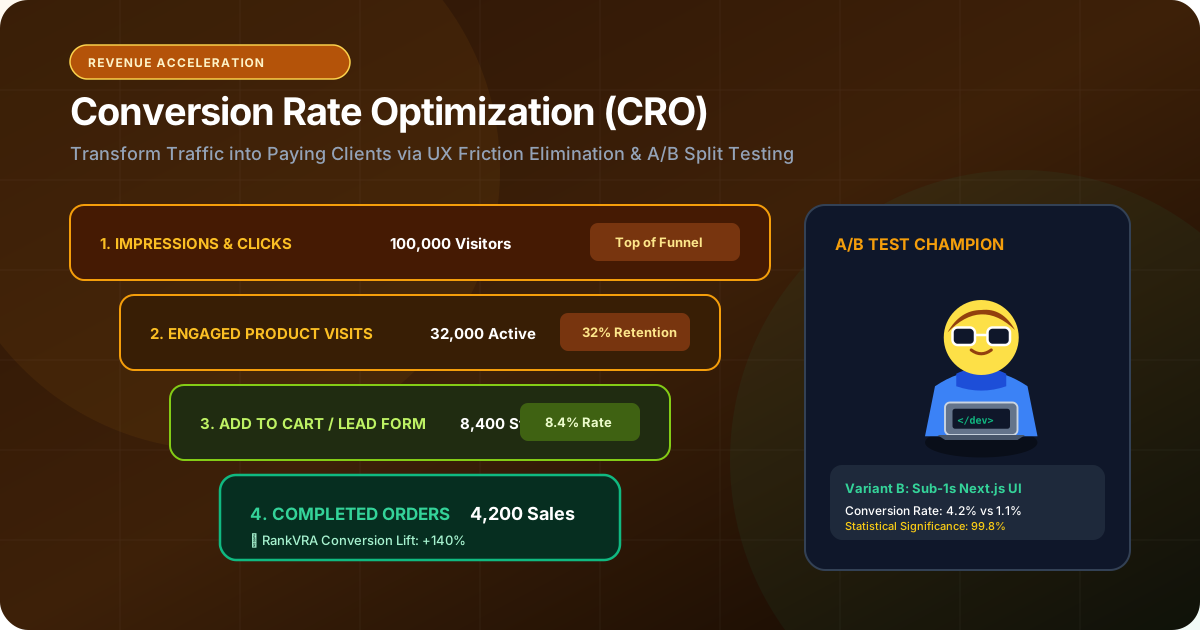
- 1. Why Traffic Without Conversion Is a Wasted Investment
- 2. The 5-Second Rule: Above-the-Fold Clarity & Value Propositions
- 3. Form Friction: The #1 Silent Lead Killer
- 4. Micro-Social Proof & Strategic Placement of Trust Triggers
- 5. Mobile Usability & Thumb-Zone Action Buttons
- 6. A/B Testing Framework for Small and Mid-Sized Businesses
Most business owners believe their revenue problem is a traffic problem. They pour hundreds of thousands of rupees into Google Ads, Meta campaigns, and SEO retainers trying to drive more visitors to their website. Yet, when those visitors arrive, 97% to 99% leave without submitting an inquiry, picking up the phone, or making a purchase. The global average website conversion rate hovers around a meager 1.5% to 2.5%. Doubling your website traffic requires doubling your ad spend or waiting a year for organic rankings to climb. But doubling your conversion rate from 2% to 4% instantly doubles your customer inquiries and top-line pipeline revenue with zero additional advertising spend. Conversion Rate Optimization (CRO) is the highest-leverage multiplier in digital business. This guide breaks down the behavioral psychology, UX engineering, and copywriting principles required to turn your website into a conversion powerhouse.
1. Why Traffic Without Conversion Is a Wasted Investment
The mathematical compounding power of conversion rate optimization
Consider the math: if your website receives 10,000 monthly visitors and converts at 1.5%, you generate 150 leads. If your average deal size is ₹25,000 and your sales team closes 20% of leads, you generate ₹7,50,000 in monthly revenue.
To generate ₹15,00,000, you could attempt to scale traffic to 20,000 visitors—an expensive and difficult task. However, by optimizing above-the-fold clarity, reducing form friction, and adding strategic trust indicators, your conversion rate increases to 3.0%.
With the exact same 10,000 visitors, you now produce 300 leads and ₹15,00,000 in revenue. Every rupee you spend on SEO or paid ads instantly becomes twice as profitable.
- Doubling conversion rate cuts your effective Cost-Per-Acquisition (CPA) by 50% immediately.
- Higher conversion rates allow you to outbid competitors profitably in Google Ads auctions.
- Traffic is a rented commodity; conversion optimization builds permanent on-site equity.
2. The 5-Second Rule: Above-the-Fold Clarity & Value Propositions
Answering the visitor's core existential question before they bounce
When a new visitor lands on your website, they do not read; they scan. You have approximately 5 seconds to answer three subconscious questions: What is this? What problem does it solve for me? What action should I take next?
Most corporate websites fail this test immediately with poetic, meaningless slogans: 'Empowering Synergy for Tomorrow's Digital Horizons'. A visitor has no idea whether you sell enterprise ERP software or organic tea.
Replace vague buzzwords with a clear, outcome-driven value proposition: 'We engineer ultra-fast Next.js websites that generate qualified B2B inquiries for manufacturers'. Pair it with a bold, contrasting Call to Action (CTA) button and an immediate visual demonstration of your work.
Could a caveman look at your hero section for 5 seconds and grunt back what you do, how it helps them, and how to get it? If not, rewrite your headline immediately.
3. Form Friction: The #1 Silent Lead Killer
Why cutting unnecessary input fields increases submissions by up to 50%
Every single input field on your inquiry form represents psychological friction and privacy anxiety. Every time you demand a fax number, postal code, annual revenue tier, or full physical address upfront, conversion rates plummet.
Research consistently proves that reducing form fields from 8 down to 3 or 4 (Name, Work Email, Phone/WhatsApp, and Brief Project Goal) increases form completion rates by 35% to 50%.
If deep qualification data is mandatory for your sales team, utilize a multi-step progressive disclosure form. A 2-step form that asks low-threat questions first (e.g., 'What service do you need?') converts significantly higher than a single long, intimidating form.
4. Micro-Social Proof & Strategic Placement of Trust Triggers
Overcoming buyer skepticism at the exact point of conversion
Social proof is most powerful when placed in direct physical proximity to your conversion triggers. Don't hide all your testimonials on a distant 'Reviews' page that nobody visits.
Place micro-social proof directly beneath your primary CTA buttons: '⭐⭐⭐⭐⭐ 4.9/5 from 80+ verified clients', 'Trusted by leading enterprises across Rajasthan', or 'ISO 9001 Certified Manufacturing'.
Showcase real client logos, verifiable video testimonials with real human faces, and concrete data metrics rather than generic quotes like 'Great service!'
| Optimization Area | Traditional Mistake | High-Converting Best Practice | Observed Conversion Uplift |
|---|---|---|---|
| Hero Headline | Vague branding slogans ('Excellence Redefined') | Direct outcome-based value statement ('Get 3x B2B inquiries') | +25% to +40% lower bounce rate |
| Inquiry Form | 8-10 mandatory fields with recaptcha puzzles | 3-4 clean fields with frictionless spam protection | +35% to +50% form completions |
| Call to Action | Generic 'Submit' or 'Click Here' | Action-oriented value CTA ('Get Your Free Growth Audit') | +15% to +28% click-through rate |
| Mobile Navigation | Complex multi-level cascading dropdowns | Sticky bottom thumb-action bar with Direct WhatsApp button | +45% to +85% mobile contact volume |
| Social Proof | Isolated 'Testimonials' tab with text quotes | Micro-trust badges & client logos placed directly under CTA buttons | +18% to +32% form conversions |
5. Mobile Usability & Thumb-Zone Action Buttons
Optimizing for one-handed smartphone browsing in the Indian market
With over 80% of web traffic occurring on mobile screens, desktop-first design is a recipe for commercial disaster. On mobile, desktop hover states don't exist, small text links are impossible to tap, and top navigation bars require awkward two-handed stretching.
Implement a persistent, sticky mobile bottom action bar that rests comfortably within the natural thumb zone. Give users one tap to dial your office directly or initiate an immediate WhatsApp chat conversation.
This single mobile UX adjustment frequently generates a 40% to 80% surge in inbound inquiries for local service and hospitality businesses within 24 hours of deployment.
6. A/B Testing Framework for Small and Mid-Sized Businesses
Validating design hypotheses with statistical significance
Never make permanent website alterations based purely on subjective personal taste or internal office debates. Formulate clear hypotheses: 'Changing our CTA from "Submit" to "Get My Free Proposal" will increase form completions by 15%'.
Use modern client-side or edge-based A/B testing tools to split live traffic 50/50 between control and variant versions. Only declare a winner once the experiment achieves 95% statistical significance with at least 100 recorded conversions per variant.
The Bottom Line & Next Steps
Conversion Rate Optimization is the ultimate digital leverage. By eliminating friction, clarifying your value proposition, and placing psychological trust triggers where they matter most, you double your business pipeline without spending an extra rupee on advertising. At RankVRA, every website we engineer is built from the ground up for maximum conversion performance and user engagement. Explore our web engineering services, discover our SEO blueprints, or request a Free Growth Audit today.
Questions Business Leaders Ask About Conversion Rate Optimization CRO
What is a good conversion rate for a B2B service or local business website?▾
While average websites convert between 1.0% and 2.5%, high-performing optimized websites regularly achieve conversion rates between 4.5% and 8.0%. For specialized high-intent local services with instant WhatsApp integration, conversion rates can exceed 10% to 15%.
How long should an A/B test run before deciding a winner?▾
An A/B test should run until you achieve at least 95% statistical significance, typically requiring a minimum of 100 to 200 total conversions per variant and at least two full business cycles (usually 2 to 4 weeks) to account for day-of-week behavioral fluctuations.
Why is WhatsApp integration so effective for Indian website conversion?▾
Indian consumers and procurement managers prefer immediate, conversational communication over formal email back-and-forth. A direct WhatsApp click-to-chat button removes friction, allows instant file/photo sharing, and gives the business an immediate verified phone number for sales followup.
What is the single biggest conversion mistake small businesses make?▾
The biggest mistake is lack of above-the-fold clarity. When a visitor lands on the website and cannot understand within 5 seconds what the company offers and what action to take next, they click the back button and visit a competitor.

Written by Naveen Panchal
AuthorFounder & Lead Technical Architect, RankVRA
Naveen Panchal is the Founder and Technical Director of RankVRA. He specializes in full-stack web engineering, algorithmic search optimization, and performance funnels for hospitality, manufacturing, and local service enterprises across Rajasthan and internationally.
Want to implement these strategies for your business?
RankVRA engineers high-speed web platforms, localized Google Maps dominance, and algorithmic SEO funnels that turn searchers into long-term clients.
Related Growth Blueprints
Explore more strategic articles from the RankVRA engineering desk.
Why Your Website Gets Traffic but No Leads: 10 Conversion Fixes That Generate Inquiries
Experiencing steady website traffic but zero leads? Discover the top 10 conversion leaks—from slow mobile LCP to intimidating forms—and learn the exact fixes to drive inquiries.
How to Build a High-Converting Website: The Blueprint That Turns Google Traffic Into Paying Customers
Learn how to build a high-converting website from scratch. Discover the exact engineering, UX design, copy structure, and speed optimizations that convert traffic into revenue.
SEO vs Google Ads: Which Strategy Generates Higher ROI for Your Business? (2026 Comparison)
Struggling to choose between SEO and Google Ads? Compare costs, revenue timelines, customer acquisition economics, and learn how to run both in synergy for maximum ROI.